
The Fashion Industry Now Drives Colour Preferences In Textiles
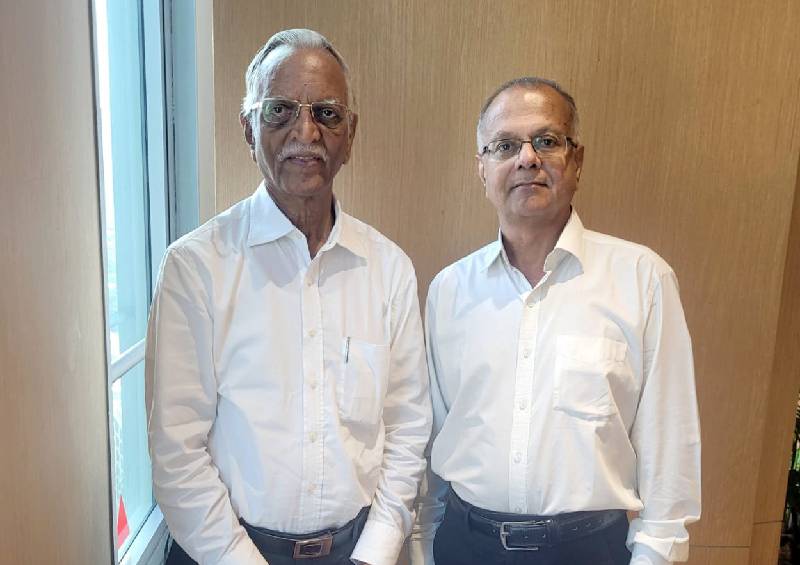
In an exclusive Interview with Textile Insights, V.C. Gupte and Rajesh Shah of Advanced Graphic Systems, speak about how the textile and colour industries have transformed over the last few decades and the latest trends driving the growth in these industries.
How have you seen the textile and colour industries transform over the decades, and what is the current status of your dream project to establish a Colour Museum in India?
Gupte: The transformation in the industry has been remarkable. Initially, very few mills could afford colour matching systems due to high costs and import duties. Today, no textile or colour industry can function without them. I was fortunate to work with Asian Paints when they became the first paint company to adopt colour matching systems, and later helped with shade matching and dispenser integration after 1995.
However, there is a shortage of technical professionals capable of handling these systems effectively. Few institutes teach colour science at the graduate level, and even fewer have qualified faculty. Unless this gap is addressed, the availability of technology alone may not yield the desired results.

My dream project is to establish a Colour Museum, a true Colour Science Park. There is currently no science centre in the world dedicated exclusively to colour and colour science. I am working to secure 1–2 acres of accessible land, ideally supported by a municipal corporation or state government, modeled on international science centres. I am optimistic that this vision will soon become a reality.
Shah: Over four decades in the textile industry, I’ve seen a shift from entirely manual operations to fully automated process houses. Lab automation and production systems now allow precision, efficiency, and consistency that were unimaginable in the past. Processes that once required hours of manual intervention are now real-time and computer-monitored.
How are current trends in textile colour preferences shaping demand, and which segments drive the highest need for colour matching solutions?
Gupte: Fashion is the primary driver of colour trends, especially with fast fashion introducing new shades at short intervals. E-commerce further amplifies these trends among younger consumers. Home textiles also show innovative colour options influenced by interior designers, while technical textiles evolve more slowly but are no longer confined to conventional colours.
Shah: Colour remains critical across fashion, home and technical textiles, with precision and consistency increasingly demanded by brands and consumers. Dyeing and processing technologies continue to evolve to meet these requirements, particularly in segments where exact shade matching is essential.
How are sustainability and eco-compliance requirements influencing colour matching and dye/print choices?
Gupte: Regulations across countries restrict banned chemicals, encouraging sustainable practices. Colour matching systems are designed to incorporate these constraints automatically while delivering accurate results.
Shah: Environmental awareness has led to ETP plants, tertiary treatment and zero-discharge systems in most processing houses. Sustainability guided by the principles of “Reduce, Reuse, Recycle, now drives dyeing, printing and colour-matching decisions.
What challenges do manufacturers face in maintaining colour consistency for global brands, and how does AGS help?
Gupte: Maintaining a set of compatible dyes makes consistency easier and ensures right-first-time performance. AGS supports clients in selecting compatible combinations and provides modern lab equipment and dyeing/printing machinery to sustain accuracy.
Shah: Challenges include climate variations, environmental regulations and older machinery in smaller process houses. AGS addresses these by providing advanced colour-matching solutions, automated systems and technical guidance to ensure repeatable, precise results that meet international and sustainability standards.
How does AGS support exporters and mills in meeting international standards?
Gupte: International brands select shades from Pantone and other shade cards, which often require careful reproduction to avoid metamerism. AGS ensures compliance with sustainability and regulatory requirements while providing solutions for accurate shade replication.
Shah: AGS helps mills and exporters meet standards such as Pantone, ISO, and brand-specific requirements through right-first-time dyeing, improved shade consistency, reduced costs and productivity gains.
With digital printing and AI-driven colour prediction on the rise, how is the market evolving?
Gupte: Digital printing uses inks but follows the same principles as conventional printing. AI-driven colour matching is still in early stages but holds promise, and I am exploring its applications.
Shah: Digital printing has grown for small-lot production with minimal environmental impact, but mass adoption is still developing. Wider penetration of AI-driven colour prediction may take another decade.
Which geographies or markets are currently the strongest drivers of growth?
Gupte: Our primary focus is India, with some support extended to customers in the Middle East and Africa, mainly linked to parent companies based in India.
Shah: India is a key driver due to its large, young and fashion-conscious population, shaping both domestic and global textile trends.
What role do technology partnerships play in the future of textile colour management?
Gupte: Colour management is crucial for meeting short-interval shade demands and frequent regulatory changes.
Shah: Partnerships with dyeing technology providers, spectrophotometers and colour-matching software are essential to achieve consistent shades, optimize recipes and improve supply chain efficiency.
How does AGS differentiate itself in a competitive market?
Gupte: AGS provides end-to-end colour solutions across industries with skilled professionals and technical support, unlike agents who primarily trade. Our systems deliver results from day one.
Shah: AGS combines expert technologists with global technology partners, serving over 3,000 clients across sectors. This enables us to meet strict multinational standards, while delivering speed, precision and sustainability.
Looking ahead, which industry shifts will impact colour matching over the next five years?
Gupte: All the shifts, such as fast fashion, retail expansion and the rise of circular textiles, will have a lasting impact on colour management, but outcomes will depend on effective handling of equipment.
Shah: These shifts will drive evolution from traditional visual shade matching to advanced, real-time, online colour platforms, ensuring manufacturers meet stringent consistency requirements efficiently.
V. C. Gupte: India’s Colour Visionary
 V. C. Gupte began his career in 1971 at the Wool Research Association, working on computerised colour matching at a time when almost no literature or tools were available. Along with colleagues, they developed their own algorithms and presented India’s first international paper on colour matching, which drew wide attention.
Soon after, Gupte joined the Mafatlal Group, where he developed and implemented colour matching systems across multiple process houses and dyestuff units. For over a decade at Mafatlal, he gained hands-on experience with cotton, polyester and nylon, while also supporting marketing, costing and inventory functions with data-driven tools.
A stint in system marketing followed, before Gupte moved to Belgium with Milton Roy, USA, providing technical support for colour matching systems across Europe, South Asia and North Africa. This expanded his expertise beyond textiles into paints, plastics, automobiles, packaging and cosmetics.
On returning to India, Gupte joined hands with Ravi Goyal, founder of Advanced Graphic Systems (AGS). Gupte helped in building up colour business with Gretag-Macbeth and Fast & Fluid Management businesses. Over the past three decades, AGS has grown into a leading solutions provider in colour matching and paint dispensing technologies. Parallely, Gupte has remained engaged with academia, teaching at ICT, SNDT, SASMIRA and DKTE, guiding postgraduate and doctoral students, and donating to set up a Colour Science Laboratory at ICT. He has also authored books on colour technology to bridge the gap between academia and industry.