
Odesi Unveils Semi-Automatic Lab Dispensing Machine At ITMA Asia + CITME 2025
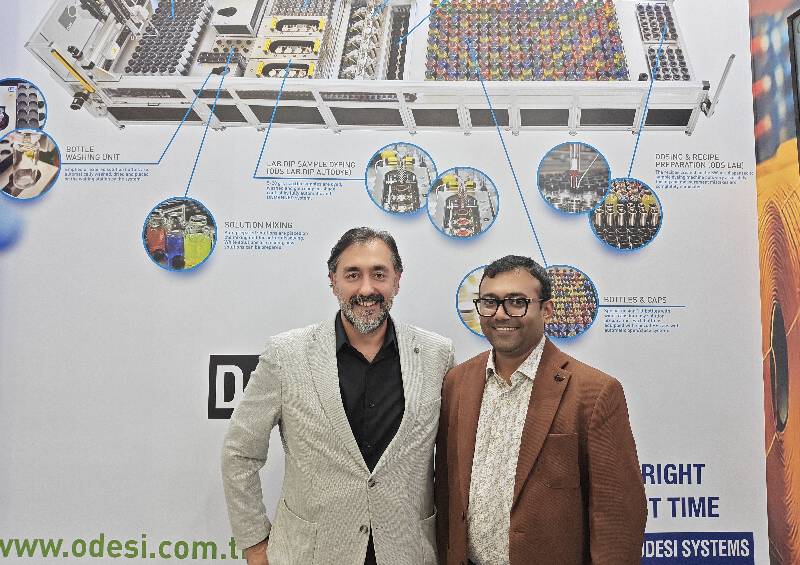
Turkish textile automation specialist Odesi is showcasing its latest semi-automatic laboratory dispensing machine at ITMA Asia + CITME 2025 in Singapore, highlighting its commitment to affordability, consistency and operational automation for dyehouses worldwide.
Speaking at the exhibition, Demirhan Demirbag, Director of International Sales & Marketing at Odesi, described the company’s newest innovation as a smart, cost-effective bridge between manual and fully automated dye preparation. He explained that the new model offers customers a significant price advantage while maintaining the reliability and precision Odesi machines are known for.
“Our new semi-automatic lab dispensing machine gives customers an affordable solution without compromising accuracy. It’s designed for laboratories that want to move toward automation gradually but efficiently,” said Demirbag.

While energy savings remain a key concern in textile manufacturing, Demirbag emphasized that Odesi’s machines are already designed to be extremely energy-efficient.
“Our machines are very conservative, they use no more energy than a household refrigerator,” he said. “Unlike other systems that still struggle to reduce power consumption, our focus has always been on low energy usage from the start.”
Demirbag noted that automation eliminates the inconsistencies and risks associated with manual dye preparation.
“In traditional dyehouses, operators prepare every dye solution by hand. With Odesi’s automated systems, no operator touches the solution, everything is handled by the robots,” he explained. “Robots don’t make mistakes, they don’t get tired and they don’t resign. This is how you achieve true standardization in the dyehouse.”
Beyond consistency, automation directly impacts labour and resource efficiency.
“Yes, it reduces labour dependency, but the biggest advantage is first-time-right dyeing,” he added. “When you get the shade right on the first try, you save on chemicals, dyes, energy and time. That’s where real sustainability starts.”
According to Demirbag, the textile industry’s biggest priority today is cost reduction, especially in energy consumption, combined with the growing push for environmental compliance.
“Energy prices have increased dramatically, so manufacturers are now focused on reducing production costs,” he said. “Automation helps them do that by minimizing errors and improving efficiency. Five years ago, energy wasn’t such a big concern. Today, it’s critical for survival.”
He added that sustainability regulations are accelerating automation adoption.
“Even if customers don’t want to automate, governments are pressing them to do so, to reduce the environmental impact of dyeing,” he noted.
Attending ITMA Asia + CITME for the first time in Singapore, Demirbag said the event offers valuable networking opportunities.
“This is my first time at ITMA Asia in Singapore and it’s a great platform to meet new customers and partners,” he said. “Everyone from across the textile world is here. We’re looking to expand our partnerships, especially in emerging textile manufacturing countries.”
As automation continues to redefine the textile industry, Odesi positions itself at the intersection of technology, sustainability and precision, helping dyehouses worldwide transition into a smarter, standardized and more resource-efficient future.