
Brazil Overtakes India As Bangladesh’s Largest Cotton Supplier: USDA
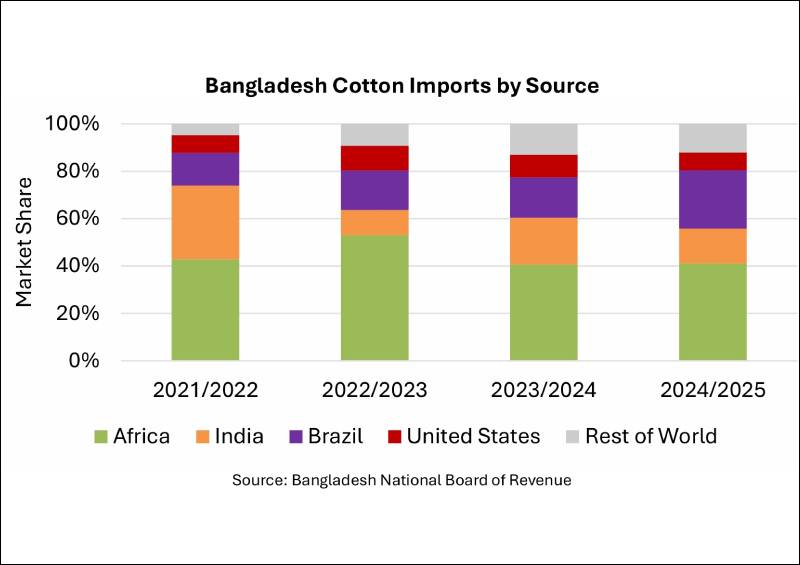
Brazil has emerged as Bangladesh’s leading supplier of raw cotton, overtaking India, according to a recent report by the US Department of Agriculture (USDA). Bangladesh is one of the world’s largest cotton importers and the second-largest exporter of readymade garments globally.
In the 2024–25 marketing year (MY25), which began in August 2024, Bangladesh imported 8.28 million bales of raw cotton. Brazil accounted for approximately 1.9 million bales, representing about 23 per cent of total imports. India ranked second with shipments of 1.4 million bales, followed by Benin with 1.06 million bales, Cameroon with 616,538 bales, and the United States with 595,902 bales.
The USDA noted that Brazilian cotton has gained popularity among Bangladeshi spinners due to its competitive pricing, strong availability during the harvest season, and consistent supply. In contrast, India was Bangladesh’s top cotton supplier in FY2024, exporting around 1.79 million bales, also accounting for a 23 per cent share. However, Indian cotton was purchased largely over a short period through the Kolkata and Benapole ports, despite relatively higher prices and some quality concerns.

For the current marketing year 2025–26, the USDA estimates Bangladesh’s cotton imports at 8.4 million bales, a 1.4 per cent increase over MY25, driven by higher consumption from local spinning mills. This also represents a 5.2 per cent rise from imports of 7.8 million bales recorded in 2024.
The report highlighted that cotton imports remained largely stable during MY25 despite initial disruptions to the readymade garment sector following political unrest and the formation of an interim government in August 2024.
Domestic cotton production in Bangladesh is expected to remain unchanged at around 153,000 bales, constrained by limited arable land and a long cultivation cycle. Cotton is currently grown on approximately 45,000–46,000 hectares.
Bangladesh’s textile industry has an annual cotton consumption capacity of about 15 million bales, depending on raw material availability, power supply and yarn demand. At present, only about half of this capacity is being utilised. Raw cotton consumption is projected to reach 8.3 million bales in FY2025 and increase further to 8.5 million bales in FY2026, reflecting a 2.4 per cent year-on-year rise.
The spinning industry converts raw cotton into cotton and blended yarn, with yarn production expected to increase from 1.7 million tonnes to 1.9 million tonnes by 2026. Despite higher domestic spinning output, Bangladesh’s garment sector is still expected to rely heavily on imported yarn and fabric.
India remains Bangladesh’s largest supplier of cotton yarn, supported by its extensive spinning capacity, shorter transit times and lower logistics costs. China continues to be Bangladesh’s leading textile exporter, followed by Pakistan and India.