
Budget 2026-27 Lays Emphasis On Strengthening India’s Textile Ecosystem
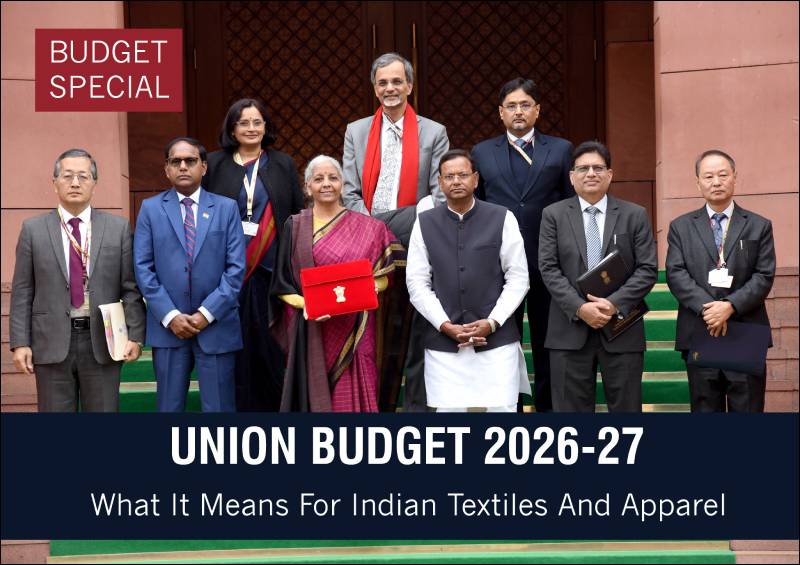
Union Finance Minister Nirmala Sitharaman presented the Union Budget 2026-27 on February 1, 2026 in the parliament. The budget aims to provide boost to the Indian textile industry through various schemes and initiatives and has been hailed by the textile industry at large.
The Confederation of Indian Textile Industry (CITI) has welcomed the Union Budget for the financial year 2026–27 presented by the Finance Minister for the decisive boost it may provide to the textile and apparel sector in raising its global competitiveness, increasing exports and safeguarding employment.

Ashwin Chandran
Commenting on the budget, Ashwin Chandran, Chairman, CITI, said, “The budget is a strong manifestation of the government’s commitment to future-proof the textile and apparel sector, make it more resilient to global headwinds, and comes as a huge shot in the arm for the industry. We convey our heartfelt gratitude to the Prime Minister, the Finance Minister, the Textiles Minister and all senior officials for announcing measures that will help the industry attain greater heights, emerge in a stronger position to contribute to the Viksit Bharat mission, and create more and better-quality jobs.”

The apex industry body believes that the launch of the National Fibre Mission, announcement of the Mahatma Gandhi Gram Swaraj initiative, Tex-Eco initiative, establishment of mega textile parks in challenge mode, textile expansion and employment to modernise traditional clusters, National Handloom and Handicrafts Programme, and the SAMARTH 2.0 skill development scheme will help local manufacturers become more efficient, innovative and sustainable, and expand their presence in global markets.
Referring to the three Kartavyas that inspired the budget, Ashwin observed: “The first Kartavya focuses on improving cost competitiveness. While we are studying the proposal, no direct announcement for the removal of import duty was made towards improving the cost competitiveness of Indian cotton-based products, which accounts for about 60 per cent of India’s total textile and apparel market.”

Durai Palanisamy
Hailing the Union Budget 2026-27, Durai Palanisamy, Chairman, Southern India Mills’ Association (SIMA), stated that the government has given importance for the growth of the textile industry by announcing National Fibre Scheme that focuses on strengthening the availability of raw materials, including man-made fibres and new age fibres.
“The government has already allocated Rs 5,900 crore under “Mission for Cotton Productivity” that covers new age fibres. Man-made fibres being the growth engine and there being a huge potential to increase the market shares in all the FTA signed countries, the scheme would provide opportunities to capture new markets,” says the SIMA chief.
Palanisamy is of the view that the announcement of Capital Support Scheme for Modernisation would enable the industry to upgrade the technology. The Technology Upgradation Fund Scheme, the flagship programme of the government, had attracted new investments of around Rs 4 lakh crore and now the investments had dwindled down as the TUF scheme was discontinued since April 1, 2022. He believes that given the high capital costs and the capital-intensive nature of India’s textile industry, the dedicated capital support scheme would enable the sector to attract the envisaged investment of $100 billion by 2030.
“Moreover, coastal cargo scheme, allocation of Rs 10,000 crore for manufacturing, announcement of high speed rail corridors, scheme for emerging technologies and AI would also help the textile industry to enhance its global competitiveness,” says Palanisamy.

Santosh Katariya
“The budget appears oriented towards strengthening long-term supply side and structural interventions across the textile value chain, rather than catalysing an immediate spurt in consumption or near-term demand. The emphasis on fibre security, capacity building, skilling and sustainability lays a foundation for durable growth, with demand side momentum expected to build progressively. We feel that the current budget allocation of Rs 1,500 crore for Integrated Textile Programme for FY26-27 will have to be enhanced further in the coming years in order to make meaningful changes in the sector,” states Santosh Katariya, President, Clothing Manufacturers Association of India (CMAI).
“Overall, we assess the announcements as constructive and positive for the textile ecosystem. The package balances supply side reforms, farm-to-factory linkages, skills, sustainability and export orientation. We look forward to rapid and transparent implementation and stand ready to partner with the government to operationalise these measures, align them with cluster needs, and ensure benefits flow to farmers, artisans, workers and textile businesses across the country,” adds Katariya.

Rajinder Gupta
“The Union Budget 2026–27 provides a strong boost to India’s textile ecosystem. By prioritising mega textile parks, strengthening the fibre value chain from natural to next-generation fibres, and promoting initiatives such as Mahatma Gandhi Gram Swaraj and enhanced skilling programmes, the government has laid the foundation for a globally competitive, modern and inclusive textile sector. These measures will empower weavers, artisans and MSMEs while accelerating sustainable growth, domestic value addition and India’s global market presence,” stated Rajinder Gupta, Chairman, Trident Group India.

Priyavrata Mafatlal
Priyavrata Mafatlal, Managing Director, Mafatlal Industries Ltd, avers that the budget marks a very important tone in the emerging Indian economy during a global shift in supply chain realignments. The Finance Minister’s focus on self-reliance, competitiveness and jobs in the textile sector is a positive development for the sector’s operating dynamics and planning visibility for manufacturers and exporters. The budget’s continued support for fibre supply and the clear thrust towards scale and value addition will help stabilize input costs, improve margins, and enable companies to take a positive call on capacity expansion and export commitments. The thrust on modernization of textile clusters and technical and value-added manufacturing is expected to improve productivity, quality and speed-to-market, which are critical drivers of global competitiveness.
“Today, there is no doubt that there is a gap between the availability of jobs and the demand for skilled manpower in the industry. To position India in the global employability index, it is essential that there is upskilling of both the existing and new workforce in technology, digital and AI skills. The budget’s emphasis on education, employment and enterprise will definitely help bridge this gap by ensuring that skilling is aligned with the needs of the new manufacturing sector, where automation, digital engineering and technology-driven services are being increasingly integrated,” adds Mafatlal.

Madhu Sudhan Bhageria
“We see the Union Budget 2026-27 as a comprehensive and forward-looking framework for strengthening India’s textile ecosystem, particularly through its integrated approach to fibres, manufacturing, skilling and sustainability. The proposed National Fibre Scheme, with its focus on man-made fibres alongside natural and new-age fibres, is a timely recognition of how the global textile industry is evolving and of India’s growing role within it,” says Madhu Sudhan Bhageria, Chairman and Managing Director, Filatex India Ltd.
“The emphasis on the Text-ECON initiative further reinforces the industry’s shift towards sustainable and globally competitive textiles, a direction that is closely aligned with Filatex’s ongoing focus on circular recycling, responsible manufacturing and traceability through its Ecosis sustainability platform. Overall, we believe the budget lays a strong foundation for a more resilient, globally competitive and sustainable textile industry, encouraging capability building and investment across the value chain,” added Bhageria.

Gautam Shahi
“India’s tariff-impacted textile sector and its entire value chain have received support from an array of schemes announced in the Union Budget 2026-27. The proposed establishment of textile mega parks, coupled with initiatives such as the National Fibre Scheme, Textile Expansion Employment Scheme, Tex Echo Initiative, Samarth 2.0, and the Mahatma Gandhi Gram Swaraj initiative should enhance its long-term global competitiveness. This, complemented by free trade agreements, will expand market access for domestic textile makers,” says Gautam Shahi, Director, Crisil Ratings.

Sanjay Gandhi
Sanjay Gandhi, Group CFO, Pearl Global Industries, stated that the Union Budget 2026 outlines a comprehensive and integrated approach to strengthening India’s textile ecosystem, with a clear focus on infrastructure development, capital access and skill augmentation. Initiatives such as SAMARTH 2.0 signal a renewed push towards industry-aligned skilling, while the emphasis on self-reliance in natural, man-made and new-age fibres is a positive step towards long-term raw material security.
“The strong focus on building technical textile capabilities is particularly significant as the sector moves up the value chain. From an apparel perspective, greater clarity will emerge once the detailed framework of the Text-ECON initiative is available, especially around its role in driving globally competitive and sustainable manufacturing. Overall, the budget seeks to enhance cost competitiveness across the textile value chain, enabling the industry to better leverage recently announced FTAs with Europe, the UK and other markets, and compete more effectively with manufacturing hubs such as Vietnam and Bangladesh. As always, the actual impact will hinge on timely execution, detailed guidelines, and the pace of on-ground implementation,” adds Gandhi.

Ketan Kulkarni
Commenting on the budgetary proposals, Ketan Kulkarni, Managing Director & Chief Executive Officer, Allcargo Logistics, pointed out: “Budget 2026-27 offers a strategic response to a rapidly changing global trade environment by strengthening India’s logistics and supply chain ecosystem. The focus on multimodal infrastructure including new freight corridors, inland waterways, cargo movement projects and last-mile connectivity for remote regions will be critical in improving efficiency and lowering logistics costs. The Rs 10,000-crore SME Growth Fund, supported by enhanced liquidity through mandatory TReDS adoption, credit-backed invoice discounting and GeM integration, will empower MSMEs to scale, formalise and participate more actively in export-led growth.”

Sanjay Jain
“The Union Budget 2026 reinforces confidence in India’s textile and apparel sector with its integrated and forward-looking vision. Continued thrust on public capex, champion MSMEs and labour-intensive sectors will strengthen global competitiveness. The launch of SAMARTH 2.0 will modernise the skilling ecosystem through deeper industry–academia collaboration, enhancing productivity across export-oriented clusters. Initiatives such as Tex-Eco and renewed focus on PM MITRA mega textile parks will accelerate investment, reduce import dependence and boost exports, firmly aligning the sector with the vision of Viksit Bharat,” said Sanjay Jain, Group CEO, PDS Ltd.

Prabhu Dhamodharan
In the opinion of Prabhu Dhamodharan, Convenor, Indian Texpreneurs Federation (ITF), “Competitiveness in textiles begins with raw material security and scale. The National Fibre Mission and mission-mode mega textile parks will strengthen supply stability, productivity and India’s ability to capitalise on FTA opportunities. Technology upgrades in clusters will be critical to building globally competitive supply chains.”
According to Bhavini Parikh, Founder, Bunko Junko, “Budget marks a turning point for upcycling and recycling in fashion. With initiatives like Tex-Eco, cluster modernisation and Samarth 2.0, circularity is now core to India’s growth strategy. Upcycling is no longer a side project, it is a policy-aligned, market-ready opportunity with jobs, climate impact and brand value built in.”

Mamta Binani
Commenting on the allocation to MSMEs in the Budget, Mamta Binani, President, MSME Development Forum – West Bengal, stated: “The Rs 10,000 crore MSME Growth Fund announced in Budget 2026 is a transformational step for India’s MSME ecosystem. At a time of liquidity stress and global trade disruptions, this fund will catalyse innovation, modernisation and global market access, reinforcing MSMEs as the backbone of India’s industrial growth and exports.”
“The Budget sends a positive signal for manufacturing under the Make in India vision. The renewed focus on technical textiles, man-made fibres and mega textile parks addresses long-standing structural gaps. Integrated clusters and skilling initiatives like SAMARTH 2.0 can help India transition from volume-led to value-driven textile manufacturing,” said Abhishek Sharma, CEO & Co-founder, Fashinza.
The CITI Chairman has welcomed the government’s emphasis on nurturing champion MSMEs and supporting micro enterprises, noting that the textile and apparel sector is predominantly MSME-driven. However, he says that that the industry has consistently sought a dedicated investment incentivisation scheme, particularly to support MSMEs in transitioning towards sustainable production models, which will also help in leveraging the upcoming India-EU FTA.
“While the details of the TexEco initiative are awaited, the absence of a direct investment support mechanism is felt. The proposal to extend the time period for export of final product from the existing 6 months to one year for exporters of textile garments, enhanced focus on improving logistics through freight corridors, the decision to establish a High-Page 2 of 2 Level Committee on Banking for Viksit Bharat, and simplification of export-import procedures are also particularly welcome,” the CITI Chairman stated.
The SIMA chief stated that the budget could have considered the removal of 11 per cent import duty on cotton as the same is essential to meet the quality cotton shortage and meet the export commitments. The duty exemption was available till December 31, 2025 and trade has started adopting the import parity price and the price has already increased by around 5 per cent when compared to the international price (Cotlook A) and 15 per cent higher than Brazilian cotton. The price gap is likely to widen in the coming months and would affect the financial viability of entire textile value chain that provides direct jobs to around 35 million people and accounts for around 75 per cent of the total textiles and clothing exports.