
Tamil Nadu Makes A Strong Debut At Heimtextil 2026 With Focus On Home Textiles
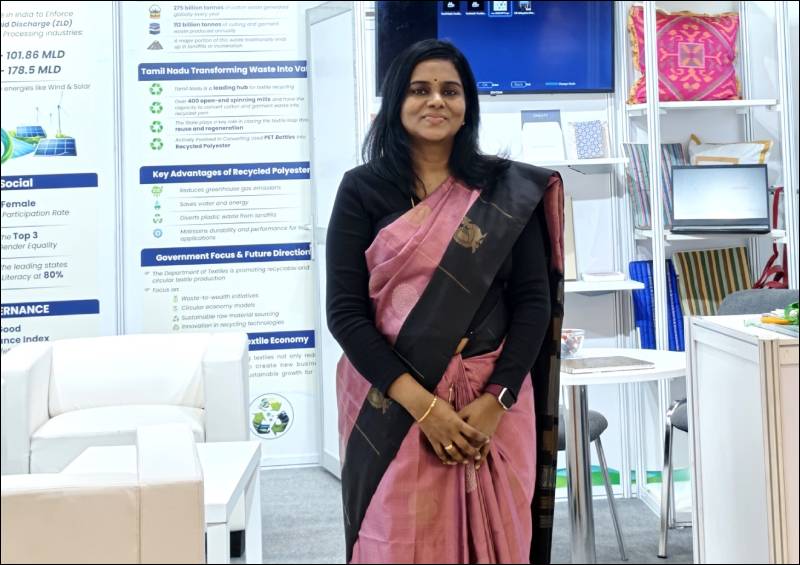
Tamil Nadu made a strong institutional debut at Heimtextil 2026 as the Department of Textiles, Government of Tamil Nadu, established a dedicated pavilion for the first time, signaling its intent to position the state as a major global player in home textiles and technical textiles. Sharing her perspective on the initiative, R. Lalitha, Commissioner of Textiles, Government of Tamil Nadu spoke to Textile Insights exclusively about the strategic objectives, market feedback, sustainability efforts and future roadmap for the state’s textile ecosystem.
Reflecting on the significance of Tamil Nadu’s participation, Lalitha noted that the initiative itself marked a milestone. “For the first time forming Tamil Nadu pavilion in Heimtextil,” she said, adding that traditionally only the Tamil Nadu Handlooms Weavers’ Co-operative Society Ltd (Co-optex) took part. “This time, the Textiles Department, Handlooms Department and Women Development Corporation have exclusively come here by customizing their products into home textiles, just to focus on the home textiles segment. The participation itself is a very big experience for us.”
According to her, the exposure was valuable not just for visibility but for learning. “The participation has helped us not only understand where we stand, but also where the world is moving towards. That has helped us understand which direction we should be taking in the coming days, especially the handlooms and textile segment,” she observed.

Tamil Nadu has long been considered one of India’s strongest home textile clusters, with Karur, Erode and surrounding regions contributing significantly to global exports. Lalitha highlighted that around 90 companies from the state were exhibiting independently across the venue, supported by the state-led pavilion comprising 10 curated stalls. “This platform has given us a good opportunity to diversify our markets from the existing ones, especially in the current geopolitical situation,” she noted, pointing to growing interest from EU markets amid expectations around free trade agreements.
During her interactions with exhibitors, Laliztha witnessed keen buyer interest around functional and technical textile applications. She shared that international visitors were enquiring about technical textiles, functional fabrics and diversification possibilities, especially for export markets.
A standout attraction was the handloom segment, which showcased an inventive push into value-added home textiles. “The handlooms department converted GI tagged silk items into home textile products,” she explained. Traditionally associated with saris and dhotis, the unique silk fabrics were transformed into cushion covers, pillowcases, laptop sleeves and bags garnering strong attention due to their authenticity and niche appeal. “GI tagged silk is not something an industry can make; it is based on the weaver and handloom is a niche segment. They had a lot of walk-ins,” Lalitha said.
Women Development Corporation’s stall also drew interest through indigenous and tribal craft expressions such as Toda embroidery from the Nilgiris and hand-embroidered products made by self-help groups. Beyond buyer engagement, Lalitha noted the educational significance for exhibitors: “The biggest achievement is making them aware of the global market. They can go back home and brainstorm on how they can diversify into various segments.”
On how the state plans to support this diversification, Lalitha outlined multiple interventions spanning technology, market access and policy incentives. “We facilitate participation in such fairs by forming the Tamil Nadu pavilion. We also have a handloom support programme and Women Development Corporation has its own marketing schemes,” she said.
The state is also running schemes for technology upgradation and technical textile adoption. “From the Department of Textiles, we have a lot of schemes for technology upgradation for technical textiles, incorporating latest machines and machineries,” she noted. Such participation, she added, helps exhibitors discover new directions while the government already subsidizes and supports their upgradation efforts.
Tamil Nadu is also emerging as a hub for circular economy initiatives in the textile value chain. Lalitha confirmed the state’s efforts in PET bottle recycling, which had drawn lots of interest during the show. “We have a lot of companies in Tamil Nadu who focus on PET bottle to fibre conversion.” she said. The fibres are used in garments and woven products, including souvenirs distributed by the state delegation. “It reflects our commitment towards circularity and recyclability.”
Lalitha further highlighted innovations in textile waste management. “We also have a few companies which are doing textile waste to paper conversion. Textiles to textile conversion is also happening, pre-consumer and post-consumer waste is being converted back into yarn,” she said, distinguishing between recycling and upcycling, both of which are active in the ecosystem.
Government support in this segment spans policy and infrastructure. “More than companies, the government itself is trying to encourage source segregation,” she said, adding that segregated PET bottles are either used for road laying or supplied to recycling units as mandated by policy. The state is also helping connect recycling units with relevant agencies and encouraging more players to enter the space to reduce landfill impact.
In a strategic move to strengthen technical textiles in Tamil Nadu, the government has signed an MoU with Messe Frankfurt. Lalitha confirmed that “alternate year they will be conducting the Techtextil event in Coimbatore,” in continuation to the Mumbai edition every second year. “We are bringing Techtextil to home in order to showcase to our industry the possibilities, trends and interesting areas in technical textiles,” she said. The first Coimbatore edition is expected in November this year.
This year marked the government’s first Heimtextil participation. Lalitha described her impressions succinctly, “First is the sheer scale of it. Other events you see only one or two halls. This is with around 12 halls of home textiles with big entities showcasing their recent products. The sheer magnitude was something that really amazed me.”
For Tamil Nadu, the experience appears to be a starting point rather than a culmination, one that signals both confidence and intent to engage deeper with global markets, sustainability, technology and circularity.
(Article by Henry Dsouza, Associate Editor Of Textile Insights)