Commerce Ministry Sets Up FTA Cell To Boost Export Opportunities
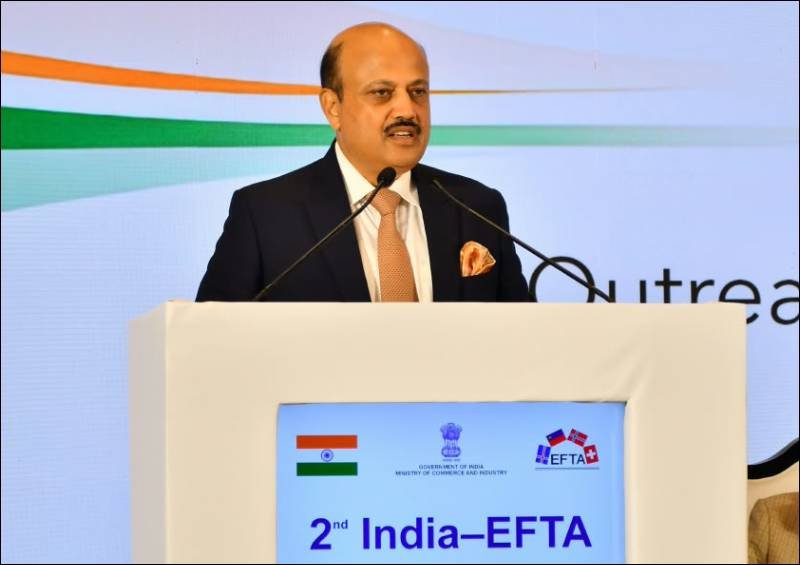
The Department of Commerce has set up a free trade agreement (FTA) utilisation cell to help Indian businesses tap export opportunities in partner markets, Commerce Secretary Rajesh Agarwal said on Wednesday.
Speaking at the India-EFTA Prosperity Summit, Agarwal said the cell would work with industry associations, export promotion councils (EPCs) and state governments to raise awareness about the benefits of trade agreements and help businesses integrate with global supply chains.
The department will prepare market-specific action plans with export promotion councils to improve utilisation of FTAs over the next four to five years. The ministry will also hold discussions with states, industry representatives and exporters this month, followed by district-level workshops during the current fiscal to familiarise entrepreneurs with the agreements.

India has finalised trade agreements with the European Free Trade Association (EFTA), New Zealand, Mauritius, the UAE, Australia, Oman, the European Union (EU) and the UK. The India-EFTA Trade and Economic Partnership Agreement was implemented in October last year. The four EFTA members are Iceland, Liechtenstein, Norway and Switzerland.
Agarwal said India’s trade arrangements with the EFTA bloc, the EU and the UK would provide access to 32 countries, with zero or preferential tariffs across a significant portion of bilateral trade.
He said the agreements should not be viewed merely as instruments for reducing tariffs, but also as a means of providing predictability to businesses. Stable tariff arrangements would help exporters make long-term investment decisions, build supply chains and plan business expansion with greater certainty.
Highlighting the potential of developed markets with high per capita incomes, Agarwal said they offered opportunities for Indian businesses to increase exports in both volume and value, provided they met the required quality standards.
Agriculture is another area with export potential, he said, noting that these markets collectively import agricultural products worth more than $1 trillion. While tariffs have not been eliminated across all agricultural categories, several products have received zero-duty or preferential market access, including areas where India has competitive strengths.
Agarwal also pointed to the limited share of Indian exports in the EFTA bloc’s total imports, estimated at around $2-3 billion. He asked exporters to use the trade agreement to increase India’s share of the bloc’s overall import basket to 2% over the next three to four years.
He urged export promotion councils to develop concrete action plans to help Indian businesses capitalise on the opportunities offered by the trade agreements.