
Zero Spinning Triangle: A Dream Or A Disaster?

By S. Murugan
When I reached the mill gate, my digital watch flashed 4:05 PM. “Uh-oh! Five minutes late!” I muttered.
The Managing Director was known for many things. Smiling at latecomers was not one of them.

I parked my car near the gate and hurried toward the Security Office to complete the entry formalities. To my surprise, nobody was there!
Just as I stepped closer, a beautiful lady security officer appeared seemingly out of thin air.
Before answering her question about my name and company, I silently congratulated the MD on his recruitment policy. “Even the angriest customer would forget half his complaints after meeting this officer,” I thought.
“Sir, could you please reply?” she asked politely for the second time. The moment I gave my details, she disappeared. Poof!
Now I understood. She wasn’t real. A digital lady made by a hologram!
Within seconds, the gate opened automatically, and a navigation map popped up on my phone, directing me to the MD’s office.
As I drove through the mill premises, I thanked my friend who had arranged this visit to one of the most technologically advanced spinning mills in the world.
The meeting with the MD was surprisingly brief. Soon afterwards, a strikingly beautiful lady technician escorted me to the spinning department, where twelve ring frames were running various counts and fibre blends.
“We have only fifteen minutes,” she said. “So I’ll show you only our latest innovation.”
“No problem,” I replied. We walked to the gear end of a machine where a giant display screen had been mounted.
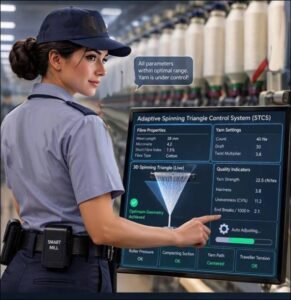
After entering a password, she opened a page displaying a crystal-clear image of the spinning triangle. I stared at the screen in disbelief.
The lady technician smiled. “This machine continuously monitors the spinning triangle in real time. It analyses its width, height, symmetry, yarn tension and several other parameters.”
As a spinning engineer, I knew those parameters change with fibre type, yarn count, twist level and spinning geometry. “Interesting,” I said.
“Our AI model creates a virtual spinning triangle using fibre properties, yarn specifications and machine settings. It predicts fibre tension distribution across the fibre strand and calculates the variation in fibre tension.”
 “Why?”
“Because uneven fibre tension is one of the major causes of weak places, hairiness and end breaks.” Now she had my full attention.
“The AI continuously searches for the geometry that gives the most uniform fibre tension distribution. Whenever it detects deviation, it automatically adjusts machine settings.”
I laughed. “You’re telling me the machine is thinking about the spinning triangle more than the spinner does?”
“Exactly!” she replied.
The screen showed colourful graphs, moving vectors and three-dimensional models.
“We also use yarn-tension sensors, balloon-monitoring sensors and predictive algorithms and using various actuators, we change machine settings to obtain an optimum spinning triangle and yarn tension,” she continued.
“Can I see the actuators?”
“Of course. But be quick. Your time is almost up.”
I leaned forward eagerly. A little more. A little closer.
And then…THUD!
Something hit my head. A second blow landed immediately.
I opened my eyes. My friend was standing beside my bed.
“What happened to the actuator?” I asked.
“What actuator?” he laughed. “Dude, wake up! It’s already 7:30 in the morning.”
Reality returned faster than a traveller flying off the ring.
The previous day’s seminar had clearly invaded my dreams.
The session had focused on the influence of the spinning triangle on end-breakage performance. During the discussion, I had wondered why we couldn’t simply eliminate the triangle and allow twist to reach right up to the front roller nip. Wouldn’t that minimize end breaks?
The speaker’s answer was an emphatic no. His explanation made perfect sense.
Why Zero Spinning Triangle Is Not Ideal
- Fibres need space to converge
When fibres leave the front rollers, they are neither perfectly parallel nor equal in length.
A small spinning triangle allows:
Edge fibres to migrate toward the yarn centre.
Fibres to align gradually.
Tensile load to be shared more uniformly.
If twist reaches the nip immediately):
A zero triangle places the twist front extremely close to the nip. Fibres are locked too early. Some fibres become poorly integrated. Weak spots can develop.
- Stress concentration increases
A zero triangle places the twist front extremely close to the nip.
The transition from drafted fibre sheet to twisted yarn becomes abrupt, creating higher local stress, greater fibre friction and increased risk of fibre rupture.
A modest spinning triangle acts as a natural stress-buffer zone.
- Drafting disturbances directly affect yarn formation
Normally, the spinning triangle separates the drafting zone from the twist zone.
When the triangle approaches zero, drafting irregularities are transmitted directly into yarn formation.
Roller vibrations, drafting waves and short-term tension peaks therefore have a greater chance of causing end breaks.
But Bigger Is Not Better Either
An excessively large spinning triangle has its own problems:
Poor edge-fibre control, increased hairiness, greater fibre loss, reduced yarn strength, and higher end-break levels.
Compact spinning helps to attain an optimum triangle significantly because it:
Reduces triangle width.
Improves symmetry.
Reduces fibre-tension variation, resulting in lower hairiness and improved yarn strength.
However, even compact spinning cannot make one triangle geometry optimal for every fibre and every count, especially the height of the triangle.
In reality, modern machine geometries, fibre properties, drafting conditions and traveller behaviour make the problem far more complex. Therefore, the true optimum spinning triangle is better defined not by height or width, but by one simple objective:
The spinning geometry that produces the minimum fibre-tension variation while maintaining stable spinning and minimum end breaks.
Generally, the optimum height of the spinning triangle, which gives better results, ranges between 2 and 6 mm. Some theoretical models say that it is 10 to 15% of the UHML of fibres.
Perhaps one day an AI system will continuously calculate this optimum geometry millions of times per day and automatically adjust machine settings. And if that day comes, my dream may not remain a dream after all.
And when that day arrives, I only hope the hologram security officer is included as a standard accessory.
(Murugan Santhanam is Managing Director of Texdoc Online Solution Pvt. Ltd.)