
Birla Cellulose Strengthens Home Textiles Focus With Sustainable Fibre Innovation
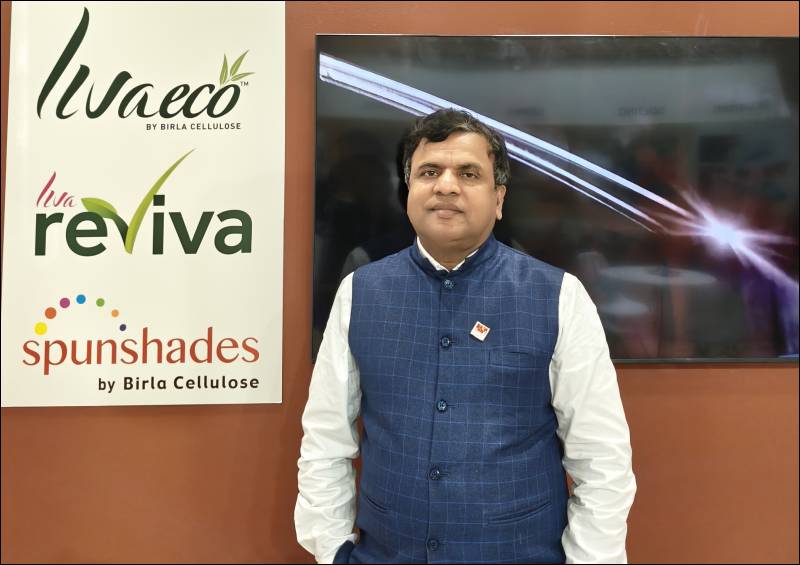
Birla Cellulose, the fibre arm of Aditya Birla Group., is intensifying its focus on the home textiles segment through a strategic push centered on sustainable fibres, expanded Lyocell capacity and deeper integration across the value chain, as global buyers increasingly prioritise traceability and environmental responsibility.
Speaking at Heimtextil 2026, Murugan Thenkondar, President – Marketing and Global Head – Business Development, outlined the company’s sharpened emphasis on Eco-Soft Bamboo, Lyocell, Dope-Dyed fibres and next-generation performance fibres, reflecting growing demand from home textile retailers in the U.S. and Europe.
“We are presenting a large portfolio of products with strong relevance for home textile applications,” he said. He highlighted Bamboo Eco-Soft for its attributes and moisture management, alongside a robust dope-dyed fibre platform capable of delivering over 70 colour shades each month. “We have built a highly organised supply chain dedicated to home textiles, supporting leading manufacturers across bed and bath linen, furnishings and flooring,” he added.
At the exhibition, Birla Cellulose showcased innovations in man-made cellulosic fibres engineered with enhanced performance attributes, underlining its shift toward higher-value, performance-driven solutions for home textiles.
The company is simultaneously scaling up manufacturing investments in India, with plans for a new Lyocell facility in South India. “The plant is expected to be operational within the next two years,” Murugan noted. “Lyocell will occupy a much larger role in home textiles, and with additional capacity we will be able to offer micro, coarse and shortcut variants, as well as filler-grade fibres.”
In recent years, Birla Cellulose has completed the transition of its portfolio from commodity cellulosics to more sustainable, branded fibres under the Livaeco brand. This transformation is supported by FSC-certified raw material sourcing, advanced chemical management systems and blockchain-enabled traceability through GreenTrack and Textile Genesis. These digital platforms enable brands to trace fibre origin and processing, aligning closely with regulatory and compliance requirements in Europe and the United States.
Recycled fibres form another key pillar of the company’s strategy. This includes mechanically recycled fibres produced by blending cotton waste with Lyocell, as well as chemically recycled fibres developed through partnerships with global technology leaders such as Circulose and Saxcell. Commercial production of mechanically recycled fibres has already been commissioned at Birla Cellulose’s Nagda facility in India.
Murugan expects the home textiles segment to sustain its growth trajectory. While cotton continues to dominate the category, structural constraints in cotton production combined with rising per-capita consumption are creating a global cellulose gap. “Lyocell is emerging as the most effective complementary fibre for products such as bed sheets, pillows, quilts and carpets,” he said.
The global apparel and home textiles market is currently expanding at an annual rate of 6-7%, underpinning long-term fibre demand. At the same time, India’s domestic home textile market, still largely unorganised and heavily reliant on cotton is expected to become a significant growth engine over the next three to five years.
Addressing concerns around U.S. tariffs on Indian home textile exports, Murugan characterised the situation as interim. “These are expected to be sorted in a due course of time. There will be a resolution, followed by pent-up demand once the situation eases,” he remarked.
Europe, UK and Rest of World continue to offer strong strategic potential, while the U.S. remains a critical market for premium bed and bath products and catering to volumes.
At Heimtextil, Birla Cellulose reported consistent buyer engagement from Europe, UK, North America, Australia and GCC and South East Asia. Nevertheless, global trade uncertainty driven by tariffs, geopolitical conflicts and supply chain disruptions, featured prominently in industry discussions. “Despite multiple global challenges in recent years, demand has not collapsed,” Murugan observed. “These disruptions will pass, and when they do, growth will accelerate.”
As sustainability expectations intensify and brands increasingly seek high-performance, nature-based alternatives to cotton, Birla Cellulose’s strategy positions the company strongly to capitalise on emerging opportunities across both export-driven and domestic home textile markets.
(Article by Henry Dsouza, Associate Editor Of Textile Insights)