Home Textile Shake-Up: Premier Fine Linens Expands Beyond USA
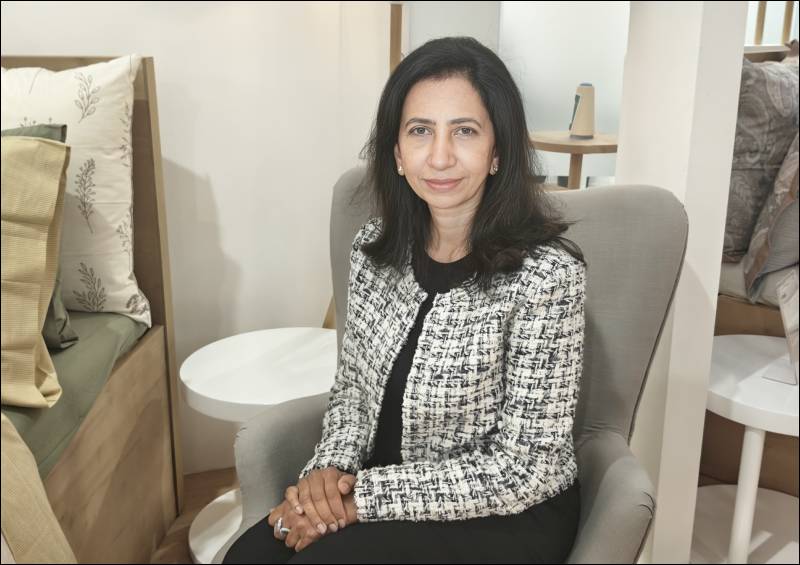
Premier Fine Linens, a long-standing leader in premium bedding and hospitality textiles, used Heimtextil 2026 as a platform to showcase its latest blends, advanced finishing technologies and sustainability initiatives. In an exclusive interaction with Textile Insights, Managing Director Shanthi Srinivasan spoke about the company’s evolving roadmap and the shifts reshaping the global home textile landscape.
Speaking about product highlights, Srinivasan said the company continues to reinforce its core bedding portfolio. “Our main product category is bedding, which is mostly sheet sets, and we are also making comforters, quilts and table linen. We do a lot of top-of-the-bed products,” she explained. This year, the focus is on 100% cotton alongside a wide range of new blends. “We are doing linen and cotton blends, pure linen, Tencel linen, bamboo cotton and many other blends,” she added. The company also introduced new top-of-bed offerings in seersucker, mattresses, and muslin, all of which were presented at the show.
Commenting on trade activity at Heimtextil, Srinivasan noted a mixed response from global buyers. “USA customers were much fewer than last year, probably because of the tariffs and because they are not seeing any relief,” she observed. In contrast, visitor interest from Europe was significantly stronger. “We had a lot of visitors from the UK and Europe. Right now, from the UK, we see a lot of potential and there is genuine interest in the India–UK FTA. They really want to work with us.”
On technological differentiation, Srinivasan emphasized that quality, rather than positioning, defines Premier’s approach. “Basically, our products are quality products—that’s what we always believe in, and that’s what Premier always believes in,” she said. The company’s focus spans weaving, fibre and finishing technologies, backed by strong in-house R&D. “Our R&D and product development is very strong, and we keep bringing out new products every few months,” she added.
Sustainability, according to Srinivasan, is deeply embedded in the company’s operations. She pointed out that Premier adopted green initiatives long before sustainability became an industry buzzword. “We invested in 140 windmills almost 20 years ago, long before the word sustainability became fashionable,” she said. Currently, around 70% of the company’s energy comes from wind power, a figure expected to rise to 85%, alongside the addition of solar energy. “We recycle 99% of the water and do heat recovery as well. We look at how we affect the planet in everything that we do,” she noted, adding that packaging, waste management and recycling remain key focus areas.
Discussing global trends and market disruptions, Srinivasan said India will continue to hold its strength in premium bedding categories. “India is very strong in-home textiles, particularly in the 300 thread count and above, so that’s not going to change,” she said. At the same time, she acknowledged that tariff uncertainty in the US and geopolitical risks have reshaped export dynamics. With the US historically accounting for nearly 65% of Premier’s turnover, diversification has become a strategic priority. “Nothing can replace the US in terms of volumes, but we are also exploring other countries. Agility is the new word, and agility is here to stay.”
On the growing influence of AI in textile design and operations, Srinivasan advocated a balanced approach. While multiple AI platforms are emerging across visuals, advertising and product design, she stressed the importance of human judgment. “You can’t ask AI to do everything,” she said. At Premier, AI is being integrated mainly into planning, operations and design development.
Looking ahead, Srinivasan outlined an ambitious growth plan for the next five years. “We are rapidly expanding our domestic presence in India,” she said, citing growth across retail, e-commerce and hospitality segments. On the export front, the company is exploring new geographies and customer profiles. Investment momentum remains strong—a quilting and comforter unit set up last year will soon be doubled, digital printing capacity is being added in Perundurai this year, sewing and processing capacities are being expanded, and new loom investments are planned. “Overall, we are scaling up. Even though last year was not great, we see a good future,” she concluded.
(Article by Henry Dsouza, Associate Editor Of Textile Insights)