
Rabatex’s Mother Mono Yarn Split Sectional Warper: Redefining Boundaries Of Textile Machinery Performance & Productivity
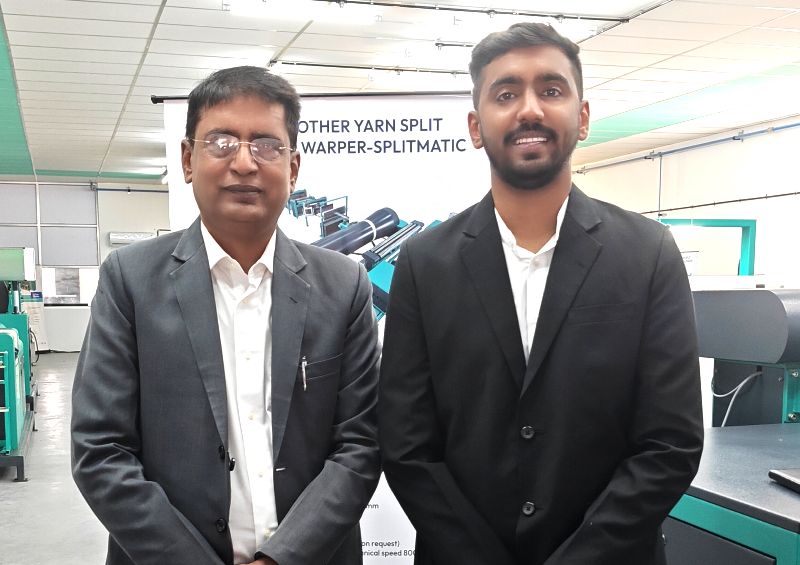
In this exclusive conversation with Henry Dsouza, Associate Editor at Textile Insights, Haresh Panchal and Keyur Panchal of Rabatex Industries discuss their latest breakthrough, the Mother Mono Yarn Split Sectional Warping Machine. From eliminating cop winding to enabling high-efficiency synthetic Warp Preparation for fabric production, they share how Rabatex is pushing boundaries in textile machinery
Could you walk us through the innovations showcased at the open house? Among them, where does the Mother Mono Yarn Split Sectional Warping Machine stand in terms of technological significance?
Haresh Panchal: At this open house, we’ve showcased multiple innovations that reflect our commitment to advancing fabric preparation technology. The centerpiece, without a doubt, is the Mother Mono Yarn Split Sectional Warping Machine, a product designed to meet the rising demand for synthetic fabrics, particularly in the apparel and technical textiles segments.
In the global textile market, especially in countries like China, Korea and Taiwan, there has been significant innovation in the use of synthetic yarns. One of the most impactful developments in recent years has been the use of mother mono yarn, which is processed into lower GSM fabrics suitable for garments and functional textiles.
Recognizing this trend, Rabatex became the first company in India to develop and launch the Mother Mono Yarn Split Sectional Warping Machine, along with the Mother Yarn Split Winder. These machines are purpose-built to process mother mono yarn efficiently. We introduced this technology about 15 months ago, and in that short time, we’ve already completed over 41 installations across India, with another 29 installations in the pipeline scheduled for the coming 3–4 months.
This is a pioneering innovation for the Indian market for synthetic fabric segment like Surat / Southern region, where demand for synthetic fabric processing is growing rapidly. The open house provided the perfect platform to demonstrate the machine’s capabilities live and address the industry’s interest.
In addition to this, we also showcased our fabric sampling solutions, an area where Rabatex is a market leader. These include sample warping machines (including single-end sizing), small-width weaving machines and complete fabric sampling setups that allow fabric development with minimal material, ideal for shorter production runs or design testing.
One highlight is our advanced sample warping machine, which can produce beams with less than 500 metres of warp using as few as 16 yarn packages. It’s a highly cost-effective and efficient solution for customers who need quick sampling without disrupting full-scale production.
Through this event, we wanted southern India’s textile professionals to see these innovations firsthand and explore how they could enhance their own operations. We believe these technologies will open up new market opportunities and improve fabric development agility across the region.
The Mother Mono Yarn Split Sectional Warper was clearly a highlight of the event. Could you walk us through the journey behind its development? What specific manufacturing challenges does it address?
Haresh Panchal: The journey began nearly three-and-half years ago, when Keyur, then in his final year of study in the U.S., decided to work on an innovative product for the Indian textile industry. He traveled to China and Korea to explore advancements in synthetic yarn processing and came across the emerging mother mono yarn technology.
During this research, he met a highly experienced Korean consultant with over 35 years of expertise in mother yarn applications. We brought him on board to guide our development team technically. The project officially kicked off around two years ago, and after extensive trials and refinements at our plant, we successfully launched the first machine in June 2024.
Since then, the machine has been well-received across India, with multiple installations already running successfully. This innovation addresses a critical gap in the market, it enables efficient warp preparation of mother mono yarn, which is essential for manufacturing low-GSM synthetic fabrics used in apparel and technical textiles. The machine simplifies a traditionally complex and cost-intensive process, making it more accessible and affordable for Indian manufacturers.
One of the key advantages of the Mother Mono Yarn Split Warping Machine is that it eliminates the traditional cop winding process. Can you explain how this works and how it improves efficiency compared to conventional methods?
Haresh Panchal: Traditionally, processing mother yarn involved preparing cops first, which were then fed into a sectional warping machine to create the warp beam. But mother yarn is extremely delicate and fine, making rewinding not only risky but also expensive. Preparing cops adds a cost of Rs 75 to Rs 80 per kg, and then there’s the additional cost of warping.
With our Mother Mono Yarn Split Warping Machine, we’ve completely eliminated the cop preparation stage. The yarn is directly split and wound onto the beam, reducing the total processing cost to under Rs 30 per kg. This translates into significant savings and better yarn integrity, as the handling steps are minimized.
Keyur Panchal: Because mother yarn is so fragile, it needs to be handled with extreme care. In the traditional method, once you convert it into cops, you’re suddenly managing 1,200 to 1,400 small packages instead of around 120 to 180 larger cones. That’s a huge increase in manual handling.
The more you handle, the higher the chances of damage or inconsistency, especially with yarn sensitivity. Even a small flaw in a single cop can affect the entire beam quality. With our direct beam warping solution, not only is handling drastically reduced, but beam quality is significantly more consistent, all in a single pass. This method is both cost-effective and quality-assured.
What are the key technical specifications of the Mother Mono Yarn Split Warping Machine, and how does it meet the high-performance demands of modern textile manufacturing?
Haresh Panchal: At Rabatex, our philosophy has always been to deliver world-class components and engineering in every machine. This model is no exception. It is powered by 100% Mitsubishi electronics from Japan, while the main control panel and all electric motors are sourced from Siemens, ensuring optimum performance, durability and low operational cost.
The machine is designed for long-term reliability, with a lifespan of 20 to 25 years, providing significant return on investment for customers. We’ve also built in robust safety mechanisms, particularly because mother yarn is extremely delicate. For instance, even a brief power failure can result in considerable material loss. That’s why Rabatex is the only manufacturer in this segment offering a 60 KVA UPS backup for the entire machine, ensuring uninterrupted operation and zero yarn wastage, even during power outages.
Keyur Panchal: Another major highlight is the hybrid functionality of the machine. Rabatex is the first to introduce a design where the same warping machine can handle both mother yarn and regular filament yarns. Switching between the two modes is seamless, just a matter of toggling from Creel 1 to Creel 2. This gives customers greater flexibility to run different types of yarn without needing separate machines.
In terms of creel technology, our machine is designed to split each mother yarn package into 12 to 16 filaments, depending on the yarn structure. Most machines in the market, especially from China, are typically limited to 10–12 splits per package. But we engineered our system from day one to support up to 16 splits, knowing that yarn technology would evolve and we didn’t want our customers constrained by machine limitations in the future.
How adaptable is the Mother Yarn Split Warping Machine when it comes to handling fine yarns or a variety of fabric types? And how future-proof is this technology?
Keyur Panchal: The machine has been engineered with high-precision components and a complex control logic, making it highly adaptable to a wide range of yarn counts and fabric types. We’ve already tested it successfully with some of the finest yarns currently available, and the performance has been exceptionally smooth and stable.
Although yarns finer than 10 denier haven’t yet been commercially tested on this machine, we’re confident, based on the system’s stability and engineering, that it can handle even those ultra-fine yarns in the future. The way the machine is built gives us confidence that it’s not just ready for today’s requirements, but also future-ready for evolving yarn technologies and fabric innovations.
Rabatex is now widely recognized for its innovation in textile machinery. What drives your commitment to staying ahead of the curve, and how do you approach investment in R&D?
Keyur Panchal: Since returning from the U.S., we made a collective decision to give back to the industry every year through meaningful innovation. To support that, we’ve committed to initiating at least three to four R&D projects annually. While Rabatex has always valued innovation, we’ve now institutionalized it with a dedicated focus, structured planning and leadership commitment.
Haresh Panchal: Developing advanced machinery isn’t a straightforward process, just conducting yarn trials can cost us upwards of Rs 4 million and we’ve scrapped more than 20 tones of yarn in the pursuit of perfection. Some components require custom molds, multiple material revisions, and repeated testing before we achieve the desired performance.
We also invested in one of the world’s most advanced design software platforms, specifically for our R&D department. Additionally, we’ve partnered with premier institutions like IIT, and we consult with domain experts whenever we encounter technical challenges.
A great example is our development of a low-torque motor system for the creel section of our New warping machine. We are currently the only manufacturer in the world offering this feature with such minimal power consumption, and it took three to four design iterations to perfect it.
We allocate around 20% of our net profit and 5–6% of our total turnover toward R&D. We see this not as an expense, but as a responsibility to develop globally competitive, affordable machinery under the Make in India vision. Our goal is to offer European-quality innovation with a shorter payback period, giving real value for money to Indian manufacturers.
What kind of training, service and long-term support does Rabatex provide to ensure smooth adoption and long-term durability of the Mother Yarn Split Warping Machine?
Haresh Panchal: We’ve had an operational office in Coimbatore for over 30 years and with the growing demand for this technology in South India, we’ve expanded our presence further. We’ve recently appointed three senior technical experts permanently in Erode, who are dedicated to supporting customers in this region.
These engineers are responsible for on-site training for customer teams, operational guidance to ensure the machine is used to its full potential and troubleshooting and preventive maintenance to ensure uptime and longevity.
Our goal is to ensure that every customer not only adopts the machine seamlessly but also experiences long-term reliability and maximum return on investment.
What can we expect next from Rabatex in terms of new product launches, collaborations or expansions? Is there anything exciting in the pipeline?
Haresh Panchal: While we’ve been a trusted name in textile machinery for decades, we are now diversifying into multi-industry solutions. Traditionally, Rabatex has focused exclusively on the textile sector, but recognizing the evolving industrial needs, we’ve ventured into the development of Automatic Storage and Retrieval Systems (ASRS).
These systems cater to multiple industries beyond textiles, offering solutions for space optimization, labour cost reduction, and automation. With over 100 ASRS installations already completed, we’re making significant investments to expand this product line further. Given the rising labour and space costs across industries, we believe ASRS will play a key role in the future of Indian manufacturing and warehousing.