URI Study Identifies Long-Term Source of PFAS Contamination In Pawcatuck River
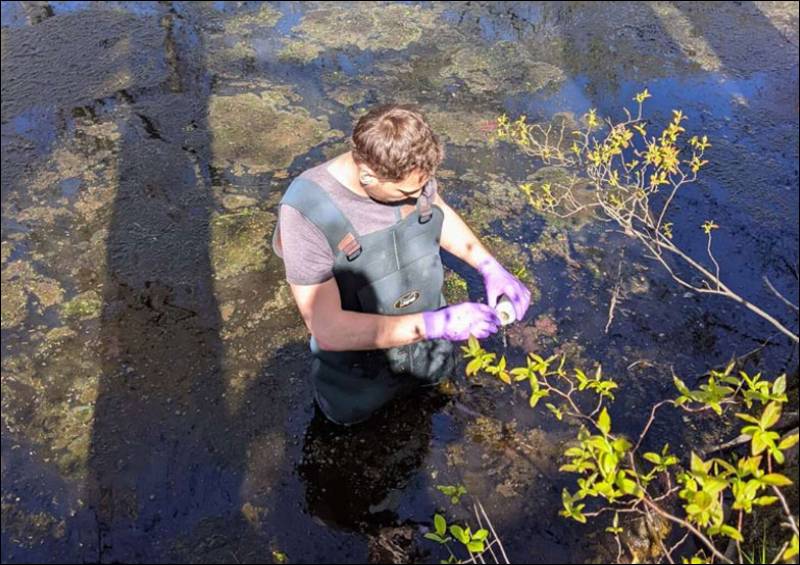
Findings support remediation planning for PFAS hotspot sites
A study led by University of Rhode Island (URI) Graduate School of Oceanography alumnus Jarod Snook, Ph.D. ’25, has identified two historically contaminated textile mill waste retention ponds as a long-term source of PFAS or ‘forever chemicals,’ entering the Pawcatuck River in Rhode Island.
Published in Environmental Science & Technology Water, the study traces PFAS contamination to former textile sites in Bradford and Westerly, where chemicals stored in pond sediments continue to migrate into the river decades after textile operations ended. The research was co-authored by members of URI’s Lohmann Lab, including Assistant Professor Jitka Becanova, Marine Research Associate Simon Vojta and Professor Rainer Lohmann.
Using a combination of environmental sampling and modeling, the team found that sediment at one of the retention ponds could continue releasing PFAS into the Pawcatuck River for more than 100 years unless remediation measures are undertaken, highlighting the persistent nature of legacy industrial pollution.
PFAS are a group of synthetic chemicals used in industrial and consumer products since the 1940s. Highly resistant to degradation, they can accumulate in the environment, wildlife and humans, persisting for decades and traveling long distances from inland rivers to coastal waters and the Atlantic Ocean.
Once in a river system, PFAS can contaminate water and sediments, bioaccumulate in aquatic organisms and disrupt ecosystems. Human exposure can occur through drinking water and seafood consumption. The Pawcatuck River is widely used for recreation and fishing, raising concerns about long-term health risks for local communities.
“Rhode Islanders value their aquatic environment,” said Snook. “Keeping it free from pollution is part of that value. We hope this study helps drive action to remediate PFAS contamination at its source.”
The two retention ponds were previously identified by the Lohmann Lab as PFAS hotspots, where concentrations in the Pawcatuck River increased sharply downstream. These findings prompted a deeper investigation into the extent of sediment contamination and the longevity of PFAS release.
A key element of the study was a passive sampling device developed by Snook during his doctoral research while participating in URI’s STEEP (Sources, Transport, Exposure & Effects of PFAS) Programme. The device enabled researchers to quantify PFAS movement from contaminated sediments into surrounding waters over time.
By focusing on well-defined and accessible freshwater sites with documented industrial histories, the study provides a transferable framework for assessing PFAS-contaminated systems elsewhere in the U.S. and globally.
“My hope is that the results will be useful for Rhode Islanders and the scientific community alike,” Snook said. “Our approach can serve as a model for investigating PFAS-contaminated sites around the world.”
Environmental remediation decisions depend on understanding both the scale and persistence of contamination. The research team emphasized producing actionable, science-based insights to support regulatory planning.
“We wanted regulators to have a solid foundation to begin planning effective solutions,” Snook said, noting that further data on contamination depth and transport pathways could strengthen future remediation efforts.
As PFAS contamination continues to raise concerns nationwide, the study offers a detailed case study of how legacy textile operations can remain sources of pollution for generations and how targeted scientific research can guide long-term remediation strategies.