Artificial Intelligence Applications Are Changing The Landscape Of Textile Value Chain. Are You Prepared?

The world is fast-moving towards the application of AI (Artificial Intelligence), robotics and digitisation in manufacturing. Smart machines, AI-controlled systems and IoT (Internet of Things) based monitoring tools are used across the textile value chain. The modern textile automation is powered by a combination of digital intelligence, connected systems and precision engineering.
What is Artificial Intelligence, and how is it helping the textile value chain?
Artificial Intelligence (AI) is technology that enables computers and machines to simulate human learning, comprehension, problem solving, decision making, creativity and autonomy. The devices equipped with AI can see and identify objects, understand and respond to human language, learn from new information and experience and make detailed recommendations to users.
AI is transforming every stage of textile production, encompassing design, manufacturing, quality control and customer interaction. AI is augmenting and revolutionising current processes, driving the industry toward a future. AI is revolutionising how fashion is designed, planned and produced. Modern AI tools help generate real-time design and efficiency gains.

10 ways AI is used in the textile and apparel industry
1. Automated Design and Pattern Making
 AI applications help in fashion design by enabling more intuitive and data-driven creation of patterns and fabrics. AI tools analyse vast trend data from fashion shows, online retail platforms, and consumer behaviour studies. This helps predict future trends in patterns, colours and materials, empowering designers to craft collections that align closely with anticipated market demands. This predictive insight shortens the time from design conception to market debut. Personalisation enhances customer satisfaction and loyalty, showcasing AI’s pivotal role in transforming traditional fashion design into a dynamic, customer-centric industry. Adobe Flierfly, CLO 3D, Slide 3D AI, Fashion INSTA and Patterned AI are some of the popular tools.
2. Fabric Inspection
Online fabric inspection software streamlines quality control by digitising the detection, recording and reporting of defects in textiles. These solutions range from cloud-based mobile apps for field agents to AI-powered industrial platforms integrated directly into knitting machines or looms. These softwares scan for defects such as mis-weaves, pattern irregularities and colour deviations. This level of precision cuts down on waste and elevates product quality. Speed of the AI-driven inspection accelerates the production cycle, reduces labour costs while enhancing the efficiency of manufacturing operations. Some popular AI-powered textile monitoring systems that detect fabric defects in real-time on the machine are Uster EVS Fabriq Vision, Smartex.ai, CATS (Datatex), FIDAS, LookOver and LTQuality.
3. Supply Chain Optimisation
AI-powered systems for supply chain management (SCM) have shifted from simple statistical models to autonomous orchestration and agentic AI in 2026. These systems use machine learning (ML) and deep learning to process real-time external data—such as weather, social signals, and geopolitical shifts—reducing forecast errors by up to 43% compared to traditional methods. By leveraging historical sales data, weather forecasts and economic indicators, AI algorithms can predict future product demands. This predictive capacity allows manufacturers to tune their production schedules, maintain efficient stock levels and minimise ‘holding costs’. Some of the popular AI tools like Llamasoft, Blue Yonder, Kinaxis Maestro, 09 Solutions and SAP IBP offer supply chain analytics that forecast demand and simulate various market scenarios.
4. Predictive Maintenance
Predictive Maintenance (PdM) represents a shift from “fixing things when they break” or “fixing things on a schedule” to “fixing things exactly when needed.” By using AI to analyse data from industrial sensors (vibration, temperature, pressure and acoustics), these systems identify the subtle “fingerprints” of equipment failure weeks before a breakdown occurs. Predictive AI maintenance is pivotal for enhancing machinery longevity and operational efficiency.
AI models process massive streams of IoT data to perform three primary functions like Anomaly Detection (Identifying patterns that deviate from “normal” operating conditions), Failure Prediction (Estimating the Remaining Useful Life (RUL) of a component), Root Cause Analysis (Determining why a machine is failing, e.g., bearing wear vs. lubrication issue, to ensure the right parts are ordered).
The real-time benefits are in terms of Reduced Downtime (typically decreases machine downtime by 30–50%), Extended Asset Life (increases the lifespan of expensive machinery by 20–40%) and Safety (prevents catastrophic failures that could lead to workplace accidents). The popular AI tools are SKF Solution, Siemens Senseye and IBM Maximo Predict.
5. Robotic Automation
Robotic automation powered by AI is transforming the textile and apparel industry from a traditionally labour-intensive craft into a high-tech sector. By integrating computer vision, machine learning and advanced sensors, robots can now handle “limp” or flexible fabrics—a task historically difficult for traditional machines.
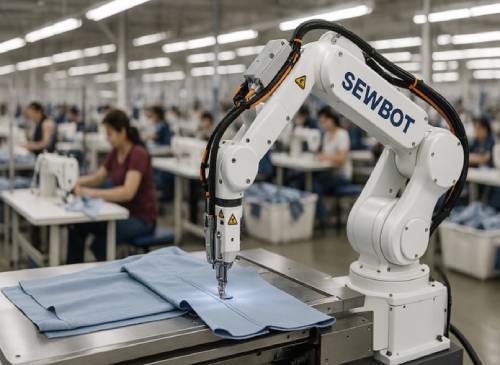
The core applications of AI robotics are Precision Cutting, Fabric Inspection, Handling & Logistics through Automated Guided Vehicles (AGVs). AI-driven robots like SoftWear Automation’s Sewbots are transforming textile manufacturing by performing precise and repetitive tasks such as fabric cutting and sewing with accuracy and efficiency. These robots, equipped with ‘Advanced Vision Systems’ and AI, handle and sew fabrics much faster than humans, with a Sewbot capable of sewing a standard T-shirt in just 22 seconds. This ensures that high-demand fashion items can be produced quickly. Integrating these robots reduces reliance on skilled human labour, which can be utilised for complex and creative tasks.
Some of the popular AI robotics are from SoftWear Automation (SEWBOT), ABB Robotics, LECTRA and Siemens.
6. Waste Reduction
AI-powered tools are fundamentally reshaping the textile value chain by transforming waste from an inevitable byproduct into a manageable resource. By 2026, industry experts project that AI adoption will be a baseline requirement for competitive, sustainable manufacturing, with early adopters reporting up to a 72% reduction in material waste.
- Manufacturing: Minimising Pre-Consumer Waste
Systems like Smartex and Robro Systems’ KWIS use high-speed cameras and deep learning to scan fabrics during production and detect micro-defects. AI algorithms (e.g., from Lectra) arrange pattern pieces like a jigsaw puzzle to achieve nearly 100% fabric utilisation, reducing cutting waste by 15-20%.
- Design & Product Development: Preventing Waste Before Production
Tools like CLO 3D and Browzwear use AI to simulate garment fit and drape on 3D avatars, which eliminates significant material and transportation waste.
- Supply Chain: Solving the Overproduction Crisis
Overproduction is estimated to drive roughly 30% of fashion inventory directly to landfills or markdowns. Platforms like Stylumia and Heuritech help in demand sensing and 20% reductions in excess inventory.
- End-of-Life: Enabling High-Quality Recycling
AI combined with Near-Infrared (NIR) spectroscopy can identify over 13 fibre types with 95%+ accuracy. New prototypes use AI and lasers to identify and remove non-recyclable elements like zippers, buttons and logos, making garments ready for high-quality chemical recycling. Mandated by EU regulations in 2026, AI-supported Digital Product Passports track a garment’s material composition from birth, providing recyclers with instant data on how to process the waste.
7. Personalised Marketing 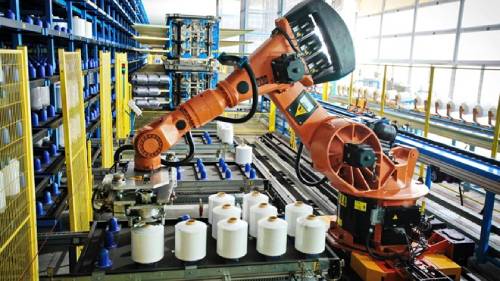
Many apparel brands have shifted to hyper-personalisation at an individual level. AI-powered marketing tools analyse thousands of data points—including purchase history, real-time browsing behaviour, and even local weather—to deliver a “one-to-one” shopping experience. AI’s capacity to sift through extensive customer data enables companies to develop highly personalised marketing strategies. Adopting AI in marketing efforts leads to increased customer engagement and higher conversion rates. AI helps optimise marketing resources by targeting consumers, thereby increasing the effectiveness of marketing campaigns.
Stitch Fix, Hook, Zalando, Stylitics, Pinterest Lens and Nieman Marcus, Valentino and Moncler are some of the popular AI tools used by the leading apparel brands for this purpose.
8. Enhanced Customer Experience
AI-powered tools enhance the customer experience for textile brands by shifting from a one-size-fits-all approach to hyper-personalisation and interactive discovery.
AI-powered chatbots and virtual assistants are transforming the retail experience by offering highly personalised shopping guidance. These systems analyse individual user interactions, preferences and purchasing histories to tailor product recommendations uniquely for each customer. Technologies like PICTOFiT (Reactive Reality) and Style3D allow customers to create realistic 3D avatars or upload photos to see exactly how garments drape and fit their specific body shape. Solutions such as Mirrorsize and Prime AI replace static size charts with data-driven recommendations, analysing thousands of body types to provide precise fit suggestions instantly. Smart chatbots provide instant natural-language support for inquiries about order status, returns and product availability, which increases customer satisfaction and boosts brand loyalty.
9. Sustainable Practices
AI is a “strategic enabler” of sustainability across the textile value chain, helping brands transition from fragmented manual processes to real-time, data-driven circular models. These tools address critical environmental challenges such as overproduction, high resource intensity and low recycling rates.
AI integrates into all the stages of the value chain to prevent waste through Circular Design & Resource Optimisation (CLO 3D, Browzwear, Materiom AI, Noble AI), Precision Manufacturing & Quality Control (Smartex, WiseEye), Supply Chain Transparency & Inventory Management (Nextail, Stylumia, TruceTrace) and End-of-Life & Automated Recycling (Rafiberd, Valvan).
Alchemie Technology’s Endeavour utilises AI to revolutionise the traditional dyeing process. By employing digital fluid dynamics simulations, the system predicts and controls the exact amount of dye, fixative and water needed for each fabric type, optimising the process to use 95% less water and 85% fewer chemicals.
10. Smart Textiles
AI plays the role of “brain” behind smart textiles, which integrate electronics directly into fabric structures. AI’s primary role is enabling these materials to sense, communicate, and react to their environment in real-time. These innovative textiles are embedded with Actuators and Sensors, enabling them to alter properties such as colour or temperature in response to changes in their surroundings. AI assists in selecting specialised fibres—such as conductive yarns or polymeric optical fibres (POF)—to optimise properties like temperature regulation, antimicrobial effects or moisture-wicking. 3D digital twin technology simulates responsive behaviours virtually, such as a fabric changing colour or a garment’s thermal insulation adjusting to external cold. Innovative 3D weaving technology (used by Unspun) integrates sensors directly into the garment’s architecture, reducing cutting waste by up to 90%.
Conclusion
In summary, the integration of AI across these 10 key areas marks a pivotal shift toward a more circular and responsible textile industry. Ultimately, the ‘AI revolution’ in textiles is defined by its ability to turn massive data into actionable intelligence. The 10 ways highlighted here represent a roadmap for a smarter, faster and cleaner apparel industry. For manufacturers and designers alike, the opportunity is clear: embrace AI-driven transformation today to ensure a competitive, sustainable and consumer-centric tomorrow.