
India’s Textile Clusters Redefine Sustainable Manufacturing

India’s textile industry is emerging as a global benchmark for sustainable manufacturing, with clusters such as Tirupur and Panipat demonstrating large-scale success in water recycling and textile circularity.
Tirupur, which contributes over 54 percent of India’s knitwear exports, has established one of the world’s largest Zero Liquid Discharge (ZLD) ecosystems for textile processing. More than 700 dyeing units in the cluster operate under ZLD systems supported by 20 Common Effluent Treatment Plants that collectively recycle nearly 130 million litres of wastewater daily, achieving recovery rates of 92–95 percent.
Industry stakeholders note that the cluster’s sustainability model is commercially viable, with recycled water and salt recovery systems helping reduce operational costs while strengthening compliance with global sourcing standards.

Meanwhile, Panipat has evolved into a major textile recycling hub, processing over one lakh tonnes of discarded textile waste annually sourced from markets including the US, UK, Europe, Japan and Korea. The cluster converts post-consumer textile waste into yarns, blankets, floor coverings and industrial textile products, while increasingly adopting chemical recycling and advanced weaving technologies to meet international quality requirements.
The cluster reportedly handles nearly 250 tonnes of textile waste daily and supports an industry turnover of around US$ 5.3 billion, including exports worth approximately US$ 1.3 billion.
India’s circular textile transition is also receiving strong policy and international institutional support. Programmes such as InTex India, a joint initiative between the United Nations Environment Programme and India’s Ministry of Textiles, are helping integrate lifecycle assessment tools and environmental footprint methodologies into textile MSME clusters.
At Bharat Tex 2025, the European Union and India’s Ministry of Textiles jointly announced seven sustainability-focused textile projects backed by EUR 9.5 million in funding to strengthen traceability, circularity and resource efficiency across the textile value chain.
Additional initiatives including the EU’s SWITCH-Asia programme, UNIDO-GEF textile projects and GIZ India’s circularity toolkit are further supporting India’s transition toward sustainable and traceable textile manufacturing systems.
On the domestic front, schemes such as Tex-Eco, Tex-RAMPS and TEEM are aimed at supporting MSMEs through investments in circular manufacturing, traceability systems and cluster modernisation infrastructure.
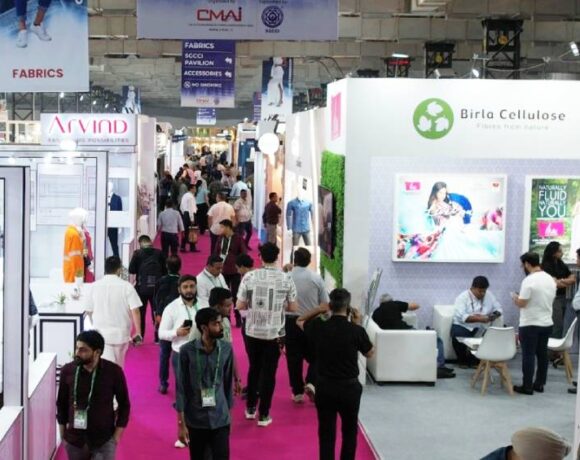
The sustainability progress of Indian textile clusters is expected to feature prominently at Bharat Tex 2026, where dedicated sustainability and traceability sessions will focus on areas such as Digital Product Passports (DPPs), circular manufacturing and compliance readiness for global export markets.
Industry observers believe India’s long-term competitive advantage in textiles will increasingly depend not only on scale and cost competitiveness, but also on sustainability credibility and transparent supply chains.