Digital Camouflage Uses Adversarial Textile Pattern To Challenge AI Surveillance
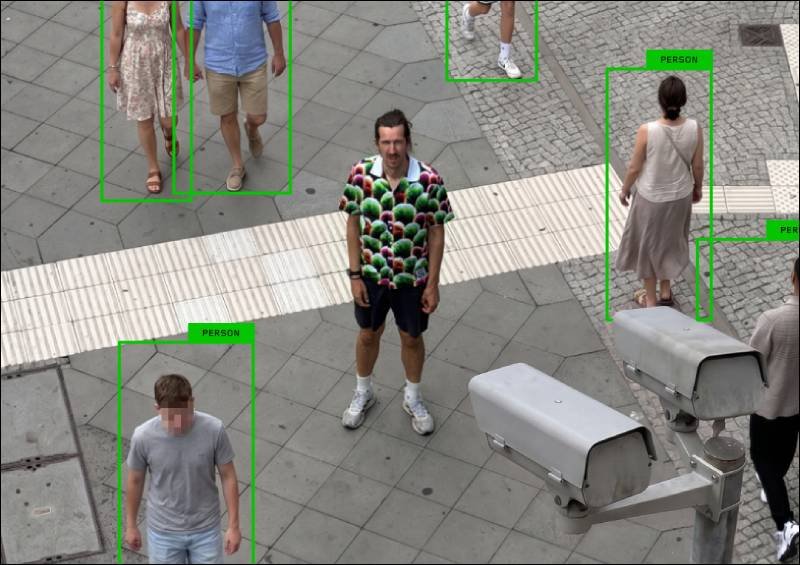
A garment featuring an abstract, hypnotic pattern has been designed to test how artificial intelligence-based surveillance systems identify people in public spaces.
Called Digital Camouflage, the garment uses an engineered textile pattern based on an adversarial attack, a technique in which visual inputs are altered in ways that can cause computer-vision systems to misinterpret what they see. The project explores whether such a pattern can interfere with object-recognition algorithms used in automated video surveillance.
The work comes as cities including Berlin expand the use of AI-supported surveillance technologies. At Berlin’s Kottbusser Tor, authorities have introduced a system capable of analysing behaviour captured by cameras and identifying actions considered potentially suspicious.

According to reports, the system is designed to distinguish between ordinary and potentially problematic behaviour. This requires the software to recognise a wide range of everyday activities, including movements and gestures that may have no connection to criminal activity.
Digital Camouflage was developed and tested against YOLO-based object-detection models, a widely used family of open-source computer-vision systems. During testing, the pattern was able to cause the detector to fail to identify the wearer as a person under certain conditions.
 The developers, however, note that the results are not universal. Performance can vary depending on the specific AI model, distance from the camera, viewing angle, lighting and other environmental conditions. It also cannot be assumed that the garment would have the same effect on surveillance systems deployed by governments or law-enforcement agencies.
The project therefore focuses not only on the effectiveness of the textile pattern but also on the growing use of computer vision in public spaces and the difficulty of independently assessing how such systems operate.
Berlin’s surveillance programme is part of a broader expansion of automated monitoring internationally. In the United States, large networks of connected cameras are used in numerous communities to monitor vehicles and activity, with data potentially accessible to law-enforcement agencies. At the same time, some communities and civil-rights groups have raised concerns about the privacy implications of these systems and have called for greater oversight or removal of surveillance networks.
Research into conventional CCTV surveillance has also produced mixed findings regarding its impact on crime. Studies have examined whether cameras prevent criminal activity, displace incidents to nearby locations or primarily influence perceptions of safety.
Another issue raised by the Digital Camouflage project is transparency. The manufacturer of the surveillance system being deployed at Kottbusser Tor has not been publicly identified, according to the project’s account, making independent assessment of the technology more difficult.
The garment is not presented as a universal method of avoiding surveillance. Its developers acknowledge that no textile pattern can reliably defeat every computer-vision system in every environment.
Instead, Digital Camouflage demonstrates a potential vulnerability in one category of object-recognition technology while raising broader questions about how people are identified and classified by machines in public spaces.
By using clothing as a physical interface between people and automated surveillance, the project highlights the growing interaction between textiles, artificial intelligence and privacy in an increasingly monitored urban environment.