Global Bedlinen Exports See Rebound In 2024 After Two-Year Slump

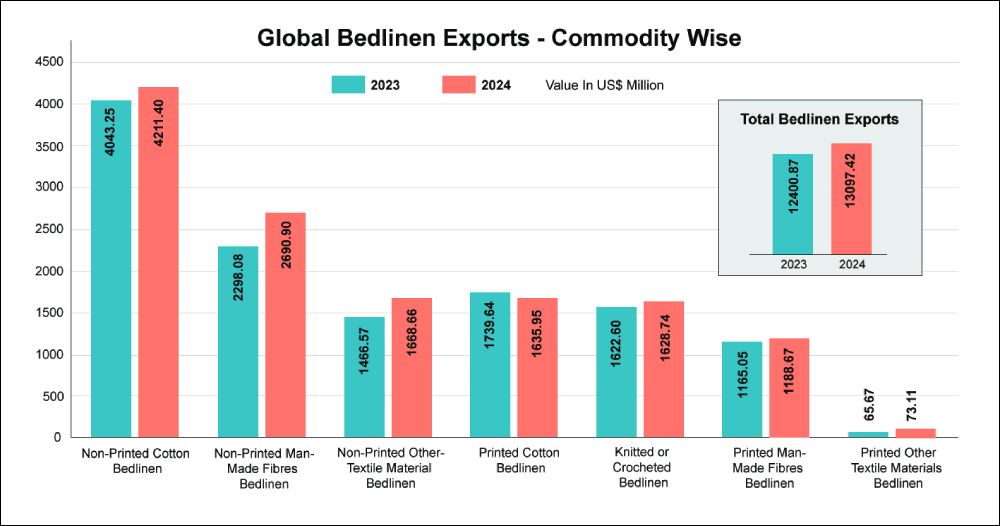
After two consecutive years of decline, the global bedlinen export market witnessed a significant rebound in 2024, recording a growth of 5.62% to reach US$ 13097.42 million, compared to US$ 12397.17 million in 2023. This marks a notable recovery for the industry. Despite this improvement, the market has yet to surpass the 2022 figures, when exports stood at US$ 13708.78 million. Among the various segments of bedlinen products, non-printed cotton bedlinen continues to hold the largest share, accounting for 32% of the total global bedlinen exports.

Parth Poddar, Director, Insignian Home
Parth Poddar, Director, Insignian Home, attributed the rebound to multiple demand-side factors: “Reduction in spending on experiences and the natural replenishment cycle for bedding products are causing an uptick in exports. Additionally, countries wanting to deleverage their supply chain from being reliant on just one country is helping India gain market share.”
Segment-wise Bedlinen Exports
The non-printed bedlinen segment has maintained its dominance in the global market for several years. In 2024, this segment recorded exports worth US$ 4211.40 million reflecting a 4.16% increase over the previous year and now comprises 65% of total bedlinen exports.
The printed bedlinen segment, which holds a 22% share, experienced a marginal decline of 2.45%, with exports totaling US$ 2897.73 million in 2024, compared to US$ 2970.37 million in 2023 and US$ 3244.14 million in 2022.
Knitted or crocheted bedlinen, representing the third major segment, grew marginally by 0.38% to reach US$ 1628.74 million in 2024. This category now comprises 12% of the global market.
Fibre-wise Bedlinen Exports
From a fibre composition perspective, cotton bedlinen remains the most exported category. In 2024, exports of cotton bedlinen reached US$ 5847.34 million, registering a modest 1.11% growth. However, its market share declined sharply from 63% in 2023 to 45% in 2024, indicating a growing preference for alternatives.
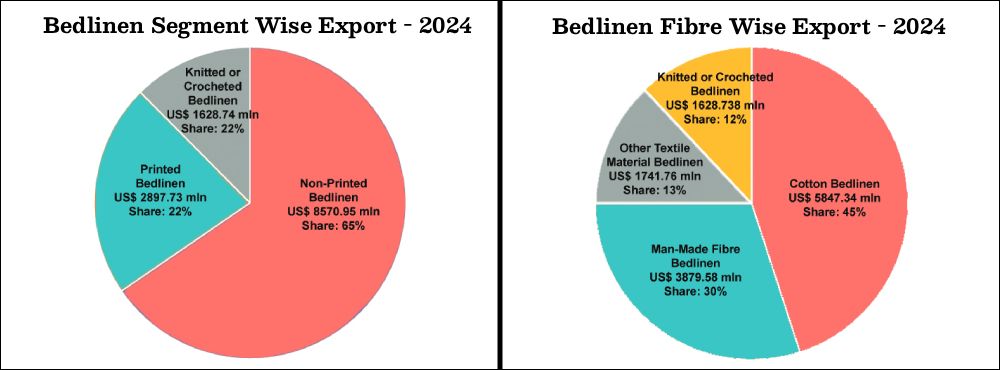
Man-made fibre bedlinen emerged as the second largest category, commanding 30% of the market. Exports in this segment surged by 12.03% to US$ 3879.58 million.
Bedlinen made from other textile materials accounted for 13% of the market, with exports totaling US$ 1741.76 million, reflecting a robust 13.67% growth over the previous year.
Commenting on this shift, Parth Poddar said, “Products made using man-made fibres retail at a lower price. As a result, they have faster sell-throughs, helping retailers maximise yield from their shelf space. This is leading to MMF gaining market share in markets that were traditionally cotton-dominant. Consumers are also looking for better value and performance from their bedding. Man-made fibre helps meet both these tasks and is now resonating well with customers.”
Commodity-wise Trends
Non-Printed Cotton Bedlinen
This continues to be the highest exported bedlinen commodity, totaling US$ 4211.40 million in 2024, a 4.16% increase over 2023. Pakistan retained its position as the largest exporter with shipments worth US$ 1359.60 million with a rise of 17.5% in 2024, accounting for 32% of the global market. China followed closely with exports of US$ 964.32million, though this marked a 3.63% decline. India came in third with exports totaling US$ 493.61 million, representing a 6.57% growth.
Non-Printed Man-made Fibre Bedlinen
This is the second-largest commodity, constituting 21% of global bedlinen exports, with a total of US$ 2690.90 million, marking a substantial 17.09% increase. China is the dominant player, accounting for 80% of global exports in this category, with shipments worth US$ 2142.62 million, up 17.07% from 2023. Pakistan stands second with US$ 162.04 million in exports, growing by 50.86%, while India, now the fourth largest exporter, grew an impressive 126.94% to US$ 32.17 million, surpassing countries like the USA, Türkiye, and France.
Non-Printed Other Textile Materials
This segment saw exports rise by 13.78% to US$ 1668.66 million in 2024. Pakistan led the market with US$ 951.65 million in exports, capturing 57% of this commodity’s global share. China followed with a strong 35.86% growth, exporting US$ 467.11 million, representing 28% of the market.
Printed Cotton Fibre Bedlinen
With a 12% market share, this fourth-largest category saw a 5.96% drop in exports, totaling US$ 1635.95 million. China remained the top exporter despite a 12.38% decline, shipping US$ 408.16 million. Türkiye followed with US$ 180.63 million (down 9.29%) and Germany with US$ 166.01 million (down 3.76%). India, now the fifth-largest exporter, showed a strong 22.28% growth to reach US$ 109.14 million.
Printed Man-made Fibre Bedlinen
Exports in this category rose by 20.3% to US$ 1188.67 million, comprising 9% of the total market. China continues to dominate, holding an 83% share with US$ 982.96 million in exports (up 1.14%). Spain ranked second with US$ 30.12 million, experiencing a 32.96% increase. India, now sixth in rank, saw a 15.36% decline to US$ 8.85 million.
Printed Other Textile Materials
This remains the smallest segment, yet grew 11.32% to US$ 73.11 million in 2024. Poland leads this category with US$ 22.69 million (up 74.01%), accounting for 31% of the market. Portugal overtook China as the second-largest exporter, growing 52.17% to US$ 8.91 million. China fell to third, with exports declining 32.66% to US$ 7.52 million.
Knitted or Crocheted Bedlinen
This segment experienced a marginal growth of 0.38%, reaching US$ 1628.74 million and capturing 12% of total exports. China overtook Pakistan as the leading exporter, growing 12.45% to US$ 517.21 million, equal to 32% of the segment. Pakistan closely followed with US$ 516.50 million, up 3.58%. Türkiye remained third, though its exports declined 9.37% to US$ 101.46 million.
On the pricing front, Parth added, “If we map bedding retails over the last decade, retail prices have largely stayed constant or have reduced. The end consumer is getting largely stable pricing but high input costs are drastically cutting down profitability for suppliers. For core programmes, we are extracting the most we can out of efficiency and for new products we are working on product engineering solutions to drive value. This helps balance things across the supply chain.”
Country-wise Export Performance
China continued to dominate the global bedlinen export market due to its large-scale production capacity, cost-effective manufacturing and competitive labour costs. In 2024, China’s exports rose 7.99% to US$ 5,489.89 million, accounting for 42% of the global market. The printed man-made fibre bedlinen category was the strongest for China, representing 39% of its total bedlinen exports, a 3% increase from 2023.
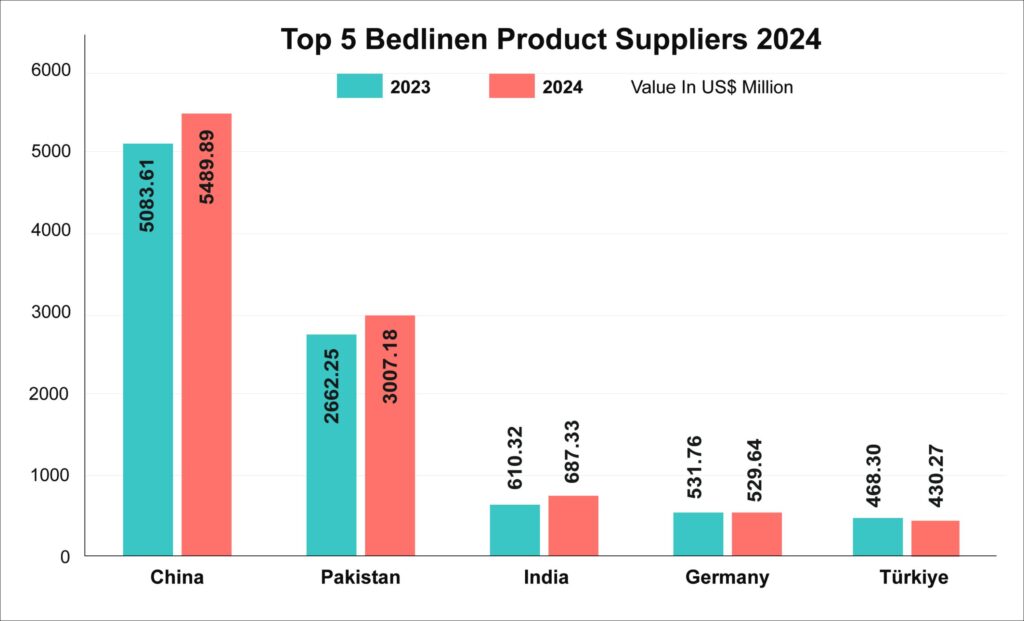
Pakistan maintained its position as the second-largest global exporter with US$ 3007.18 million in exports, growing 12.96% in 2024. It now commands 23% of the global market, with non-printed cotton bedlinen making up 45% of its total bedlinen exports.
India, known for its premium-quality cotton bedlinen, ranks third globally. Exports from India totaled US$ 687.33 million in 2024, registering a growth of 12.62%. India holds a 5% share of the global market, with non-printed cotton fibre bedlinen accounting for 72% of its total bedlinen exports.
Sharing how Insignian Home has stayed competitive in this evolving market, Parth Poddar noted, “We have worked in a focused manner on developing our man-made fibre portfolio. This has helped increase our competitive edge. We are also developing products in line with the latest trend using MMF, thereby creating a value-added range of polyester and cellulose-based bedding. Additionally, we have been focusing on designing performance-based bedding and have signed a deal with US-based 37.5 to use their proprietary fibres for bedding products.”
The global bedlinen export market demonstrated resilience in 2024, bouncing back from a two-year downturn with a healthy 5.62% growth. While traditional markets like cotton fibre saw marginal growth and a declining share, the surge in man-made and other textile fibre categories signaled shifting preferences in global demand. China continues to be the leader, with Pakistan and India following as major exporters. However, smaller players like Poland, Portugal and Spain have also shown notable improvements, especially in niche commodity segments, indicating a more diversified and competitive global bedlinen market.
(Source: Export data based on UN COMTRADE and ITC statistics, calculated by ITC and analyzed by Textile Insights.)
Article by Henry Dsouza, Associate Editor Of Textile Insights