India–EU FTA: A Turning Point For Textile Exports
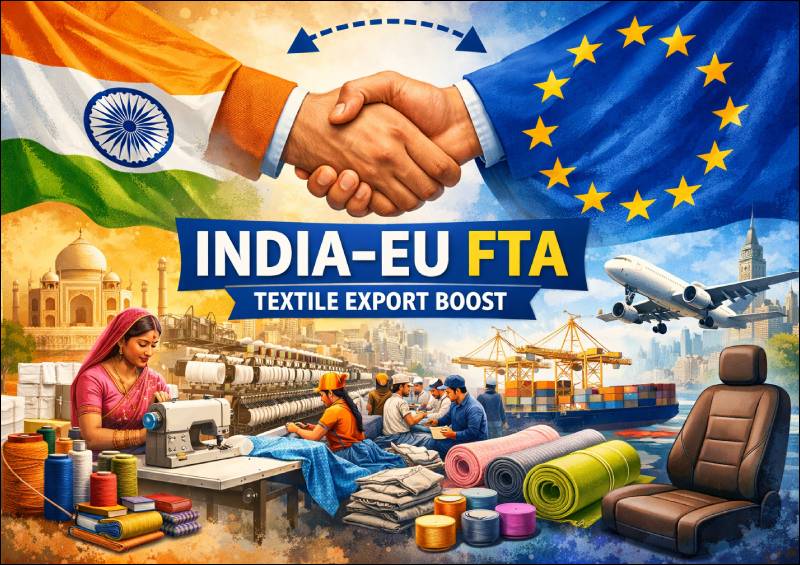
After nearly two decades of negotiations, the India–European Union (EU) Free Trade Agreement (FTA) is being hailed as a defining moment for India’s textile and apparel industry, with zero-duty access expected to significantly reshape export dynamics, sourcing strategies and employment generation across the value chain.
One of the most critical outcomes of the agreement is the elimination of tariffs on textile and apparel exports to the EU, which earlier averaged up to 12 per cent. Industry leaders believe this move will immediately enhance India’s cost competitiveness and offer exporters a compelling alternative to the U.S. market, where duties on certain categories have risen as high as 50 per cent. With ready-made garments accounting for nearly 60 per cent of India’s textile exports to the EU, the removal of duties is expected to improve buyer sentiment, unlock higher order volumes, and trigger fresh investments across spinning, weaving, processing and garmenting.

Sanjay Jain, Group CEO, PDS Ltd
Highlighting the export-led opportunity, Sanjay Jain, Group CEO, PDS Ltd, said the FTA could materially shift sourcing decisions in favour of India. He noted that Europe remains a key growth market for Indian exporters, especially as global brands reassess their supply chains amid geopolitical and regulatory pressures. “Zero-duty access is expected to improve price competitiveness, expand labour-intensive segments such as handlooms, and drive capacity expansion across key states, boosting employment for artisans, weavers, and women workers,” Jain said. He added that with nearly 33 per cent of PDS’s annual revenue of USD 1.5 billion already coming from Europe, the company expects to benefit meaningfully through higher order volumes and longer-term sourcing commitments from EU brands, particularly through its manufacturing arm, Knit Gallery.

Sammir Dattani, Executive Director, Sanathan Textiles Ltd.
The agreement also opens up wider opportunities beyond fashion-led apparel. Sammir Dattani, Executive Director, Sanathan Textiles Ltd., said the reduction of tariffs from 12 per cent to zero will significantly enhance market access and enable Indian manufacturers to deepen their presence across multiple European countries. He pointed out that Europe hosts some of the world’s leading fashion houses as well as automotive manufacturers that depend heavily on imported textiles for apparel, upholstery, technical fabrics and automotive interiors. According to Dattani, the FTA creates an opportunity for Indian companies to participate more meaningfully in both fashion-driven consumption and high-value technical and automotive textile segments.

Rahul Mehta, Chief Mentor, Clothing Manufacturers Association of India (CMAI)
From an industry-wide perspective, the deal comes at a time when exporters are under pressure due to global trade disruptions and higher tariffs in other markets. Rahul Mehta, Chief Mentor, Clothing Manufacturers Association of India (CMAI), described the India–EU treaty as a potential game changer for the sector. “The textile industry is currently under massive stress due to U.S. tariffs. The EU deal provides a much-needed relief, but it is now up to the industry to rise to the occasion and meet the compliance and sustainability requirements of the EU market,” Mehta said. He added that if Indian factories align products, processes and certifications to buyer expectations, textile and apparel exports could grow by 25 per cent over the next few years.

Gautam Singhania, Managing Director, Raymond Group
Echoing similar views, Gautam Singhania, Managing Director, Raymond Group, emphasised the broader economic and employment impact of the proposed FTA. He said duty-free access to the EU would be a major boost for one of India’s largest employment-generating sectors. “Textiles remain among the biggest employers in the country, and zero duty on exports to the EU will be beneficial not just for the industry but for the wider economy as well,” Singhania said. He also noted that a strong agreement with the EU could enhance India’s bargaining position in future trade negotiations with the United States.
Currently, India’s textile and apparel exports to the EU stand at around US$ 7.2 billion, representing a relatively modest share of the bloc’s total import market. However, with tariff barriers removed, industry estimates suggest exports to the EU could grow by 20–25 per cent annually once the agreement is fully implemented. Key textile clusters such as Tiruppur, Karur, Surat and Ahmedabad are expected to benefit from higher capacity utilisation, renewed capital expenditure and stronger order pipelines.
While the agreement still awaits formal ratification and implementation, expected over the next couple of years, industry stakeholders agree that preparedness will be crucial. Investments in sustainability, traceability, compliance and technology adoption will determine how effectively Indian manufacturers capitalise on the expanded access.
Overall, the India–EU FTA signals a structural shift for the textile and apparel sector. By eliminating tariffs, diversifying export markets and reinforcing India’s strengths across cotton, yarn, fabrics and garments, the deal positions India as a more competitive and reliable sourcing destination for Europe, setting the stage for sustained export growth and job creation.