Itema Focuses on Innovation And Customer-Centric Approach To Deliver Positive Performance In Challenging Global Environment
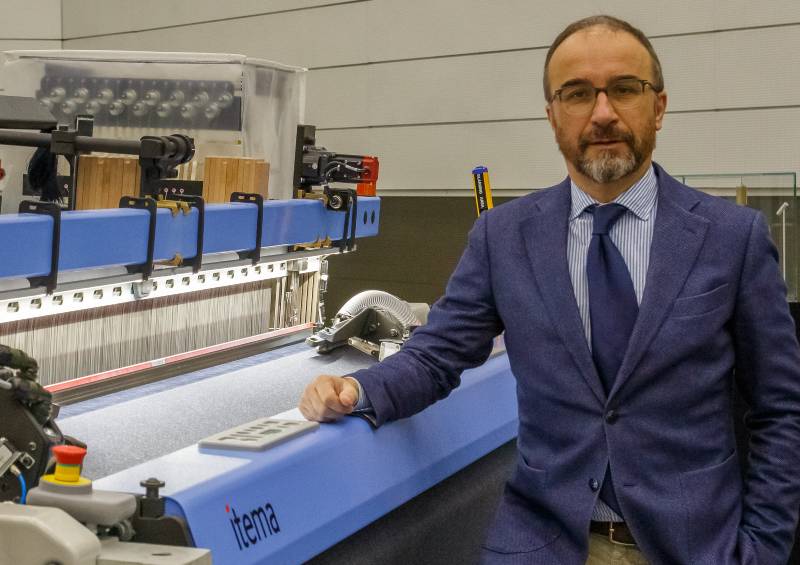
In an increasingly volatile global environment marked by currency fluctuations, shifting trade policies and cautious investments, Matteo Mutti, shared insights into the company’s 2025 performance, technological advancements and evolving customer dynamics, in an exclusive interview with Henry Dsouza, Associate Editor, Textile Insights.
Reflecting on last year’s performance, Matteo Mutti noted that 2025 was largely in line with expectations in terms of overall volumes, despite an uneven regional distribution of sales. While some markets underperformed, India emerged as a strong growth driver, delivering better-than-expected results. Considering the challenging global conditions, he described the overall performance as positive, with the company successfully matching its budgeted volumes.
On the innovation front, Itema introduced several key developments during ITMA Asia in Singapore. Among the highlights were the Itema MEC-T, its newly developed in-house mechanical tucking units, designed to deliver improved performance and higher selvedge quality. MEC-T mechanical tuckers have already established themselves as a benchmark, with more than 100 looms installed only in India and delivering satisfactory results. The company also unveiled the GalileoAX airJet weaving machine, manufactured at its China facility, and developed to make the renowned Itema weaving experience accessible to all by combining the Itema textile excellence with competitive cost and energy efficiency. Last but not least, the company also launched the super-wide free-flight version of the rapier GalileoRX for technical fabrics, which has gained strong acceptance, particularly in coating applications.
As regards investment trends, Mutti explained that the current environment is less about a clear shift in sourcing or supplier preferences and more about widespread uncertainty. While supply chains have largely stabilised following the disruptions caused by the pandemic and geopolitical tensions, fluctuating tariffs, volatile currency movements and changing trade policies, particularly in the United States, have created a wait-and-watch approach among investors. He observed that rather than shifting investments, many players are holding back decisions due to the unpredictability of market conditions.
Currency depreciation has further added to the complexity, especially with the Indian rupee weakening significantly against the euro, leading to a 20–30% increase in machinery costs. Mutti acknowledged that such external economic factors can impact purchasing decisions, but emphasised that customers continue to invest if the value proposition remains strong. He pointed out that even if returns on investment take longer, buyers are willing to proceed when performance and efficiency gains justify the cost. To manage pricing challenges, Itema leverages its dual manufacturing strategy, producing machines in Italy and China, thereby offering flexibility in pricing and currency exposure.
Highlighting the importance of proximity to customers, Itema recently established a service centre in Surat, strengthening its commitment to the Indian market. The facility offers round-the-clock support, including spare parts, technical services and textile consultancy. Mutti stressed that the company’s approach goes beyond selling machinery, focusing instead on delivering comprehensive solutions tailored to customer needs. Over the past five years, Itema has sold more than 4000 weaving machines in Surat alone, underlining the region’s strategic importance.
In terms of manufacturing, the company continues to operate primarily from Italy and China. While Italy remains its technological and cultural base, China serves as a critical production hub due to its scale and market relevance. Although cost advantages in China have narrowed over time, Mutti noted that the exposure to local design approaches and market dynamics continues to be beneficial.
Discussing broader industry challenges, he emphasised that continuous evolution is inherent to the textile sector. With over three decades of experience, he observed that the industry has transformed significantly and continues to adapt to new realities. He reiterated that while challenges are constant, Itema remains committed to addressing them through an open, flexible and customer-centric approach.
Looking ahead, while not disclosing specific details, Mutti hinted at upcoming innovations that will be revealed later in the year at India ITME Exhibition. Despite prevailing uncertainties, he expressed confidence in Itema’s strategy, which is built on innovation, strong customer relationships and operational adaptability, positioning the company to navigate the complexities of the global textile machinery market.