
Jute MSP Up 4.9% As Policy Signals Sector Support
The Cabinet Committee on Economic Affairs (CCEA) has approved a Minimum Support Price (MSP) of Rs 5,925 per quintal for TD-3 grade raw jute for the 2026-27 marketing season, marking a 4.9 percent increase over Rs 5,650 per quintal fixed for 2025-26.
Announcing the decision, Information and Broadcasting Minister Ashwini Vaishnaw said the hike would benefit jute growers, particularly in West Bengal and Assam. India is among the world’s largest producers of raw jute.
The government said the new MSP ensures a return of 61.8 percent over the all-India weighted average A2+FL cost of production of Rs 3,662 per quintal. Based on the projected C2 cost of Rs 4,945 per quintal, the MSP is 19.8 percent higher. The move aligns with the Centre’s policy since 2018-19 of fixing MSP at least 1.5 times the average cost of production. Farmer groups, however, continue to demand MSP based on the Swaminathan formula of C2+50 per cent.
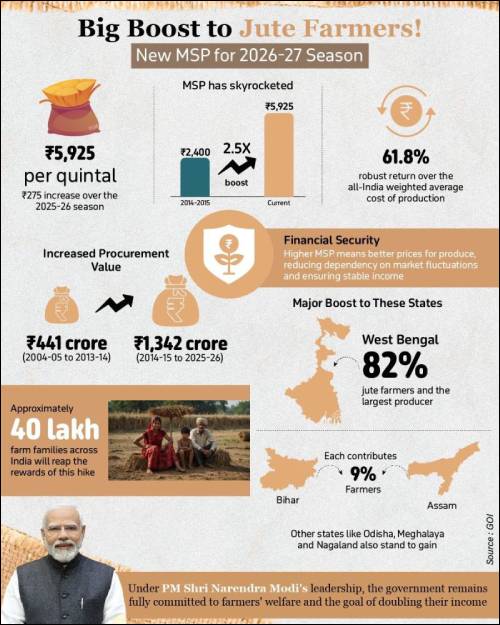 According to an official statement, MSP payments to jute farmers rose to Rs 1,342 crore during 2014-15 to 2025-26, compared with Rs 441 crore in 2004-05 to 2013-14. The Jute Corporation of India will continue as the nodal agency for Price Support Operations, with any losses fully reimbursed by the Centre.
In its recommendation, the Commission for Agricultural Costs and Prices flagged significant differences in jute production estimates between the Agriculture Ministry and the Jute Advisory Board, saying the divergence affects price policy and business decisions. It reiterated the need for an expert committee to address the issue.
The Commission also expressed concern over declining jute acreage over the past two-and-a-half decades, noting wide productivity gaps across states. Yields in Assam and Bihar remain below West Bengal and the national average. It called for strategic interventions to expand area under cultivation and address productivity disparities.
The CACP further suggested gradually reducing compulsory jute packaging under the Jute Packaging Materials (Compulsory Use in Packing Commodities) Act, 1987, to ensure adequate availability of raw jute for diversified products. It recommended revising premiums for TD-1 and TD-2 grades and increasing discounts for TD-4 and TD-5 relative to TD-3 MSP.
Noting that India is a net importer of raw jute but a net exporter of jute products, the Commission highlighted concerns over export incentives offered by Bangladesh, which it said hurt Indian farmers and industry. It called for closer monitoring of imports and corrective steps to curb subsidised inflows. With the US being a key market and recent tariff hikes adding uncertainty, the CACP also urged diversification of export products and destinations, as the top five markets account for 50–70 percent of India’s jute goods exports.