Looming Cotton Crunch? Indian Mills Turn To Imports As Crop Outlook Dims
India’s cotton story is getting tighter. Just as textile mills are gearing up for stronger export orders, the country’s cotton crop is facing weather-related risks, pushing up fibre prices and increasing the industry’s dependence on imports.
The latest USDA Foreign Agricultural Service (FAS) assessment has pegged India’s cotton production for 2026-27 at 24.5 million 480-lb bales, equivalent to around 5.3 million tonnes. The estimate is three per cent lower than the previous forecast, with yields expected to fall two per cent to 464 kg per hectare.
The concern comes at a time when cotton demand from Indian mills is moving higher. FAS has raised its forecast for domestic mill consumption to 26.2 million bales, about two per cent higher than its earlier estimate, driven largely by improving textile and apparel export prospects.

Weather—A big worry
Cotton sowing may have recovered from a slow start, but the crop is still playing catch-up. As of July 31, cotton had been sown across 10.354 million hectares, down 2.4 per cent from 10.606 million hectares during the same period last year. The gap, however, has narrowed sharply from the roughly 12 per cent deficit recorded on July 17.
The bigger question now is not acreage, but what happens to the crop already on the ground.
The India Meteorological Department has forecast below-normal rainfall through August-September, with western and central India facing the greatest risk of prolonged dry spells. Cotton is entering the crucial squaring, flowering and early boll-setting stages, making rainfall distribution particularly important for final yields.
Too little rain could hit yield potential, while excessive rainfall in parts of Maharashtra and Madhya Pradesh could bring its own problems, including waterlogging, disease and nutrient losses.
Mills want more cotton
While farmers contend with an uncertain monsoon, textile mills are preparing for stronger demand.
India’s cotton yarn exports rose 9 per cent year-on-year during August-June of MY 2025-26, standing 17 per cent above the five-year average. Bangladesh remained the largest buyer with a 40 per cent share, followed by China at 22 per cent.
The export outlook has received a further boost from India’s trade agreements. The India-UK Comprehensive Economic and Trade Agreement (CETA), which entered into force on July 15, eliminated tariffs on 99 per cent of Indian goods from the first day, including bringing UK import duties on Indian textiles and clothing to zero. Duty-free access under agreements with the UAE and Australia is also supporting export-oriented mills.
That combination of stronger export opportunities and a potentially smaller cotton crop output could keep the fibre market under pressure.
Imports step into the gap
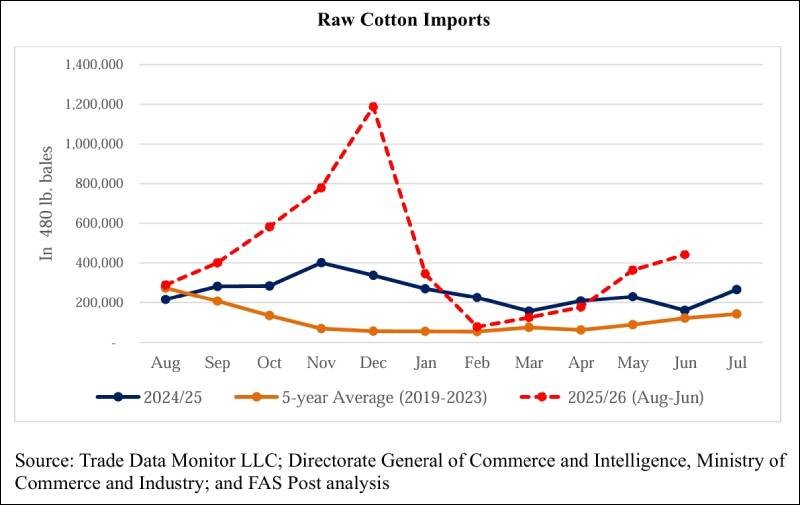
And this is where imported cotton is becoming increasingly important. India’s cotton imports surged 72 per cent year-on-year during August-June of MY 2025-26, and were nearly three times the five-year average. Brazil, Australia, the US and Mali were the leading suppliers.
For 2026-27, FAS expects India to import around 3 million 480-lb bales, or approximately 653,000 tonnes.
The reason is not simply a shortage of cotton. Mills are also looking for machine-picked, contamination-free and higher-quality fibre that can help them meet increasingly demanding yarn and textile applications.
The temporary removal of the 11 per cent import duty on raw cotton has made those imports more attractive. The exemption, applicable from June 1 to October 31, removes the basic customs duty, Agriculture Infrastructure and Development Cess and social welfare surcharge.
But what happens after October 31 could become an important question for spinning mills.
Cotton prices refuse to cool
The tightening supply situation is already showing up in prices.
Domestic lint prices increased 8 per cent over the past month, while Shankar-6 seed cotton prices rose 15 per cent as market arrivals remained low. Cotton prices were also 26 per cent higher than a year earlier during the period cited in the report.
The pressure could intensify as the new season begins. The minimum support price for long-staple cotton is set to rise by 7 per cent to Rs 8,667 per 100 kg from October 1.
For spinning mills, higher cotton prices could squeeze margins unless yarn and downstream textile prices move up in tandem.
Raw cotton exports could take a back seat
India may also have less cotton available for overseas buyers.
FAS has kept its 2026-27 cotton export forecast at 1.2 million bales, citing strong domestic mill demand, tighter exportable supplies and the industry’s growing focus on value-added textile exports.
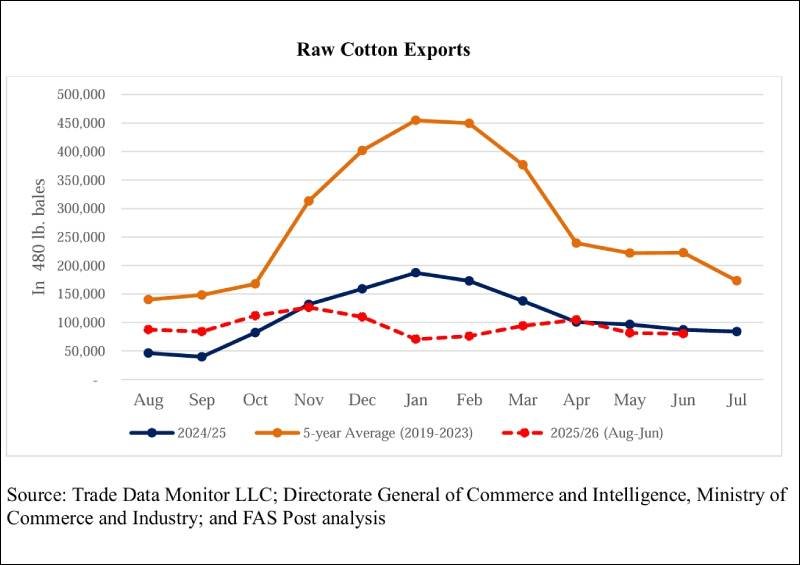
The trend was already visible last season. India’s raw cotton exports during August-June of MY 2025/26 were down 17 per cent year-on-year, with Bangladesh accounting for 88 per cent of export volumes.
In other words, more of India’s cotton could stay at home and increasingly find its way into yarn, fabric and garments rather than being exported as raw fibre.
Quality remains another piece of the puzzle
Quantity is only one side of India’s cotton challenge. Quality remains equally important.
The USDA report points to issues such as higher trash levels, moisture variability and foreign-matter contamination in Indian cotton. The government’s Kasturi Cotton initiative is aimed at addressing these concerns through defined fibre standards and blockchain-backed traceability.
However, certified Kasturi cotton still accounts for only a small share of India’s overall crop, with the industry working to expand certified ginning infrastructure, farmer participation and market adoption.
What lies ahead?
India enters the new cotton season with an interesting contradiction: mills are expecting more business, but the fibre market could become more challenging.
FAS expects total cotton supply at 39.5 million bales in 2026-27, with domestic consumption at 26.2 million bales and imports at 3 million bales.
The coming months will therefore be crucial for the entire textile value chain. The monsoon will determine the crop’s final potential, while cotton prices, import policy and export demand will decide how comfortably spinning mills can secure fibre.
For India’s textile industry, the message is clear: the race for cotton is getting tighter just when demand is beginning to pick up.