
Ministry Of Textiles Holds National Webinar To Align States Ahead of Textiles for Global Markets Summit
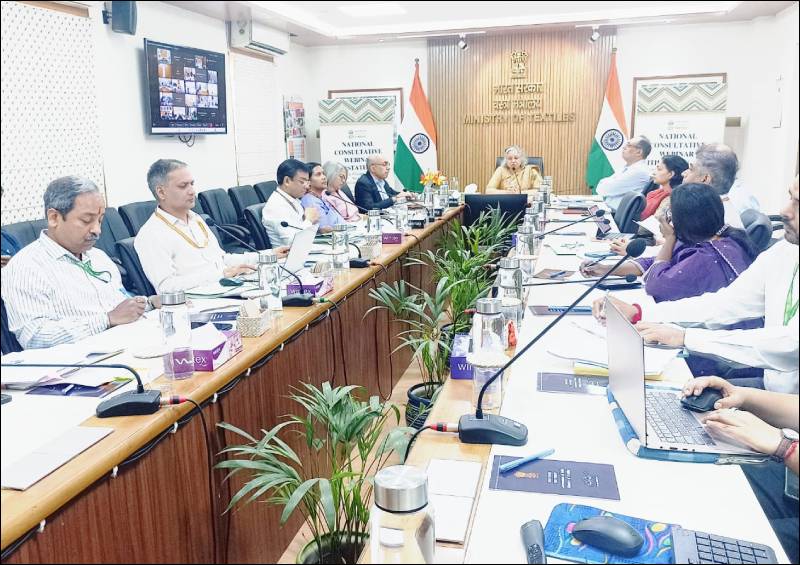
The Ministry of Textiles conducted a National Consultative Webinar with States and Union Territories as part of its preparations for the Departmental Summit on Textiles for Global Markets, scheduled for June 2026. The initiative follows directions from the Cabinet Secretary to strengthen Centre–State coordination in driving growth across priority sectors.
In her opening remarks, the Secretary (Textiles) noted that while India’s textile sector has seen steady domestic growth, export performance has remained relatively modest. She reiterated the government’s vision to scale textile and apparel exports from around US$ 40 billion to US$ 100 billion by 2030, stressing the need for closer collaboration with States and UTs. She also highlighted the importance of developing a focused, outcome-driven agenda for the upcoming summit to build national consensus and identify actionable strategies for boosting exports.
The Additional Secretary outlined the objectives of the consultative process, stating that it would help identify policy gaps, infrastructure and logistics challenges, and regulatory bottlenecks impacting exports, enabling targeted interventions at both State and national levels.
The Trade Advisor provided an overview of India’s textile export landscape and State-wise performance, emphasising the need for market diversification, greater technology adoption, and stronger value chains to enhance global competitiveness.
The DDG, Ministry of Textiles, presented the District-Led Textile Transformation (DLTT) framework, aimed at improving district-level export competitiveness through convergence of schemes, institutional coordination, and data-driven planning. Panipat was showcased as a pilot district to demonstrate the effectiveness of a district-driven export development model.
States and UTs were also encouraged to actively participate in Bharat Tex 2026, scheduled from July 14–17, 2026, as a key platform for investment promotion, buyer–seller interactions, international networking and showcasing regional textile ecosystems.
During the interactive session, participating States highlighted key concerns including expansion of textile districts, infrastructure and logistics gaps, the need for skilling and technology support, export facilitation for MSMEs and support for handloom and traditional sectors. Several States also called for tailored policy support for niche textile segments and improved export readiness among small producers.
The Ministry outlined next steps, including State-level stakeholder consultations, preparation of district export action plans, and further deliberations to finalise the agenda for the national conference. It reaffirmed its commitment to working closely with States and Union Territories to strengthen India’s position in global textile markets through coordinated policy support, institutional collaboration and district-driven strategies.