
India has one of the world’s largest textile ecosystems, spanning spinning, weaving, processing, garments, home textiles and technical textiles. Yet its manufacturing base remains fragmented. Global brands increasingly want large orders, consistent quality, shorter lead times and

Despite a staggering $17 trillion invested in sustainable technologies over the past decade, progress remains uneven across sectors, technologies and businesses, according to Bain & Company’s fourth edition of The Visionary CEO’s Guide to Sustainability. The global sustainability transition is entering a new phase, one defined less by a uniform march towards greener
Traceability has become a business necessity for the textile industry as brands, regulators and consumers demand greater transparency, avers Manmohan Singh in this exclusive interview with Textile Insights Livaeco Lyocell is described as a third-generation man-made cellulosic fibre. What sets it apart from viscose and modal in terms of technology and performance? Livaeco
Greater export orientation could become a catalyst for investment, modernisation and sustainable growth in textile processing, states Smeesh Koul, Vice President – Processing Machinery, Accessories & CSG, A.T.E. Enterprises Private Limited (TEG), in this exclusive tete-e-tete with Henry Dsouza, Associate Editor, Textile Insights You have progressed from managing a
Investments in cooling systems for Bangladesh’s apparel factories could be commercially viable, with an estimated payback period of one to four years, according to new research by Cornell University’s Global Labor Institute (GLI). The findings are part of a new report, “Six Seasons, Four Summers: How to Solve Fashion’s High Heat Problem”, which examines the […]
Global apparel sourcing decisions used to rest on a fairly narrow set of criteria: unit cost, capacity and turnaround time. That calculus no longer holds on its own. Trade policy is being rewritten in real time, buyers are actively rebalancing where they place orders, and market access itself has turned into a variable rather than […]
India is putting serious financial muscle behind sport. The revamped Khelo India Scheme, together with enhanced support to National Sports Federations, carries an outlay of ₹36,441 crore for 2026–27 to 2030–31. The Union Budget 2026–27 has added further pace, allocating ₹4,479.88 crore to the Ministry of Youth Affairs and Sports and another ₹500 crore for […]
Ahead of INDIA ITME 2026, Kornit Digital demonstrates how single-step digital technology resolves fabric separation, dye migration and inventory risk for Indian garment exporters. As global apparel sourcing shifts toward shorter lead times and higher fabric diversity, Indian garment exporters and textile manufacturers face a dual challenge: maintaining volume efficiency

Biotechnology startup WTRLSS has launched a digital denim dyeing and finishing technology that it says can reduce water consumption by up to 99.9%, moving the company from research and development into commercial deployment across the global denim industry. The Los Angeles-based company, formerly known as Lab Denim, said its MultiActiv technology compresses multiple stages
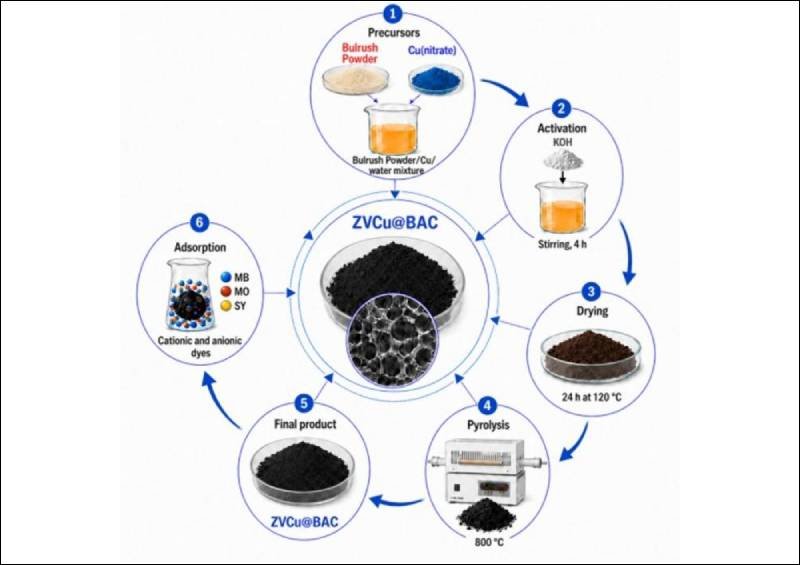
Researchers at Doshisha University, Japan, have developed a reusable adsorbent from bullrush agricultural waste that can remove both cationic and anionic synthetic dyes from industrial wastewater. The researchers developed a zero-valent copper nanoparticle-enhanced bullrush activated carbon composite (ZVCu@BAC) through a single-step co-pyrolysis process. Laboratory tests