Premier Fine Linens: Powerhouse Of Innovation

From its humble beginnings in 1945 as a spinning mill in Coimbatore, Premier Fine Linens has evolved into a powerhouse of innovation in the global home textiles industry. With quiet consistency and firm resolve, this family-owned yet professionally managed enterprise has built an enviable reputation in sustainability, automation and inclusive employment.

Shanthi Srinivasan, Managing Director, Premier Fine Linens
The Beginnings
Premier’s journey started from a single-floor spinning facility with over 100,000 spindles under one roof, still operational and maintained with modern efficiency. Premier was at one point engaged in multiple ventures beyond textiles, including sanitary napkins, distilleries and garments. However, the management, guided by a clear long-term vision, focused its efforts around textiles, a decision that laid the foundation for what would become a globally competitive brand.
With an 80-year legacy, the Premier Group and an impeccable track record of innovation, commitment to quality and customer-centric approach. Premier Fine Linens is redefining industry standards by creating industry benchmarks for home and hospitality textiles sector. Under the able and visionary stewardship of Managing Director Shanthi Srinivasan, the company has maintained its legacy of traditional craftsmanship even while growing to become a dominant player in the global home textile industry, both in the hospitality and retail sectors. “The fusion of tradition with technology keeps us innovative while honouring our heritage,” avers Shanthi Srinivasan (Click Here to Read full interview)

Dr. T. Kumaravel, Senior Vice President – Sales & Marketing, Premier Fine Linens
Premier’s first foray into exports began with fabrics in 1996, coinciding with the European market’s shift away from in-house processing in favour of outsourcing to environmentally compliant partners. But it was not long before the company decided to forward-integrate first by setting up a small made-ups division, then by moving into the complete bed linen product segment by setting up a state-of-the-art processing facility that is one of the largest wide width process houses in South India. “Around 2002-2003, we took a strategic decision to go beyond fabrics. That’s when our journey into finished articles like bed sheets, fitted sheets and pillowcases began,” informs Dr. T. Kumaravel, Senior Vice President – Sales & Marketing (Click Here to Read full interview)
In terms of market strategy, Premier maintains a multi-tiered approach. About 65% of its exports go to the United States, but the company is rapidly expanding into the UK and EU, taking advantage of new Free Trade Agreements. Europe, Middle East, Oceania, Africa and Russia are all key focus areas for the company, each with their own dedicated teams and region-specific strategies.
Today, Premier Fine Linens has a turnover of USD 50 million out of the group’s turnover of USD 250 million, with its business spanning across 25 countries.

Diverse Product Portfolio
The company’s diverse portfolio of branded products meets the discerning tastes, preferences and choices of customers worldwide. Its range of high class and quality products include Ecora, the company’s organic product category available in a wide range of weaves, textures and designs, ranging from sateen, percale, yarn-dyed, dobby, jacquards and matelasse. Ecora’s beautifully crafted bed linen is certified by ‘Control union certifications’, of the Global Organic Textile Standards.
 Premier’s Nanosil uses the power of silver to bring long-lasting antimicrobial properties to bed linen. This unique patented technology contains ultra-fine silver nanoparticles that release silver ions at a controlled rate when bacterial presence is detected.
The company’s Ultra-Fine Cotton is a blend of exceptionally long staple cotton which has a natural characteristic of fineness and is incredibly silky, soft and light-weight.
Premier’s Suvin is a unique blend of cotton that is considered as one of the best cottons in the world. It was developed in the 70s by crossing Sujatha (Indian Cotton) and St. Vincent (Sea Island Cotton) and has no parallel or alternative in the world today.
The company’s Pure Naturals product is manufactured from conventional cotton with no dyes or chemical additives. The entire manufacturing process uses green energy from windmills.
The company’s Linacel is a blend of linen and cellulosic fibres like lyocell or tencel. Linacel is available in a wide range of weaves, textures and designs ranging from sateen, percale, yarn dyed, dobby and jacquards.
Sine Cera has been developed very consciously without use of any bleaching or dyeing nor any harsh chemicals in the process. This unique process reduces the water and electricity consumption substantially.
Another game-changing innovation is Oxy-Wash, a low-water, steam-based wash process that reduces water usage by up to 80% compared to conventional methods, offering an eco-friendly alternative to garment washing.
The certifications tell their own story. Premier is among the first Indian companies to earn the “Made in Green” certification from OEKO-TEX, a label that verifies the product was manufactured in environmentally friendly facilities and under socially responsible working conditions. The company is also certified for Supima, Egyptian and organic cotton and is now working with the Indian government’s Kasturi Cotton brand.
As online business began to take a larger share of the retail market, the company was quick to move with the changing times and successfully launched its own e-commerce brand Blue Dahlia for discerning customers. Blue Dahlia offers top-grade linens on platforms like Amazon and Myntra. Westbrooke Linens, focused on the U.S. market, sells through Amazon and other digital outlets.
Fully Integrated Operation
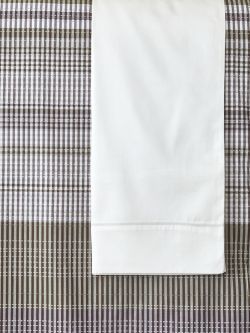 Premier Fine Linens is a fully integrated operation encompassing four manufacturing divisions. The company has built world-class infrastructure, a weaving unit, a state-of-the-art processing facility and two separate made-ups units, including one that is fully automated and located just minutes away from the Coimbatore airport. Here, European machinery largely from Germany and Switzerland works in perfect sync with Japanese embroidery machines like Tajima to deliver precision and speed.
At 4,00,000 spindles, the company has one of the highly efficient and modern spinning capacities in the industry, with yarn counts ranging from 20s to 240/2 yarns. Premier uses the finest of Indian, Supima, Egyptian, Organic, Suvin and BCI cotton to produce superior quality of yarn.
The company has weaving capacity of over 2 million metres per month in wide and narrow width fabrics. It is specialized in yarn-dyed, jacquards, dobbys, percales, sateens, twills and matelassé.
Premier has a processing capacity of 5 million metres per month in wide and narrow width fabrics. Empowered by a highly skilled workforce who ensure to achieve a great finish on the fabrics using state-of-the-art machinery from Osthoff, Benninger, Menzil, Kusters, Montforts and Mahlo.
The company is equipped with machinery from Fongs with yarn dyeing capacity of over 75000 kg per month producing bleached, vat and reactive dyed. This capacity provides excellent support in creating various yarn dyed fabrics in Dobbies and Jacquards.
The company’s factory is equipped with five 18 head embroidery machines from KSM, Switzerland and Tajima, Japan. Apart from embroidery, the expertise also extends to various other embellishments like picotting, multiple pleating, marrowing, laces, etc. Premier continues to expand embroidery, adding multi-head Tajima machines to its fleet, ensuring scalability and consistent output quality for export markets.
The factory has a sewing capacity of 750,000 sheet sets per month with SMART and ETON line management systems. Other machineries include high precision Durkoff Adler sewing machines from Germany and machines from Juki, Brother, Cornelly and Pegasus.
The company has a quilting and comforter making plant with a capacity of 10,000 pieces per month. It is capable of making single and multi needle designs. Recently, it added a comforter-manufacturing facility equipped with seven new machines for multi-needle quilting, capable of handling various fibre blends such as polyester-tencel, polyester-organic cotton and even cotton-wool mixes. Plans are also underway to build an in-house fibre fill plant to further integrate the comforter value chain.
Discharging Social Responsibility
Technology aside, what truly distinguishes Premier is its decades-long commitment to environmental and social governance well before these became industry mandates. Premier takes its responsibility to the society and the environment seriously and invests in improving society. As early as the late 1980s, the company invested in windmills for power generation. Today, 65% of its energy comes from renewable sources and the goal is to achieve 100% by 2030 by incorporating solar power. The company also runs one of the most advanced effluent treatment plants in the country, operated in partnership with an Italian firm, which recycles more than 99.4% of wastewater. Reducing carbon footprints and establishing corporate policies that benefit the environment remain the company’s CSR goals.
Over $1 million has been spent on various school infrastructure development over the last few years and the company’s efforts continue in that sector. A school for the underprivileged, from Grade 1-8, for 500 students at an estimated cost of USD 700,000 has been kickstarted. This will be a lasting legacy to the students living in poorer communities to access education at a minimum cost.
More than 200 employees benefit from free education every year. The company’s long term association with universities helps to empower women employees through ‘study while working’ programmes through distance education. Additionally, all the children of the employees working for Premier group of companies benefit from an Education Support Program.
Premier Fine Linens provides housing accommodation to nearly 240 families and 2000 single accommodations are provide to its employees. Apart from this, employees are constantly encouraged to attend training workshops to continuously improve their skills to meet a dynamic, state-of-the-art work environment. A specialised training centre with state-of-the-art facilities will be set up in 2026 to empower the employees with a successful upgrade of skills.
Empowering women in the workforce to establish equality has been the long-standing policy of Premier Fine Linens. The company is committed to the growth, development and well-being of its women workforce. Its training facilities offer various courses on finance, women’s health, counselling as well as specialised technical skills to help them be upwardly mobile in the workforce.
More than 65% of the workforce is female, and they benefit from subsidized food, medical care and extensive upskilling opportunities. The company serves more than 4,000 meals a day in a highly hygienic, fully automated canteen that rivals any modern commercial kitchen.
The Path Ahead
Looking ahead, the company is entering a new phase of transformation. In 2021, Premier established a Business Excellence division focused on implementing Industry 4.0 technologies and automation. The team today is taking the company to a whole new level. This includes a fully automated sheet manufacturing line that produces a complete set from raw rolls with minimal human intervention.
New expansions include bringing digital and rotary printing in-house and talks are on with a few manufacturers and also exploring new categories like towels and table linen.
To meet the challenges of highly competitive global markets, Premier Fine Linens continues to upgrade technology and automate manufacturing processes to improve quality and productivity. Continuous improvement, efficiency, integrity and accountability is built into administration and management policies of Premier Fine Linens
At its core, Premier Fine Linens is more than just a textile exporter. It’s a living example of how Indian industry can be modern, sustainable, globally competitive, and yet deeply rooted in values that matter: education, inclusivity and ecological stewardship.
Article by Henry Dsouza, Associate Editor of Textile Insights