Quack Solutions: The Great Humidification Misadventure

The day our boss discovered “Free Energy”!
Every time our boss returned from a visit, we braced ourselves.
Not because he was terrifying — he wasn’t — but because the stories he brought back from other mill bosses were.
Especially the ones he heard on flights.
Those bragging bosses would settle into their seats, adjust their seatbelts, and begin their favourite in‑flight entertainment:
“Let me tell you what we have achieved…”
And our boss, bless him, would absorb every word like a sponge dipped in jealousy. By the time he landed, he would have taken a silent oath to make us achieve the same — or better — no matter what laws of physics stood in the way.
One such “development” he brought back was a gem:
“Energy saving in humidification system!”
The next morning, he called for a meeting.
“I am sorry to understand that we have been wasting electrical energy in our humidification system so far!” he began, circling the topic like a vulture waiting for the right moment to dive.
We sat silently.
One question echoed in all our minds:
“Are we? In what way?”
He continued, “One mill has stopped the return air plant completely and is using fogging inside the departments. They have saved 30% energy!”
His face carried the expression of a man who had just realised he had been losing money for years because he didn’t know about this “innovation.”
For a moment, I wondered if that bragging boss had reinvented thermodynamics.
Or discovered a hidden switch labelled “Free Power.”
Before the fantasy could go further, our mechanical engineer stood up.
“Sir, stopping the return air fan in an adiabatic humidification system is not advisable. The return air fan maintains air balance, distributes humidity evenly, and stabilises pressure. Without it, humidity fluctuates, efficiency drops, and the entire system becomes unstable.”
It was a calm, technical, perfectly logical explanation.
Our boss listened politely and then delivered the classic managerial knockout:
“When one mill is doing it successfully, why can’t you try? And anyway, the pneumafil suction will remove the hot air, no?”
Argument over. The boss is always right. We implemented his idea. And initially, nothing catastrophic happened. Management was thrilled to see the electricity bill drop. But nature was quietly sharpening her claws.
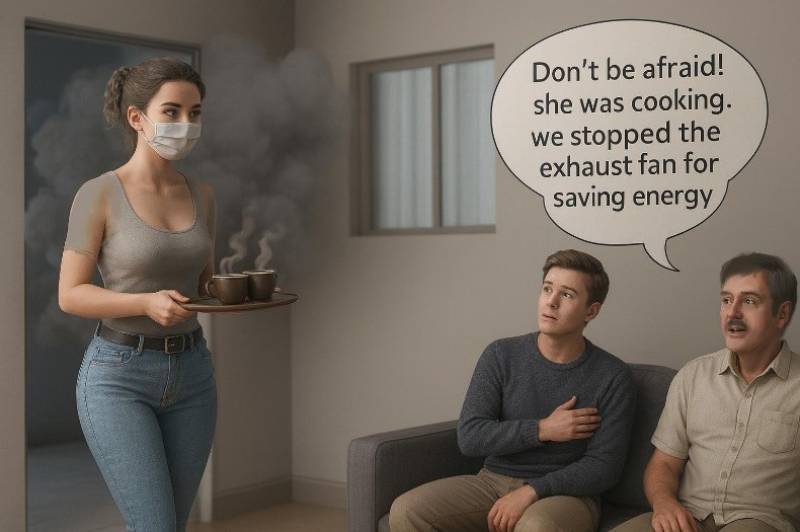
THE SITUATION AFTER SOME TIME
When I entered the department one day, the entrance doors were wide open — apparently another “energy-saving feature.” Why waste calories pushing doors when the wind can do it?
The moment I stepped inside, a blast of hot outside air hit me so hard I nearly grabbed a ring frame to avoid being blown back to the parking lot. I ducked behind a machine like a soldier dodging enemy fire.
Every window was open.
A female worker battled the airstream, her bobbins bobbing like boats in a cyclone.
A male worker stood in the breeze, arms spread, enjoying his personal Ooty moment.
As I walked along the ring frame, droplets hit my face.
“Water!” I yelped, looking up for a leak.
No leak.
Just the fogging nozzle enthusiastically converting the department into a tropical rainforest!
Maybe the nozzle pores were choked, I thought.
But no — this was intentional.
Why use a proper humidification plant when you can create your own monsoon?
Cotton flies swirled around me like mosquitoes at a summer wedding.
Fluff decorated the creel bars and spindle beams like Christmas ornaments.
Temperature and humidity fluctuated along the machine, like turbulence on a flight.
A drenched worker walked past — either sweating or freshly baptised by the fog system — and immediately stood in the airstream to dry off.
I escaped to the QC lab.
The QC in charge sat frozen, staring at the computer monitor, as if it owed him money.
“Any problem?” I asked.
He jumped up.
“Yes, sir… classimat faults are increasing. Yarn variation is rising.”
Not good.
Not good at all.
Before I could respond, the production in charge stormed in.
“Sir, we cannot continue like this. Workers are complaining about the heat. Machines are performing poorly.”
I knew the reason — poor climate control.
But I couldn’t go against the boss.
So I allowed him to add more workers to manage the chaos.
But chaos doesn’t stay hidden for long.
Soon, the management saw the truth:
Higher quality claims.
Higher wages.
Lower productivity.
We immediately restored the original humidification system.
THE LESSON
After that, our boss never again entertained quack solutions from people who knew just enough to be dangerous.
Pseudo‑experts often brag loudly, but they don’t understand system interactions.
Their half‑knowledge can tempt even experienced managers.
But it is our responsibility to think holistically, evaluate carefully, and consult real experts before making decisions that affect quality, people and performance.
Because in a textile mill — as in life — shortcuts rarely save energy.
They usually create heat.