Removal of QCOs: A Big Relief For Textile Industry & A Step Towards Competitive Growth

By prioritizing ease of doing business and reducing input costs, the move to rescind QCOs strengthens India’s global trade credibility and sets the stage for faster growth, greater innovation and more inclusive development, writes Sandeep Dangi, BE (Tex. Technology), MBA
In a landmark decision welcomed across India’s manufacturing sectors, the Government of India has withdrawn Quality Control Orders (QCOs) on key raw materials used in the textile, chemical, and polymer industries.
The move, announced on November 12, 2025 by the Ministry of Chemicals and Fertilizers, covers 14 products, including:
- Purified Terephthalic Acid (PTA)
- Mono Ethylene Glycol (MEG)
- Polyester Yarns and Fibres (POY, FDY, PSF, IDY)
- Polyethylene (PE), Polypropylene (PP), Polyvinyl Chloride (PVC)
- Acrylonitrile Butadiene Styrene (ABS), Polycarbonate (PC), and Polyurethane (PU)
Industry experts have hailed this decision as a transformative step that will lower raw material costs, improve supply availability, and make Indian manufacturing globally competitive.
International trade dynamics had always been complex to understand. And when it came to protecting domestic industries, every country does it, irrespective of its declared ideology, capitalist or communist, free-trade or protectionist.
This had been brought into sharp focus when the Trump administration began its investigation into the high tariffs charged by several countries on American goods. The U.S. had especially focused on China, Mexico, Canada and of course, India. President Trump has repeatedly described India as a Tariff King and one of the key offenders in maintaining high duties on imported goods.
Tariffs had long been a well-accepted and familiar tool for controlling imports and determining what could or could not enter a country. However, many had not realized that there was another way of managing imports, through non-tariff barriers. The Government of India had used them extensively as a means of restricting or banning the import of certain goods. Until now.
One such tool had been the QCO — Quality Control Order, which Government of India had applied in sectors such as chemicals, footwear, and textiles. Executed and monitored by the Bureau of Indian Standards (BIS), QCOs had become an effective means of controlling unwanted imports into the country over the years.
So how did it work? QCOs had mandated specific quality standards for certain products, requiring manufacturers to comply with these standards before selling their goods in India. On paper, this had appeared to be a positive step toward maintaining product quality in the Indian market. But in practice, it had often been used to restrict imports from certain countries and companies.
For any company that wished to sell in India, it had been essential to obtain a BIS certification proving that the products listed under a QCO conformed to the prescribed Indian standards. Since most international companies were already accustomed to high-quality norms, this should have been straightforward, they should have been able to secure BIS certification without difficulty. So what had stopped them from exporting to India?
The answer lay in the BIS certification process itself. Any company seeking BIS certification had to navigate a long list of formalities and procedural hurdles. The BIS granted its specially designed ISI mark to overseas applicants or foreign manufacturers under the Foreign Manufacturers Certification Scheme (FMCS), ideally within six months.
First, foreign manufacturers had to set up a branch office in India with all necessary permissions and nominate a local agent. Next, they had to submit the BIS registration application in the prescribed format, along with supporting documents and fees. The BIS would then conduct a preliminary inspection of the product at the applicant’s manufacturing and testing units and collect samples for independent testing. Finally, if BIS officials were satisfied that the product met the required standards, the certification would be granted.
However, the real issue had emerged in the phrase “Preliminary inspection of the product at the applicant’s manufacturing and testing unit.” If BIS officials did not conduct this preliminary inspection in time, the entire application would remain stalled indefinitely.
This had been precisely what exporters of yarns, fibres, and fabrics from specific countries and companies had faced. In the absence of BIS certification, they had been unable to export their products to India. The result had been clear, these restrictive QCOs had protected certain domestic manufacturers, allowing them to sell their costlier products in the Indian market without the threat of cheaper foreign competition. But all this changes now.
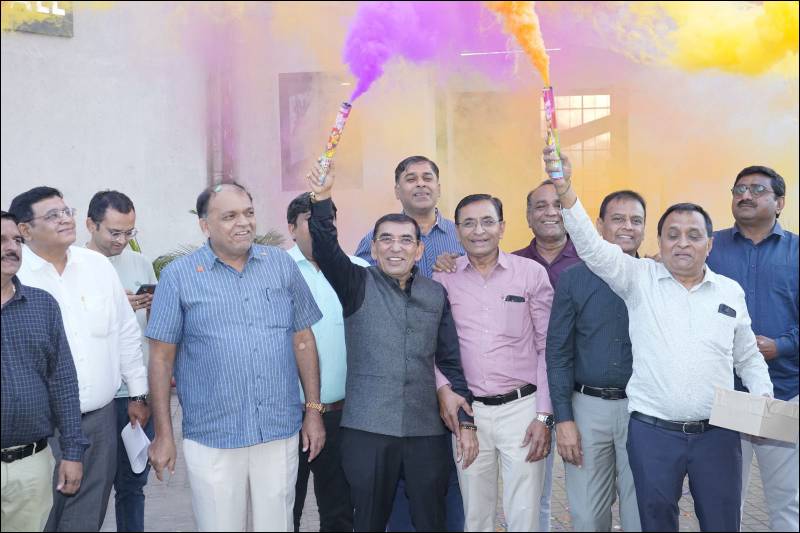
Ashok Jirawala, President, Federation of Gujarat Weavers’ Welfare Association (FOGWA) and Vice President, SGCCI and chamber officials celebrate rollback of QCO order
A Long-Awaited Relief for Surat and India’s Textile Sector
Surat, India’s man-made fibre (MMF) hub, which accounts for over 60% of the country’s polyester-based textile production, has reacted positively to the decision.
“This move will bring major relief to Surat’s textile entrepreneurs. The withdrawal of QCOs on polyester raw materials will help stabilize yarn prices and reduce input costs,”
said Ashok Jirawala, President, Federation of Gujarat Weavers’ Welfare Association (FOGWA) and Vice President, SGCCI.
The QCOs had made it difficult to import high-quality and specialty yarns from China, Taiwan and Korea, materials that are critical for innovative fabrics and value-added garments. With their removal, the industry expects a direct reduction of Rs 20-25 per kg in polyester yarn prices within days.

Bharat Gandhi, Chairman of FIASWI.
“Now, the 30% shortfall in yarn imported from China will be overcome by the fabric manufacturers.” said Mayur Golwala, Secretary of Sachin Industrial Association. He added that the removal of QCOs would immediately ease working capital pressures and restore smooth availability of raw materials, particularly for MSMEs engaged in powerloom weaving and fabric processing.
Echoing this sentiment, Bharat Gandhi, a senior textile leader and Chairman of FIASWI said: “The government’s decision to revoke these QCOs is a welcome and much-needed reform for the Surat textile industry. It will revive hundreds of small and medium enterprises that were unable to afford high-cost domestic yarns. BIS certification should never become a hurdle for business, it must remain a facilitator. We will try that there is no BIS implemented on textile machinery too.”
Why QCOs Became a Challenge
Originally intended to ensure quality compliance under the Bureau of Indian Standards (BIS), the QCO regime had evolved into a non-tariff barrier restricting imports. Foreign suppliers were required to secure BIS licenses involving long approval cycles, factory inspections and extensive documentation, a process that in practice stalled many global manufacturers from supplying to India.
This created an artificial shortage of essential inputs like PTA, MEG, and polyester yarns, forcing domestic downstream industries to rely on higher-priced local suppliers, leading to a significant rise in fabric and garment costs.
Economic and Policy Significance
The decision aligns with India’s broader Ease of Doing Business and Make in India objectives.
By ensuring that raw materials are available at internationally competitive prices, the policy will help the weaving, knitting, and apparel sectors enhance exports and invest in innovation.
Industry analysts also point out that this reform will help India’s Free Trade Agreement (FTA) negotiations with the European Union and United States, both of which had raised concerns about India’s non-tariff trade barriers.

Mohan Kamlani
Immediate Market Impact
Textile traders in Surat expect a sharp decline in polyester yarn prices within just a few days of the announcement. Import of yarn and other textile raw materials and intermediates had reduced to a trickle, especially from China. But we expect a major surge in coming months.
“Orders have already been placed with frontline polyester yarn suppliers from abroad by major Indian weavers and purchase houses. Most have their order books full for next one month. We expect that second line spinners too will face a surge in demand in coming days. Domestic yarn prices will come down and imported yarn prices will go up to meet midway,” said Mohan Kamlani, a major yarn importer. Manufacturers believe this price drop will soon reflect in lower fabric costs, helping the city’s weaving and garment industries regain momentum in both domestic and export markets. This will also help the Indian textile industry to regain its competitive edge in export markets.
The Way Forward
While the government’s commitment to maintaining product quality remains intact, industry leaders have emphasized the need for streamlined certification and inspection processes to prevent future trade disruptions. Quality control is essential, but it must be implemented with efficiency and transparency. The focus should be on empowering industry, not restricting it.
Experts suggest that the government may, in future, reintroduce QCOs selectively, especially for finished consumer goods rather than raw materials, ensuring both product safety and industrial competitiveness.
The government’s decision to rescind QCOs on key fibre and polymer materials marks a turning point for India’s textile and manufacturing sectors. By prioritizing ease of doing business and reducing input costs, the move strengthens India’s global trade credibility and sets the stage for faster growth, greater innovation and more inclusive development.
As one industry veteran aptly summarized: “This reform is not just about removing restrictions, it’s about restoring India’s confidence in its own industries.”