
Textile Ministry Set To Launch TEEM Scheme To Strengthen Textile Value Chain
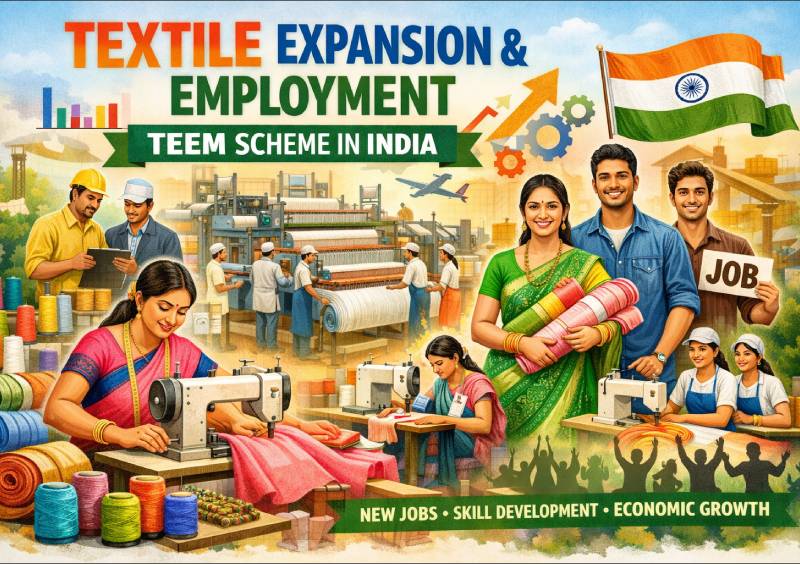
The Union textile ministry is all set to launch the Textile Expansion and Employment (TEEM) scheme. The scheme is part of a larger, five-part strategy – an ‘Integrated Programme for the textile sector’ announced by the Union Finance Minister Nirmala Sitharaman in the Union Budget 2026-27. The integrated programme aims to strengthen the entire value chain, targeting a massive expansion in manufacturing capacity and job creation to meet Vision 2030 goals. India aims to create a US$ 350-billion textile and apparel industry by 2030, including achieving exports worth US$ 100 billion by that period.
The five-part integrated initiative proposed to enhance competitiveness and employment, includes the Textile Expansion and Employment Scheme to modernize traditional clusters with capital support, machinery and technology upgrades as also the National Fibre Scheme to promote self-reliance in raw materials like silk, wool and MMF, Samarth 2.0 for workforce skilling; the National Handloom and Handicraft Programme to support artisans and the Tex-Eco Initiative for sustainable manufacturing.
“The Textile Expansion and Employment Scheme focuses on modernisation of traditional textile clusters through capital support for machinery, technology upgradation and establishment of common testing and certification centres. The scheme, which is expected to be launched soon, is likely to enhance productivity, quality compliance and large-scale employment generation,” says an official.

Dr. Gurudas Aras
“The Textile Expansion and Employment scheme announced by the FM during the Budget seeks to enhance productivity, improve quality compliance and generate large-scale employment. It aims to modernise traditional textile clusters by providing capital support for machinery, technology upgrades and common testing centres. By promoting the growth of the sector, the scheme aims to create significant, high-quality job opportunities. The scheme will help the industry in becoming more competitive through technological advancements. As a result of all these benefits, the scheme will strengthen India’s position as a global textile manufacturing and export hub,” states Dr. Gurudas Aras, independent Director & Strategic Advisor.
The Union textiles ministry recently convened the first post-budget national industry consultation at Vanijya Bhawan, New Delhi, bringing together senior government officials, industry leaders, financial institutions, development partners and representatives from across the textile value chain to deliberate on implementation priorities following the Union Budget 2026 announcements. The consultation focused on operationalising two key initiatives the Textile Expansion and Employment (TEEM) Scheme as also the Tex Eco Initiative – aimed at strengthening competitiveness, modernisation, sustainability and employment generation across the textile and apparel sector.
Rohit Kansal
While delivering the welcome and context-setting address, Rohit Kansal, Additional Secretary (Textiles), said that the Union Budget has been distinctly textile-centric, with a strong focus on employment generation and manufacturing growth. He noted that the announcement of the Integrated Programme for the textile sector provides a comprehensive framework to align investments, policy support and institutional efforts across the value chain. He further underlined that the Budget signals a clear intent to scale manufacturing, strengthen domestic capabilities and position textiles as a key driver of inclusive growth and job creation.
During the consultation, officials of the ministry of textiles highlighted that the TEEM scheme would rest on four pillars: Access to affordable finance, operational excellence, enhancement of the cluster

Ashwin Chandran
ecosystem, and promotion of cluster competitiveness, innovation and branding.
“The entire industry welcomes this proactive move on the part of the Union Textiles Ministry to make the TEEM Scheme operational at the earliest. The scheme has tremendous potential to enhance the competitiveness of India’s textile and apparel sector. It can create more, new and better-quality jobs for our youth, and enable the sector to leverage the opportunities opening through the FTAs. At CITI, we remain committed to collaborating closely with the ministry and other key stakeholders to make this scheme a huge success,” says Ashwin Chandran, Chairman, CITI.

Sanjay Jain
“The five-point textile integrated programme is a great move as, in the background of the various FTAs being signed and the GST realisation, the future of textiles and apparels is much brighter. However, to capitalise on the same, we need a solid manufacturing base for which the textile expansion and employment scheme will go a long way in helping in industry in creating that foundation with that scale to take care of the future opportunities,” states Sanjay Jain, MD, TT Ltd.
As part of the TEEM scheme, the Union ministry would focus actively on addressing six areas: Access to affordable finance, technological obsolescence, limited downstream capacity, high attrition rates & low employee productivity, weak cluster infrastructure, as also branding and market access issues related to power costs, ease of doing business, environmental compliance and cotton price volatility.
Some of the measures also being contemplated by the Ministry of Textiles include: Unlocking low-cost global funding for on-lending to textile and apparel entities intermediated by financial institutions, providing various subsidies and incentives to drive operational excellence, including employment incentives; establishing textile Seva Kendras to serve as local-level integrated support services for textile and apparel businesses as also supporting tech-driven start-ups and innovation pilots demonstrating textile and apparel use cases.