‘We Design Water Treatment Systems To Be Inherently Efficient Using Best Engineering Practices’
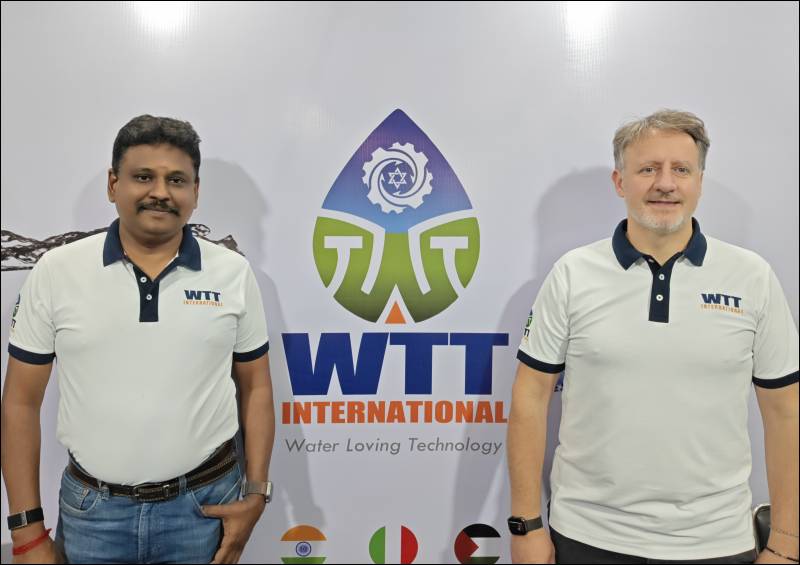
In this exclusive interview with Henry Dsouza, Associate editor of Textile Insights, WTT International’s D. Venkatesh talks about the paradigm shift in the mindset of textile industry players wrought about by their innovative and cost-effective ZLD systems, while Andrea Pelissero, speaks about the company’s plans to establish a global footprint, moving from South Asia to Africa, the Middle East, and the Americas in the near future
WTT International has built its reputation on sustainability-driven innovation. How would you describe the company’s mission and its evolution since inception?
Venkatesh: We began as a typical solution provider, much like many others in the field. In our early years, we partnered with an Italian expert who brought deep technical experience, which helped us penetrate the market effectively and achieve considerable success.
Our real transformation began when industries started adopting Zero Liquid Discharge (ZLD) systems. We initially supplied ZLD plants knowing only theoretically what operational challenges lay ahead, but lacked practical exposure- As that was the first ever time ZLD for Textile Effluent is done in India. That changed when we decided to run and operate the plants ourselves. By doing so, we gained firsthand insight into the problems, and naturally, solving those problems led me toward innovation.
It started with small adjustments and improvements, but over time innovation became my passion. ZLD was often considered expensive, both in terms of investment and operation. While equipment costs are unavoidable, our goal became clear to make ZLD operation as affordable as possible. Every innovation we’ve developed has been directed toward this vision of achieving zero liquid discharge at near-zero operational cost.
Today, we’ve reduced total ZLD operational costs to around Rs 80-90 per m3 of feed water. When you factor in reduced freshwater intake and the reuse of recovered salts, we’ve effectively neutralized much of the operational expenses.
Have these innovations led to any notable breakthroughs?
Venkatesh: Yes, absolutely. For instance, one of our recent successes is with Bhilwara Spinners, where we installed our advanced 97% recovery RO system. The plant now consistently achieves 97% recovery in a single skid, a benchmark result that reflects how far we’ve come in optimizing both performance and cost-efficiency.
There is often a perception that ZLD systems are prohibitively expensive and that the return on investment is not justifiable. But given your experience and recent innovations, how would you explain the real cost dynamics and savings potential of ZLD compared to traditional discharge systems?
Venkatesh: That’s a very important point, most people immediately talk about ROI when it comes to ZLD. But, in our case, we’re not talking about investment recovery, we’re talking about operational costs, the day-to-day cost of running a plant. When you compare a ZLD system with a conventional discharge system, the operational economics tell a very different story.
In a typical discharge plant, industries spend around Rs 30–35 per kilolitre just to meet discharge norms, controlling parameters like COD and Colour. Even then, many plants still struggle to meet these limits. On the other hand, the cost of freshwater itself is rising sharply. The industry pays an average of Rs 60 per kilolitre across India, Rs 85 in Tirupur and similar levels in Rajasthan. In some areas, companies even have to transport freshwater by truck, which makes it even more expensive.
Now, if you take Rs 60 as the cost of freshwater and another Rs 20 for the salt that we recover and return to the user, our operational cost is already balanced. Essentially, our ZLD systems pay for themselves in running cost terms, not through ROI on equipment, but through operational efficiency and savings.
We achieve this not by adding expensive new systems but through innovation within the process. We design systems to be inherently efficient, using the best engineering practices, high-performance pumps and optimized process sequences. Beyond equipment efficiency, it’s our process design that brings real savings.
For example, biological based ZLD was one of our earliest breakthroughs. We were actually the first company in the world to install a ZLD plant for Textile Effluent treatmernt at Century Yarns and Denim in Indore back in 2004-2005, even before Tirupur adopted the concept. At that time, there were no evaporators, we relied on biological systems, membrane technologies available at that time and Solar Evaporation. We installed nine common treatment plants in Tirupur, based purely on biological treatment when others believed it wasn’t possible without chemical treatment systems. Today, that approach is proven and widely accepted.
Of course, the technology has evolved and today’s ROs and evaporators are far more advanced than those of 20 years ago. In one case, a customer who switched from raw water to our recycled water system reported savings of Rs 21 per kilogramme of fabric, purely because chemical consumption dropped significantly, something even we hadn’t anticipated.
So, yes, the savings go beyond just water or salt; they extend across the entire process chain. And within the water treatment facility itself, our innovations have already made ZLD not just feasible, but sustainably affordable.
During the Tiruppur crisis, when the dyeing units were forced to shut down due to pollution issues, WTT played a key role in helping the industry recover. How did you help transform Tirupur’s wastewater management system, and what specific solutions or models did you introduce?
Venkatesh: That period was truly a turning point, both for Tirupur and for us. When the Zero Liquid Discharge (ZLD) mandate was imposed, neither the industries nor the solution providers had any clear idea of how to implement it. The Tamil Nadu government appointed the Tamil Nadu Water Investment Company (TWIC) to guide the industry and several Common Effluent Treatment Plants (CETPs) were planned.
Initially, most consultants proposed physico-chemical treatment systems, but we knew this approach would fail. Such systems use lime, polymers and iron based chemicals, all of which increases the Operating cost and damage RO membranes. The treated water would never be suitable for reuse. We instead proposed a biological treatment model, which was not only more effective but also reduced operational costs by more than half.
At first, there was resistance, but we demonstrated the difference directly to the units. Eventually, the industry recognized that biological treatment was the only sustainable route. TWIC then asked us to prove it, we built nine CETPs in Tirupur, pioneering biological-based ZLD systems. While others adopted different technologies, today all CETPs in Tirupur operate on biological treatment, proving our model’s long-term viability.
Our approach was simple yet robust: biological treatment as pre-treatment, followed by Pre-filtration (MBR/MF/UF), a degasser system to remove Carbonates and Bicarbonates, all without any colour removal or hardness resins. We eliminated unnecessary chemical steps that added costs but no real value. With this lean setup, we consistently achieved 92–93% recovery, far higher than the 80% industry norm at the time.
Over time, we kept improving. By 2017, through process refinements and selective conditioning, we pushed recovery to 97% and followed by Brine recovery from RO Reject with only 1.5% of the total volume going to evaporation. The remaining salts were separated, purified and reused leaving behind a very less volume of mixed solid sludge.
In short, our innovation transformed Tirupur’s crisis into a model of sustainable industrial water management, proving that ZLD is not only possible, but also economically and operationally viable.
Which of your water treatment technologies are most in demand within the textile industry, and what makes them stand out?
Venkatesh: We currently have two technologies that are generating strong demand in the textile sector. The first is our 97% recovery in single skid RO system, which has drawn a lot of attention because such a high level of recovery had never been achieved before. Even within our own team, there was initial skepticism. But after a series of trials, optimizations and problem-solving, we successfully reached 97% recovery in a single skid, something the industry previously thought was impossible.
The second technology, which I believe will be a real game-changer, is our Caustic Recovery System. It’s still relatively under-promoted, but its potential impact is huge. We’ve completed extensive pilot studies with excellent results and we’re now preparing to roll out a full-scale plant. This technology can completely transform caustic recovery for two major textile applications, mercerizing in cotton processing and weight reduction in polyester and saree production, both of which consume highly concentrated caustic soda.
Given that caustic costs around Rs 40 per kilogramme today, our system can recover and reuse it at an operational cost of just Rs 2-3 per kilogramme, a massive saving. In addition, since the recovered caustic no longer drains into the effluent treatment plant, the wastewater’s pH remains balanced. This eliminates the need for large quantities of acid for neutralization, offering double savings both in chemical cost and in ETP operation.
In short, while our 97% RO system has already set a new performance benchmark, our upcoming Caustic Recovery System has the potential to redefine efficiency and sustainability in textile wet processing.
How does WTT International support its clients after installation across all your solutions? What kind of after-sales and operational services do you provide?
Venkatesh: Customer support has always been a core strength of WTT International. We don’t stop at installation, we stay with the client throughout the plant’s life cycle. We have a dedicated operations and service team with offices in Surat and Rajasthan and our engineers are strategically stationed across India to ensure quick on-site support whenever required.
Most of our plants are now fully online and remotely monitored. We have a 24×7 central monitoring centre that tracks plant performance in real time and provides remote assistance whenever there’s an issue. Even at night, our team is connected to resolve problems immediately – downtime is simply not an option for us.
Beyond technical support, we also handle Operation and Maintenance (O&M) for several plants, currently about six facilities across India. In these cases, the customer only provides the necessary chemicals and consumables, while our team manages the entire operation independently. From ensuring consistent performance to handling breakdowns, everything is managed by WTT to keep the system running round the clock, 365 days a year.
As we expand globally, we’re replicating the same service model. We already have offices in India, Italy and Dubai and a strong network of local representatives and service partners in multiple countries. Many of these partners are well-established engineering agencies, ensuring that our clients, wherever they are, receive the same reliability, responsiveness and technical excellence that define WTT International.
How receptive are Indian textile manufacturers to adopting advanced water treatment technologies such as Ceramic Filtration, MBR or High Recovery RO system? Have you noticed any change in their mindset over time?
Venkatesh: Indian textile manufacturers have become increasingly positive and open-minded toward adopting new technologies. From a customer perspective, there is a clear shift, they are now more focused on longevity, sustainability and operational efficiency rather than just the initial cost of investment.
Earlier there was some hesitation. Many believed that advanced technologies were too expensive or complex to maintain. However, that perception has changed significantly. Today, the market has matured to a much higher level. Manufacturers have realized that while investment cost is a one-time concern, it’s the operational cost that truly determines long-term viability.
Of course, there are still a few who remain cautious and sometimes competitors add confusion by misrepresenting technologies for their own advantage. But overall, the textile industry as a whole has become far more progressive and receptive. They now see innovation as an essential part of remaining competitive, not just a luxury.
In short, the mindset has evolved from ‘Is it affordable?’ to ‘Is it sustainable and efficient in the long run?’ and that’s a very healthy change for the industry.
Which are your key markets at present and are you planning to expand your presence globally particularly in regions like Europe, Africa or the Americas?
Pelissero: Yes, absolutely. That is our next major focus area. In India, WTT International is already well established, but globally we are now in the expansion and exploration phase. As you rightly mentioned, we are actively targeting Europe, Africa, the Indian subcontinent and both Central and South America.
In fact, I recently visited Central America, covering countries like Honduras, Guatemala and El Salvador, where we’ve received very positive responses and several promising inquiries. We expect to commission our first plant in that region very soon.
And outside India, which countries have already adopted WTT’s technologies?
Pelissero: We already have a strong presence in Bangladesh, where WTT systems are running successfully. We are currently manufacturing a plant for Vietnam and discussions are progressing in a few other Southeast Asian markets.
More recently, we’ve seen a surge in demand from Egypt, driven by new trade agreements with the United States and the relocation of textile production from Turkey to Egypt. This shift is creating a strong growth wave in the region and we see great potential to establish a significant presence there.
So, step by step, we’re building a global footprint, moving from South Asia to Africa, the Middle East, and the Americas, with the goal of making WTT’s sustainable water solutions accessible worldwide.