
India–New Zealand FTA Opens New Growth Chapter For Textiles
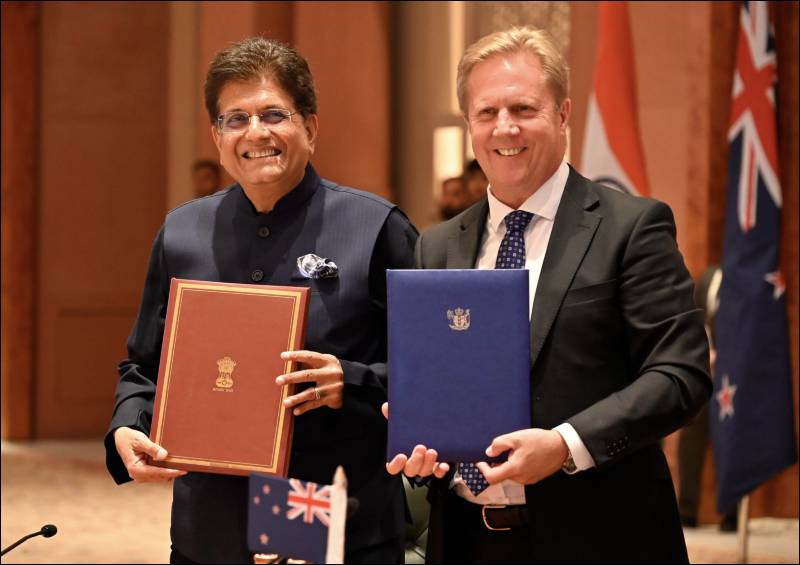
India’s textile and apparel sector is set for a significant export push following the signing of the revolutionary India–New Zealand Free Trade Agreement (FTA), a comprehensive pact that promises to reshape bilateral trade and unlock new opportunities across goods, services, investment and talent mobility. The agreement was signed at Bharat Mandapam by Piyush Goyal and Todd McClay, marking a decisive step in strengthening economic ties between the two nations.
At the heart of the FTA is a game-changing provision: 100 per cent duty-free access for all Indian exports to New Zealand from day one. For India’s labour-intensive textile and apparel sector, this translates into immediate price competitiveness in a high-value, quality-conscious market.
Calling the agreement a defining milestone, Goyal said it aligns with India’s broader vision of building global partnerships that empower MSMEs, farmers, women and youth. McClay described it as a once-in-a-generation opportunity that will boost exports, create jobs and deepen economic engagement.


K. Sakthivel
For the textile industry, the impact is expected to be immediate and far-reaching. K. Sakthivel, Chairman of Powerloom Development and Export Promotion Council (PDEXCIL), termed the FTA a breakthrough moment for the powerloom sector. “The India–New Zealand FTA is a bold and visionary step by the Government of India. For our powerloom industry, the backbone of India’s textile exports, this agreement is a true breakthrough,” he said. “With 100% duty-free access, our weavers, manufacturers and exporters can now enter New Zealand’s market with greater confidence and competitiveness.”

A Sakthivel
Echoing similar optimism, A Sakthivel, Chairman, Apparel Export Promotion Council, highlighted the potential for rapid export growth. “The FTA with New Zealand is going to be very good for the apparel sector. Our exports could increase three to four times within the next two years,” he noted, adding that zero-duty access will significantly benefit labour-intensive segments and MSMEs across the value chain.

Ashwin Chandran
Industry bodies have also underlined the agreement’s strategic importance in diversifying export markets. The Confederation of Indian Textile Industry (CITI) believes the FTA will reduce dependence on a limited set of geographies while supporting India’s ambition of building a US$ 350 billion textile and apparel industry by 2030. “Amid ongoing geopolitical tensions, the signing of this FTA comes as a breath of fresh air for exporters,” said Ashwin Chandran, Chairman of CITI. He emphasised that New Zealand, as a high-income and quality-conscious market, can serve as a benchmark for Indian products in terms of quality and pricing.
Data highlights the opportunity: made-up textile articles were already the fourth-largest category of Indian exports to New Zealand in 2025, valued at NZ$ 80.22 million, indicating strong demand potential that can now be scaled further under duty-free access.
Beyond market access, the FTA also strengthens supply chain integration and long-term collaboration. It includes a US$ 20 billion investment commitment from New Zealand into India over the next 15 years, spanning agriculture, infrastructure, manufacturing, startups and emerging technologies. For the textile sector, this could translate into improved access to capital, advanced technologies and global best practices.
The agreement also opens new pathways for skilled professionals, with 5,000 temporary work visas and expanded post-study work rights for Indian students, enhancing talent mobility and cross-border expertise.
From a product perspective, segments such as sustainable textiles, home textiles and technical textiles are expected to see strong traction. Additionally, New Zealand’s strength as a global supplier of premium wool presents an opportunity for Indian manufacturers to source high-quality raw materials and produce value-added garments for export.

Vijay Agarwal
Industry leaders have also pointed to the broader implications for global competitiveness. Vijay Agarwal, Chairman of TEXPROCIL, said, “The agreement will enhance India’s global positioning, boost exports and generate employment, particularly for women and youth, while reinforcing the country’s role in global value chains.”

Suketu Shah
From the perspective of manufacturers, Suketu Shah, CEO, Vishal Fabrics Ltd., highlighted the untapped potential of the New Zealand market. “This pact empowers Indian textile manufacturers to leverage their superior quality for greater global reach. It opens new growth avenues for value-added exports and strengthens competitiveness,” he said.
The Handloom Export Promotion Council also welcomed the agreement, noting that it will create new opportunities for handloom exports and deepen India’s engagement with high-value international markets.
With bilateral trade currently estimated at around US$ 2.4 billion, the FTA is expected to significantly accelerate trade flows, enhance market access and position India more strongly within global value chains. For the textile and apparel sector, already one of the country’s largest employers and export contributors, the agreement comes at a critical time, offering both stability and expansion in an increasingly uncertain global trade environment.
As India continues to sign strategic trade agreements, the India–New Zealand FTA stands out as a high-impact deal, one that not only opens a new market, but also reinforces the sector’s shift towards value addition, diversification and global competitiveness.