
Handloom Hackathon 2026 Showcases Innovation To Transform India’s Handloom Sector
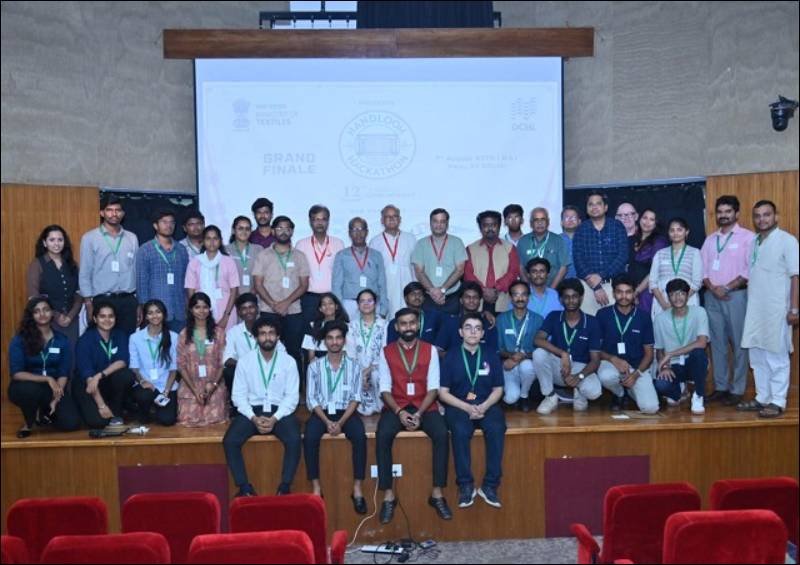
The Handloom Hackathon 2026, a nationwide innovation initiative organized by the Office of the Development Commissioner for Handlooms under the Ministry of Textiles, concluded successfully at the Research and Innovation Park, IIT Delhi. Conceptualized by ThinkStartup, the competition attracted over 2,500 participants, with 280 finalists from the top 100 shortlisted teams presenting technology-led solutions aimed at modernizing and strengthening India’s handloom ecosystem.
The hackathon served as a national platform for innovators, researchers, academicians and industry experts to address key challenges related to loom modernization, design innovation, sustainability, market access and weaver livelihoods. The shortlisted teams showcased practical solutions designed to improve productivity, preserve traditional craftsmanship and enhance the global competitiveness of India’s handloom sector.
Addressing the gathering, Dr. M. Beena, IAS, Development Commissioner (Handlooms), emphasized the need to integrate technology with India’s rich handloom heritage. She highlighted the sector’s inherent sustainability and stressed the importance of innovation in loom processes, design development and marketing. Dr. Beena also highlighted the Indian Handmade Portal, which enables weavers to access global markets directly without intermediaries.

Winners Across Four Key Themes
The competition recognized innovative solutions across four thematic categories:
- Weaver Livelihoods & Financial Inclusion: VIZHI – AI Powered Trend Forecasting App by Madeshwaraboobalan V and Srinidhi B (IIHT Salem), which uses AI to forecast market trends and help weavers make informed production decisions.
- Market Access & Digital Integration: Sutradhar by Atharv Sanjeev Kumar and Gurkirat Singh (IIT Madras), designed to connect rural weavers directly with global buyers.
- Sustainability & Environmental Impact: Savinya by Naveen Goyal, Mahak Goyal and Ritu Devi (Savinya Studio), which integrates sustainability and circular economy principles throughout the handloom value chain.
- Innovation in Design & Operations: Weaver Mithra Back Support System by Sriram Vaggu and Adigoppula Vishal (KLB IIHT Hyderabad), addressing occupational health challenges faced by weavers.
Strengthening Industry-Academia Collaboration
The event underscored the importance of collaboration between academia, industry and government in advancing the handloom sector. Dr. Deepti Gupta, Head of the Department of Textile and Fibre Engineering at IIT Delhi, announced the proposed Centre of Excellence for Handloom Technology at IIT Delhi, to be established in collaboration with the Ministry of Textiles. The centre is expected to focus on technology integration, productivity enhancement and standardization while preserving the uniqueness of handcrafted textiles.
Sanjeeva Shivesh, Co-founder of ThinkStartup and Program Director of the Handloom Hackathon 2026 Organising Committee, described the initiative as a milestone in driving social and economic impact for India’s weavers. He noted that the winning solutions demonstrate how innovation can preserve heritage while creating new opportunities for growth and market access.
Pathway to Commercialization
The Ministry of Textiles has committed to providing one year of incubation support to investor-ready participants, helping promising innovations move from concept to commercialization. The initiative aims to build a modern, innovation-driven image for India’s handloom sector while ensuring that breakthrough solutions deliver tangible benefits to weaver communities.
The successful conclusion of Handloom Hackathon 2026 marks another significant step toward building a technology-enabled, sustainable and globally competitive handloom ecosystem, reinforcing the Ministry’s vision of empowering India’s weavers through innovation and collaboration.