Traceability Becomes A Market Requirement: OEKO-TEX
Annual Report 2025/26 highlights sharp growth in certified organic cotton and MADE IN GREEN as regulatory scrutiny of textile supply chains intensifies
Traceability is rapidly moving from a competitive advantage to a requirement for market access as regulatory scrutiny of textile supply chains increases across major markets, according to the OEKO-TEX® Annual Report 2025/2026.
The report highlights growing demand for verifiable information on the origin and production of textile products, driven by new and evolving requirements in the European Union, the US and Canada. For textile and apparel companies, the ability to document a product’s journey from fibre to finished article is becoming increasingly important for meeting customs requirements, responding to regulatory investigations and managing potential trade restrictions.

OEKO-TEX® ORGANIC COTTON has expanded its supply-chain presence to more than 20 countries, reflecting growing demand for traceable organic cotton. More than 33 million kg of OEKO-TEX® ORGANIC COTTON is now covered at the ginning level, while the number of certificates issued during the 2025/26 financial year increased by more than 200% compared with the previous year.
Digitalisation is also playing a growing role in strengthening traceability. OEKO-TEX’s partnership with TextileGenesis is supporting the digital recording of transactions involving OEKO-TEX® ORGANIC COTTON. The token-based technology is designed to reduce administrative requirements across the supply chain while providing a more secure and scalable system for tracking transactions and supporting sustainability claims.
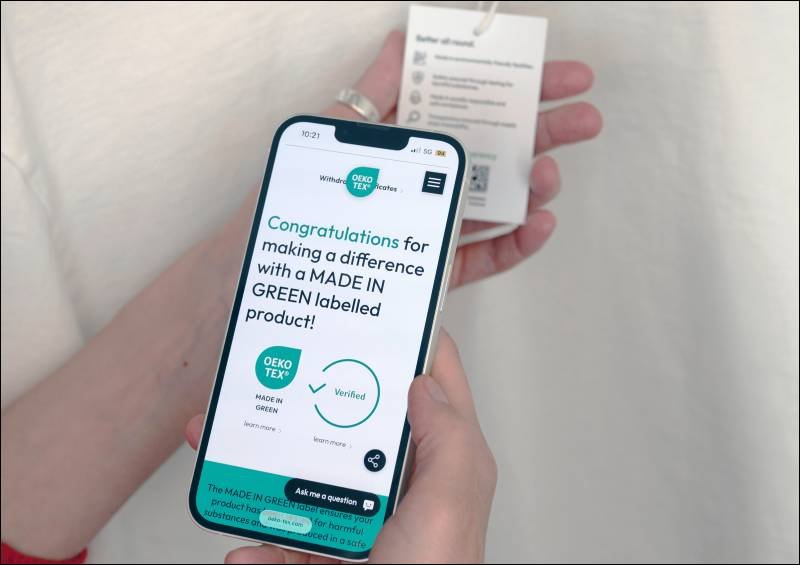
Demand for OEKO-TEX® MADE IN GREEN also increased by more than 13% during the financial year. The label provides verified supply-chain information for textile products, giving brands and consumers greater visibility into where and how products are manufactured.
The growth comes as companies face tighter requirements for substantiating environmental and sustainability claims. From 27 September 2026, the EU Directive on Empowering Consumers for the Green Transition (EmpCo, EU 2024/825) will introduce stricter requirements for sustainability labels, including requirements for labels to be based on certification schemes whose criteria are verified by independent third parties.
OEKO-TEX said its MADE IN GREEN label, along with its other certificates and product labels, will remain compliant with the requirements taking effect under the directive.
“Developments in our industry confirm that trust is becoming our hardest currency,” said Dr Alfred J. Beerli, CEO of OEKO-TEX®. He said increasing regulatory complexity presents an opportunity for companies to demonstrate credible progress through greater transparency rather than simply treating traceability as a compliance exercise.
On the new EU requirements, Beerli added that what becomes law in September 2026 reflects principles that OEKO-TEX has been advocating for more than three decades.
Alongside its continued investment in traceability and digitalisation, OEKO-TEX also increased its focus on product and quality controls during the 2025/26 financial year.
The developments underline a wider shift across the textile and apparel industry, where sustainability claims are increasingly expected to be supported by documented supply-chain data, independent verification and auditable processes. For manufacturers and brands, traceability is therefore becoming less of an additional sustainability credential and more of a critical requirement for regulatory compliance, market access and customer trust.