India Yet To Gain From China+1 Shift In Global Apparel Sourcing
India’s share of global apparel exports remained largely unchanged at around 3% in 2025, despite a significant decline in China’s share over the past 15 years, according to a PL Capital sector report.
China’s share of global apparel exports fell from 36.9% in 2010 to 27.3% in 2025, a decline of 9.6 percentage points. India’s share, meanwhile, slipped marginally from 3.2% to 3% during the same period.
Bangladesh and Vietnam have emerged as major beneficiaries of the shift in global sourcing. Their combined share of world apparel exports increased from around 7% in 2010 to more than 13% in 2025, according to the report.

“The China+1 wave has led to moderation of this share by ~9.6%. This contraction in Chinese export dominance has released US$ 50–60 billion in floating volume into the global sourcing matrix,” PL Capital said in its Textiles Sector Report.
The brokerage attributed the gains of Bangladesh and Vietnam to competitive production costs, trade agreements and integrated manufacturing ecosystems.
India, by comparison, continues to face structural challenges, including fragmented manufacturing capacity and the absence of large integrated hubs covering fibre, fabric and garmenting. Higher cost of capital is another constraint, the report said.
Opportunity From Supply-Chain Diversification
PL Capital said several factors could improve India’s position as global brands diversify sourcing away from China. These include government support through initiatives such as the Production Linked Incentive (PLI) scheme and PM MITRA, along with improved market access through trade agreements.
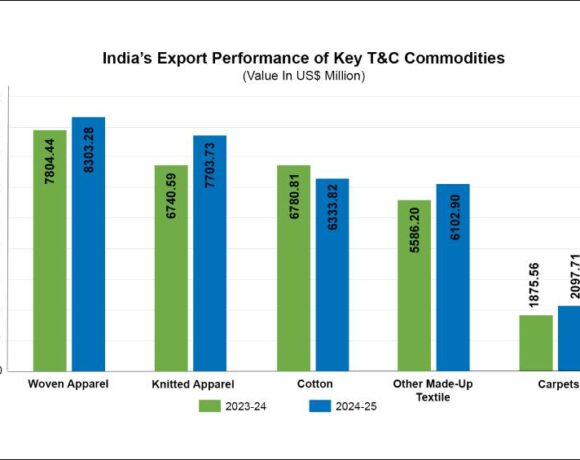
India’s textile and apparel exports stood at around US$37 billion in FY26, with ready-made garments accounting for approximately 44% of the total. India represented around 4% of global textile and apparel exports in 2025, the report said.
However, the brokerage cautioned that the China+1 opportunity may not benefit all Indian textile and apparel companies equally. Global brands are increasingly consolidating their sourcing with fewer suppliers capable of meeting requirements related to scale, reliability, traceability and environmental, social and governance (ESG) compliance.
“Buyers are consolidating vendor lists around partners that can offer capacity, reliability, traceability, ESG compliance and multi-country supply resilience,” PL Capital said.
The report identified scale, fragmented garmenting capacity, longer lead times, limited depth in man-made fibres and slower technology adoption as some of the key challenges facing Indian manufacturers relative to competitors in China, Vietnam and Bangladesh.
Against this backdrop, the next phase of growth in India’s apparel export sector is expected to be shaped by manufacturers that can build larger capacities, integrate supply chains and improve execution and delivery capabilities.
The report suggests that strengthening manufacturing ecosystems and expanding capabilities beyond cotton and other traditional fibres will be important for India to convert the changing global sourcing landscape into sustained export growth.