FICCI TAG 2026: Technology, Scale And FTAs To Drive India’s Textile Export Growth
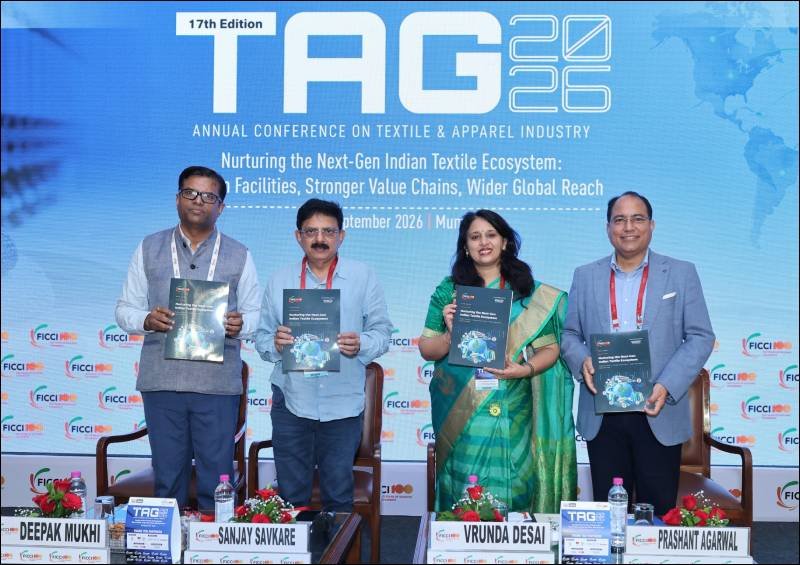
Industry consolidation, collaboration, technology adoption and investments in modern manufacturing infrastructure will be critical to strengthening Maharashtra’s textile exports and India’s global competitiveness, Maharashtra Textile Minister Sanjay Savkare said at the 17th edition of FICCI TAG 2026 in Mumbai.
Held under the theme Nurturing the Next-Gen Indian Textile Ecosystem: Modern Facilities, Stronger Value Chains, Wider Global Reach, the annual FICCI textile industry conference brought together policymakers, industry leaders, manufacturers, exporters, technology providers and other stakeholders to discuss strategies for strengthening India’s textile manufacturing and sourcing ecosystem.
The inaugural session featured Sanjay Savkare, Textile Minister of Maharashtra and Vrunda Manohar Desai, Textile Commissioner, Government of India, who jointly unveiled the FICCI-Wazir Annual Textile Industry Report 2026.

The report examines the evolving textile industry landscape and identifies modernisation, automation, digitalisation, artificial intelligence, sustainable value chains and wider global market access as important priorities for the sector’s next phase of growth.
Addressing the gathering, Savkare highlighted the resilience of India’s textile industry amid changing global trade dynamics and supply chain challenges. He stressed that greater consolidation, collaboration and investment in modern manufacturing infrastructure would be essential to build scale, productivity and competitiveness across the textile value chain.
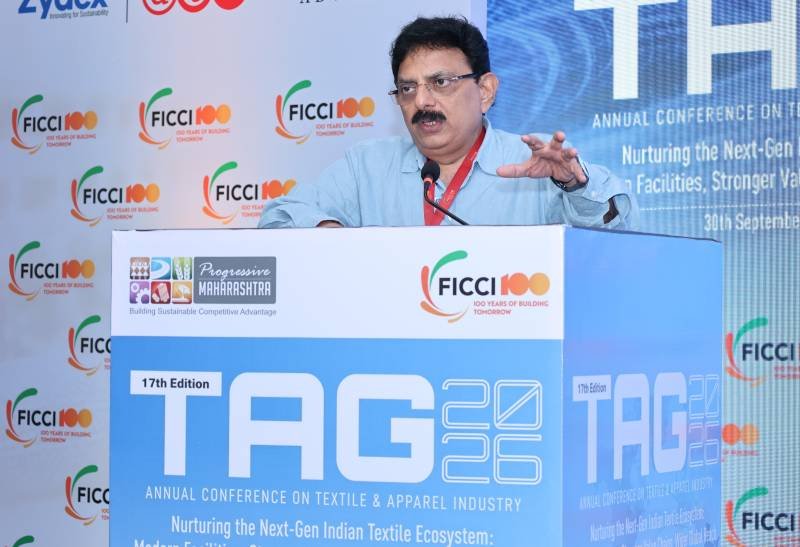
Maharashtra Textile Minister Sanjay Savkare addresses the FICCI TAG 2026 conference in Mumbai.
Desai highlighted the government’s continued focus on strengthening the textile ecosystem through policy interventions and flagship initiatives. She emphasised modernisation, stronger value chains and export competitiveness, while encouraging the industry to leverage opportunities emerging from India’s expanding network of Free Trade Agreements (FTAs).
Presenting the report’s findings, Prashant Agarwal, Managing Director, Wazir Advisors, said automation, digitalisation and artificial intelligence would be among the key drivers of competitiveness and profitability for textile companies in the coming years. He also stressed the need to attract young engineering talent and build innovation-led manufacturing ecosystems.
Focus on Future Factories
The first session, Designing the Future Factories: Scale, Automation, and Data-Driven Operations, examined how Indian textile manufacturers can develop large-scale, globally competitive facilities supported by automation, digital technologies and data-driven decision-making.
Discussions covered productivity improvements across spinning, weaving, processing and garmenting, along with the changing skill requirements of modern textile manufacturing.
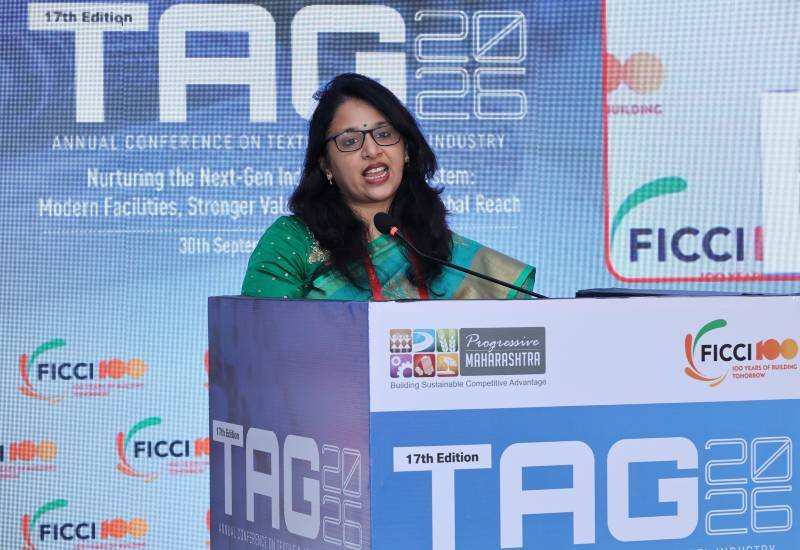
Vrunda Manohar Desai, Textile Commissioner, Government of India, addresses the FICCI TAG 2026 conference in Mumbai.
Sammir Dattani, Executive Director, Sanathan Textiles, emphasised that overcoming barriers to scale through automation and large investments would be important for future growth. Biji Chacko, COO, Alok Industries, highlighted the need to combine automation with skilling across the workforce.
Shaleen Toshniwal, Managing Director, Banswara Syntex, pointed to scale and automation as important elements of sustainable growth, supported by infrastructure such as PM MITRA parks. Debabrata Ghosh, Vice President, Barmag India, highlighted the role of advanced machinery and technology in improving quality and competitiveness in the MMF sector.
Building Sustainable Value Chains
The second session, Farm to Fashion: Stronger & Sustainable Value Chain, focused on developing integrated, resilient and sustainable textile value chains.
Industry experts discussed the need to move towards higher value-added products, strengthen the man-made fibre (MMF) ecosystem and adopt globally accepted sustainability practices. The role of government initiatives, including PM MITRA and PLI, was also discussed.
Panellists highlighted the importance of collaborative infrastructure and common facilities to improve operational efficiency and reduce costs across textile clusters.
Expanding Global Market Access
The third session, Diversifying Market Access: Leveraging FTAs & Exploring New Markets, examined opportunities to expand India’s textile exports through trade agreements and market diversification.
Discussions focused on opportunities arising from the India-UK FTA and the proposed India-EU trade agreement, alongside potential markets in Africa, Latin America, West Asia and Southeast Asia.
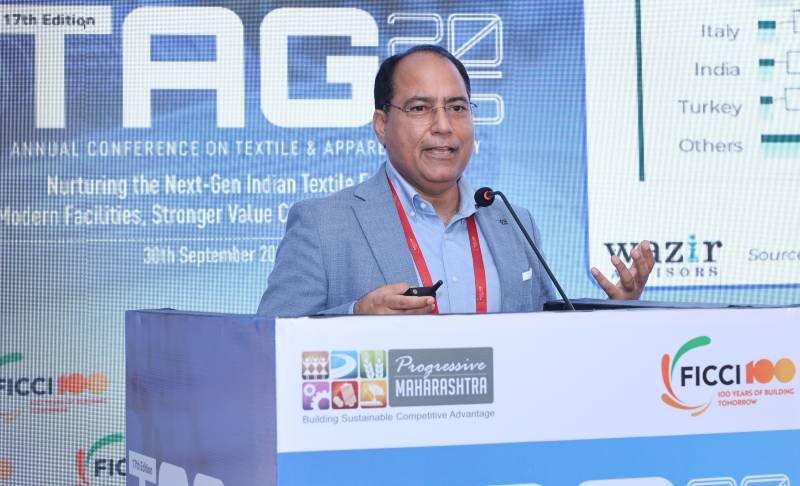
Prashant Agarwal, Managing Director, Wazir Advisors, presents key findings of the FICCI-Wazir Annual Textile Industry Report 2026 at FICCI TAG 2026 in Mumbai.
R K Mishra, Additional DGFT, Directorate General of Foreign Trade, Mumbai, highlighted the implementation of India’s FTAs and their potential to improve market access for Indian exporters. He said that if India’s textile exports double over the next five years, exports to the European Union alone could potentially increase by an estimated USD 7-10 billion.
Mishra also urged textile companies to make greater use of e-commerce channels to access international markets and align production capabilities with evolving global demand.
Kumar Anshuman, General Manager, ECGC Ltd, encouraged textile exporters to leverage ECGC’s support and risk-cover mechanisms for international business.
The discussions at FICCI TAG 2026 highlighted the interconnected role of technology, scale, sustainability, skilled talent, infrastructure and market access in strengthening India’s textile industry. Industry participants stressed that modern manufacturing facilities, resilient value chains and broader export markets will remain central to India’s ambitions of becoming a preferred global textile and apparel sourcing destination.
The conference was supported by the Department of Textiles, Government of Maharashtra, ECGC, Grasim Industries, Revalyu, Barmag, Zydex and A.T.E. Enterprises, with Wazir Advisors as Knowledge Partner.