
Kornit Atlas MATRIX To Bring Single-Step, Multi-Fabric Digital Production To INDIA ITME 2026
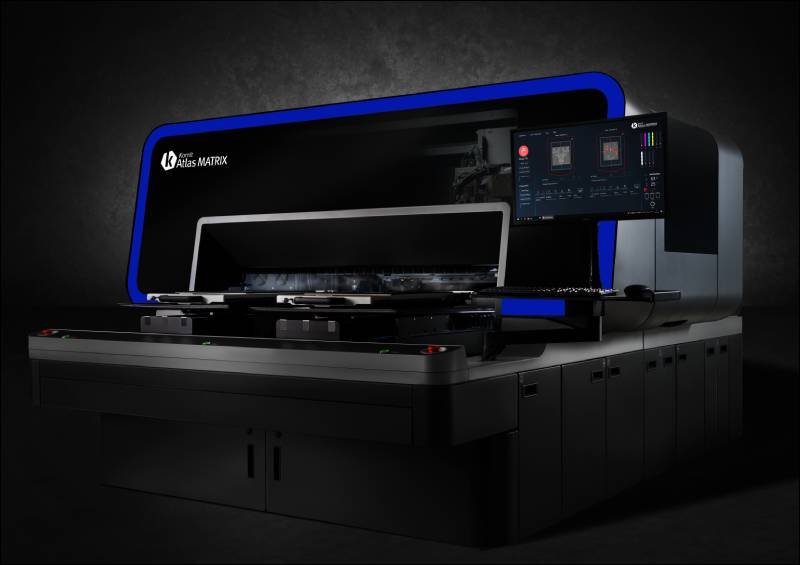
Ahead of INDIA ITME 2026, Kornit Digital demonstrates how single-step digital technology resolves fabric separation, dye migration and inventory risk for Indian garment exporters.
As global apparel sourcing shifts toward shorter lead times and higher fabric diversity, Indian garment exporters and textile manufacturers face a dual challenge: maintaining volume efficiency while responding to rapid style turns.
This will be a relevant theme at INDIA ITME 2026, taking place from 4 to 9 December at the India Expo Centre & Mart in Greater Noida. Kornit Digital will exhibit at Hall 1, Stall H1A14, where it will demonstrate the Kornit Atlas MATRIX live. The system combines direct-to-garment and advanced direct-to-film capabilities across cotton, dyed polyester and blended fabrics.

The Multi-Fabric Production Challenge
Conventional screen printing remains central to Indian apparel manufacturing, particularly for stable designs and predictable high-volume programmes. Its limitations become more apparent when producers face frequent artwork changes, more colorways, lower minimums, urgent replenishment or a broader substrate mix. Separate screens, set-ups and production routes can add time and complexity when job profiles are highly variable.
Polyester presents an additional technical challenge. During curing, dyes in the fabric can migrate into the printed image, affecting colour accuracy, opacity and consistency. This is especially relevant to sportswear, athleisure and performance apparel, where deep-dyed and sublimated polyester fabrics are widely used.
Digital production can complement established manufacturing processes by supporting sampling, short and medium runs, test-and-repeat programmes, personalization and demand-led replenishment. Its practical value, however, depends on whether a platform can deliver industrial consistency across more than one fabric or application category.
One Workflow Across Cotton, Polyester, and Blends
Atlas MATRIX combines Kornit MAX and Karbon technologies within a unified, single-step workflow. Kornit positions the system as media-agnostic, allowing producers to move among cotton, dyed polyester and blends within one production environment. The intention is to reduce the operational separation associated with different fabric categories while supporting fashion, licensed, sportswear and performance applications.
At the centre of its polyester capability is DigiBlocker, Kornit’s proprietary digital ink blocker. Karbon Shield is designed for direct printing on dyed polyester and performance garments, controlling dye migration within the digital process.
Karbon Transfer extends the platform to direct-to-film decoration for complex placements and products such as caps, bags and accessories. For producers combining direct and indirect decoration, the platform is intended to support colour consistency across both methods.
The fluid configuration includes NeoPigment Eco-Rapid ink, DigiBlocker, Intensifier 2.0, and Q.fix 2.0. Intensifier 2.0 is designed to improve wash and rub durability, including performance aligned with JIS 1 and 2 rub-fastness requirements. Q.fix 2.0 supports colour coverage and a softer hand-feel.
Expanded colour configurations include red and green channels for broader colour matching, or neon pink and yellow for higher-impact sports applications. Kornit notes that neon availability remains subject to product timing.
Decorative differentiation is addressed through Kornit XDi technology. XDi can produce dimensional effects that emulate threadless embroidery, high-density printing, vinyl and screen-transfer aesthetics. The XDi Digitizer converts two-dimensional artwork into printable dimensional effects, offering an alternative route to premium decoration.
Automation, Output and Workflow Control
Atlas MATRIX incorporates QualiSet, a machine-vision calibration technology designed to maintain repeatability across jobs, machines and production locations. Automated calibration can reduce routine manual intervention and shorten the time needed to confirm that the system is operating within defined quality parameters.
An optional Rapid Size Shifter allows pallet dimensions to be adjusted without complete pallet replacement, supporting mixed production across garment sizes and applications. Production information can also be monitored through Kornit Konnect, which provides near-real-time and historical performance data.
Published specifications list a maximum print area of 60×90 cm and resolution of up to 1,200 dpi. Output is stated at up to 150 impressions per hour on cotton and 98 on polyester, depending on production conditions. Actual results will vary according to artwork, fabric, print mode, utilisation, labour, consumables and local operating conditions.
Total Cost of Ownership (TCO) therefore extends beyond rated speed. Relevant considerations include the range of orders handled on one platform, job-change time, operator requirements, workflow integration, consistency, rework and access to applications that might otherwise require separate production routes.
Environmental and Compliance Considerations
Atlas MATRIX uses Kornit’s water-based NeoPigment Eco-Rapid pigment ink and integrates printing and treatment into a digital workflow.
The Kornit ecosystem also references Bluesign System Partner status and relevant GOTS, and Eco Passport approvals. Manufacturers should assess applicability according to the specific ink, substrate, process and final-product requirements.
The environmental case for on-demand manufacturing also relates to production planning. Producing closer to confirmed demand can reduce speculative inventory, support smaller replenishment cycles and limit obsolete finished goods. The effect will vary by business model, but it connects resource efficiency with working capital and supply-chain responsiveness.
What Visitors Can Evaluate at INDIA ITME
The live demonstration will allow visitors to examine Atlas MATRIX output across different fabric categories and consider the system in relation to their own production mix.
Areas for evaluation will include dye-migration control, colour performance, hand-feel, durability, dimensional effects, job changeover and the integration of direct printing with transfer-based decoration.
Kornit’s regional team will also be available to discuss workflow integration, target applications, production volumes, commercial considerations and how digital technology may complement established screen-printing and garment-manufacturing infrastructure.
Visit Kornit Digital at INDIA ITME 2026
Dates: 4–9 December 2026
Venue: India Expo Centre & Mart, Greater Noida
Location: Hall 1 | Stall H1A14