
AI Meets Human Ingenuity At ITAMMA Awards
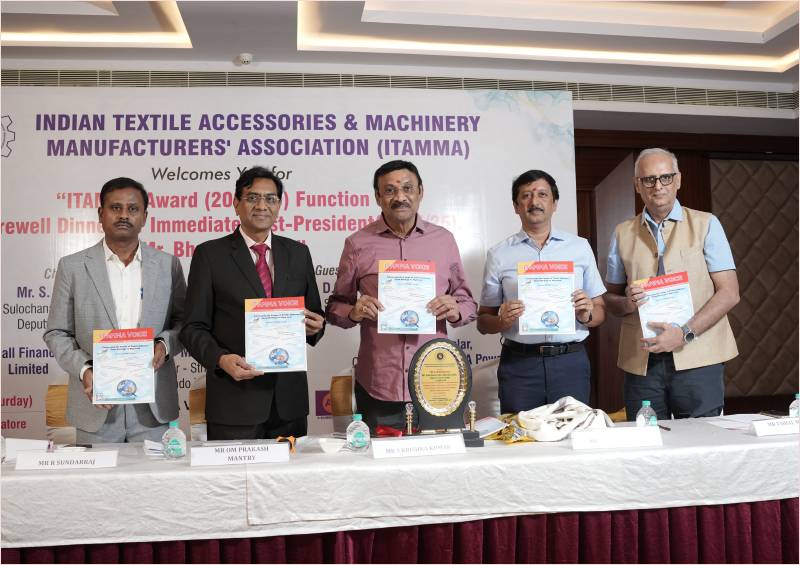
Innovation, resilience and the role of human capital in driving the textile industry forward were the central themes at the ITAMMA Awards 2024–25, held at Jenny’s Club in Coimbatore.
The event brought together key stakeholders from across the textile machinery and manufacturing ecosystem, against the backdrop of global economic uncertainty and evolving trade dynamics.

Omprakash Mantry, President, ITAMMA
In his welcome address, Omprakash Mantry, President of ITAMMA, highlighted the challenging global environment impacting India’s textile sector. He pointed to geopolitical tensions, including disruptions in the Red Sea, inflationary pressures and rising protectionist tariffs, which have collectively constrained exports, tightened margins and reduced order volumes during 2025–26.
He noted that textile exports to the United States are projected to decline by 9–10% in 2026, with hubs such as Tirupur facing estimated revenue losses of around Rs 15,000 crore. Additionally, increased shipping costs due to Red Sea disruptions have slowed trade flows to key markets in Europe and the U.S.
Despite these challenges, Mantry expressed optimism about India’s long-term growth trajectory. With a current global market share of around 4%, the country is targeting US$ 100 billion in textile exports by 2030. This ambition is being supported by the China+1 sourcing strategy, new Free Trade Agreements with the UK and UAE and a strong push towards sustainability and value-added products to meet stringent European regulations.

S. Krishnakumar, MD, Sulochana Cotton Spinning Mills & Deputy Chairman, The Southern India Mills & Association (SIMA)
Delivering the chief guest address, S. Krishnakumar, Managing Director of Sulochana Cotton Spinning Mills and Deputy Chairman of Southern India Mills’ Association, praised ITAMMA and its members for their longstanding contribution to the textile industry since 1948.
He commended the association’s diverse award categories ranging from Make in India initiatives to export excellence which, he said, serve as a strong motivation for industry players to continuously improve performance and competitiveness.
Referring to recent concerns about a slowdown in the sector, Krishnakumar expressed confidence that the Indian textile industry has moved past its most difficult phase and is poised for a return to double-digit growth in the near term.
He highlighted key policy measures announced in the Union Budget 2026–27, including five major schemes aimed at boosting the sector, alongside structural reforms such as the removal of anti-dumping duties on MMF raw materials, rationalisation of GST across the MMF value chain, and the conclusion of major FTAs with the UK, U.S., and EU.
Further, initiatives such as PM MITRA Parks, the PLI scheme, and the National Technical Textiles Mission (NTTM) are expected to accelerate investments and enhance global competitiveness.
Emphasising the need for a forward-looking approach, he stated, “The time has come to perform by way of innovation, taking advantage of Artificial Intelligence and other modern technologies, to make India a global leader in textiles and clothing manufacturing.”
D. Venkadesan, CEO, Sri Jayajothi and company private limited
In a thought-provoking session, guest speaker D. Venkadesan, CEO of Sri Jayajothi and Company Pvt. Ltd., Rajapalayam, delivered a presentation titled Innovation is Not Technology – It is People.
He highlighted that while the industry has increasingly adopted advanced automation and modern machinery, true and sustainable innovation stems from human capital rather than technology alone.
Drawing from his company’s experience as one of India’s large spinning operations with over 70,000 spindles and a diverse yarn portfolio, Venkadesan stressed that innovation is fundamentally a cultural and human-driven process.
He explained that innovation is not merely about introducing new software or equipment, but about fostering a mindset where employees are empowered to take initiative, challenge conventional practices, and solve problems creatively.
“Technology is only a tool,” he noted, adding that without skilled and motivated people, it can become a limitation rather than an enabler. He emphasised that meaningful innovation arises from understanding real-world challenges, improving processes, and encouraging collaboration across teams.
Venkadesan further underlined the importance of leadership in nurturing a culture of continuous improvement, where experience, expertise, and employee engagement drive operational excellence.
The event armored a balanced narrative for the Indian textile industry acknowledging short-term headwinds while remaining optimistic about long-term growth.
With shifting global sourcing patterns, increasing emphasis on sustainability, and supportive policy frameworks, India is well-positioned to expand its footprint in global textile trade. However, industry leaders stressed that overcoming internal challenges such as fragmented manufacturing and infrastructure gaps will be critical.
Ultimately, the consensus at the ITAMMA Awards was clear: the future of the textile industry will be shaped by a combination of advanced technologies like AI and the power of human innovation.