Design First, Sustainably Always: Sutlej’s Competitive Edge At Heimtextil

The global home textiles market is undergoing a structural reset. Post-pandemic consumer sentiment, sustainability norms, geopolitical disruptions, ESG compliance pressure and price volatility have collectively shifted the basis of competition from scale to capability from merely producing textiles to delivering responsible, design-led outcomes. It is against this backdrop that Sutlej Textiles and Industries Ltd made a pointed statement at Heimtextil 2026 in Frankfurt, that the future belongs to integrated, sustainable, traceable and design-intelligent suppliers.
For Sutlej, the show was less about showcasing new collections and more about communicating maturity. The messaging was crisp; design differentiation, digital transparency, circularity and global resilience. These pillars gave international buyers, many of whom were navigating the maze of European due-diligence legislation and rising sustainability expectations, a clear sense of trust and direction.
Speaking during the fair, Smita Joshi, Vice President – Home Textiles & Exports at Sutlej, explained that the company’s evolution over the past few years has been driven in equal measure by market realities and internal conviction. One of the most discussed elements at the booth this year was the Digital Product Passport (DPP), developed to quantify a product’s environmental footprint across parameters such as water usage, energy consumption, waste generation and carbon intensity.
“We have made a very special mark with the digital product passport wherein we are trying to measure the impact of every product on the ecosystem,” Joshi said. “Transparency is not just a regulatory subject anymore, it is commercial.”
The DPP move aligns seamlessly with upcoming European regulations around traceability and circularity. It also offers private labels, furniture retailers and converters an audit-ready solution at a time when compliance is becoming a precondition for future business in Europe and the UK.
But the digital layer is only one part of Sutlej’s sustainability stack. The company operates a zero-liquid-discharge facility for its home furnishing division, recycles roughly 90% of its water, utilizes solar power to offset conventional energy usage, keeps landfill waste below 0.45% and has invested in a closed-loop ecosystem through its Sutlej Green fibre plant. PET bottles are converted into fibres, which are spun into yarns and ultimately transformed into finished textiles, a circular narrative that resonates strongly with European and British buyers who increasingly evaluate not just the product but the path it took to exist.
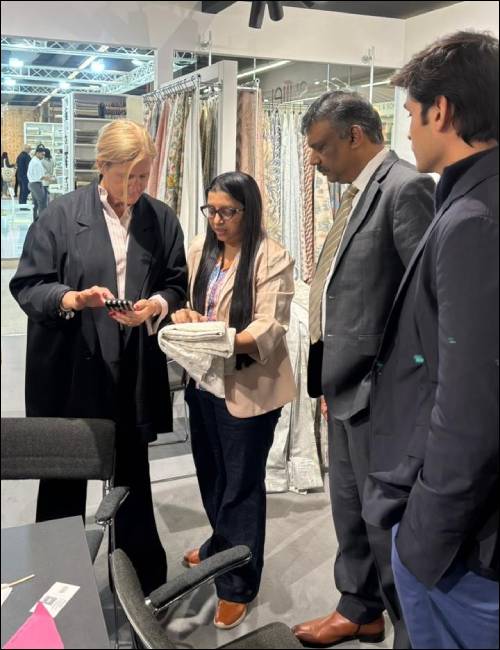 “We are very conscious about usage of renewable energy, minimizing carbon footprint, recycling fibres and ensuring we are not damaging the ecosystem,” Joshi explained. “This is where industry needs to move, not just for compliance, but for relevance.”
While sustainability commanded attention, it was design that won hearts. Sutlej’s booth displayed sustainable natural fibre fabrics, 100% cotton bedding, inherent FR and blackout solutions, recycled polyester products and a wide range of embroideries, dobbies, prints, plains and textures suitable for upholstery, drapery and bedding. The standout, however, was the multi-colour jacquard upholstery collection, referred to internally as the company’s hero product due to its commercial success across multiple geographies.
“It has worked for us in all the markets,” Joshi observed. “People think we are a design-first company, and that comes from our in-house archives as well as the 100-year-old American Silk archive that we own.”
This archival advantage is quietly powerful. In an era where heritage storytelling drives premium brand positioning, having deep design archives is not merely a marketing flourish, it is a competitive barrier. European and American upholstery programmes increasingly seek distinctive pattern languages and artisanal aesthetics that can’t be mass-replicated. Sutlej’s spun yarns, which imbue fabrics with a hand-woven character, have become a differentiator especially valued in markets where upholstery has outperformed tariff-sensitive direct-to-retail bedding.
That market dynamic led to another counterintuitive insight—while global uncertainties and tariff regimes were expected to depress shipments, Sutlej recorded its strongest growth in the most tariff-affected regions. “We have grown the most in the United States followed by the UK, funny in a way because we are in the middle of tariff discussions and yet we managed to clock that growth,” Joshi said. The company credits its performance to operating at the more premium end of the market, where buyers weigh design, durability, service and ESG compliance as heavily as the price.
The U.S. market did see pressure in finished direct-to-retail goods, but converter and furniture business remained resilient. In the U.K., Sutlej is logging nearly 50% growth driven by upholstery and sustainability credentials. Meanwhile, India continues to expand through both B2B channels and the company’s consumer brand Nesterra.
Backward integration also supported this performance. With capabilities spanning recycled fibre manufacturing, spinning, weaving and finishing, the company can forecast with greater accuracy, control quality across lots and offer spun yarn aesthetics few competitors can replicate at scale. These upstream strengths are becoming increasingly valuable to international brands seeking supply chain stability at a time when disruptions have rewritten procurement playbooks.
Trend intelligence forms the final layer of Sutlej’s competitiveness. The 20-member design team participates in major global design weeks, furniture fairs and décor events while leveraging trend forecasting and retail scanning to maintain both aesthetic fluency and technical relevance. Yet, as Joshi emphasized, sustainability within Sutlej is treated as a cultural subject rather than a compliance checkbox, “We are not limiting sustainability only to fabrics. We are looking at it from employees to what we are using, what we are eating. It has to be meaningful, not just for cameras.”
Sutlej reported strong visitor engagement across all the days, drawing buyers from the U.S., U.K., Netherlands, Belgium, Germany, Spain, Russia, Japan, Canada, Australia and India. With direct PO placements at fairs now rare, the goal was to secure commitments, initiate sampling rounds and enter testing cycles. On those metrics, Sutlej closed positively with strong leads and new accounts.
Heimtextil 2026 offered a glimpse of the sector’s next competitive frontier. The advantages now lie not in lowest cost, but in highest clarity of design intent, ESG transparency, circularity, compliance readiness and supply chain execution. Sutlej’s presence showcased how Indian home furnishing companies are repositioning themselves for this new era, exporting not just textiles but a philosophy anchored in responsibility and global design literacy.
In a year where the industry seeks stability, Sutlej’s model suggests that resilience will accrue to those who can answer global questions, not merely global orders.
(Article by Henry Dsouza, Associate Editor Of Textile Insights)