Driving India’s Transition To Traceable, Residue-Free & Organic Cotton: How Zytonic Technology Enables Farm-Level Transparency And Profitability

Dr Shailendra Singh, COO – Agro, Zydex Industries Pvt Ltd
Cotton is not just India’s largest commercial crop—it is the backbone of the country’s textile economy, engaging nearly 6 million farmers and contributing over 23% of global cotton production. Yet, this highly valuable crop faces a paradox: while global demand for organic and residue-free cotton is rising sharply, India struggles to capture this premium market due to inconsistent supply, high production costs and lack of traceability to the farmer level.
Globally, brands sourcing organic cotton demand not only certification but verifiable evidence of how cotton is grown—right up to the farm where it originates. However, India’s current traceability system effectively stops at the ginner, making it impossible to confidently validate whether cotton is truly organic or residue-free. This gap limits India’s ability to build trust with global buyers seeking reliable, large-scale, clean cotton supply chains.

At the same time, cotton farmers themselves are struggling. Soil degradation, rising pest pressure, erratic rainfall and high dependence on chemical fertilizers have reduced net profitability. Without an affordable, dependable pathway to organic or residue-free production, most farmers avoid transitioning due to fear of yield loss and uncertain markets.
This is where the Zytonic Technology Platform emerges as a scalable, field-tested solution that simultaneously supports profitable organic transition, enhances climate resilience and enables farmer-level traceability—the missing link in India’s cotton value chain.
Cotton’s Traceability Challenge: Why the Current System Falls Short 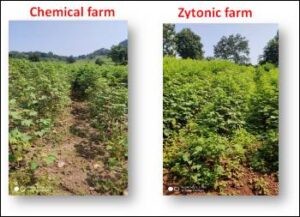
For cotton to be certified organic or residue-free, buyers require documentation of farming practices, inputs used, pesticide absence, soil health status and yield history. However:
- Traceability typically begins at the ginner, not the farmer.
- There is no structured digital or physical verification of farm-level practices.
- Input use such as pesticides, fertilizers and water cannot be validated reliably.
- Variability in quality and farm practices leads to inconsistent supply, a major concern for global textile brands.
- Organic certification takes years and is costly, discouraging mass adoption.
A farmer-centric traceability system—supported by consistent practices and validated outcomes—is essential to unlock the global premium for Indian cotton.
Zytonic Technology Platform: Enabling Consistent, Traceable, Profitable Organic Cotton
The Zytonic Technology Platform by Zydex offers a breakthrough transition pathway for cotton farmers. Built on strong scientific foundations, it addresses the three biggest constraints in cotton’s organic shift:
- Lack of quality organic matter and soil biology
- High pest pressure and dependency on chemicals
- Water stress and climate vulnerability
-
- Rebuilding Soil Health for Organic Cotton
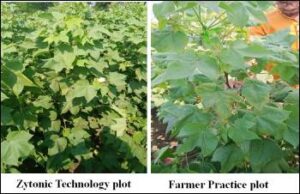
- Rebuilding Soil Health for Organic Cotton
One of the fundamental challenges of organic cotton is the availability of sufficient, high-quality FYM (Farm Yard Manure). Traditional FYM takes 8–10 months to decompose and often remains partially digested, reducing its effectiveness.
Zytonic Godhan, supported by fungal bio-digestion technology, accelerates the decomposition process, producing fully digested FYM within 45–60 days. This FYM is 4–6 times more effective, enabling farmers to cover more acreage with the same amount of dung.
This enriched soil environment supports:
- Better seed germination and stronger root systems
- Higher nutrient availability
- Improved water-holding capacity
- Greater tolerance to heat and moisture stress
These are critical factors in cotton’s long 160–180 day crop cycle.
- Enhancing Climate Resilience in Cotton
Cotton is highly sensitive to high temperatures, moisture stress and erratic rainfall. Zytonic-treated soils retain moisture longer and improve water infiltration, reducing irrigation needs by up to 30–40%. The role of Zytonic Suraksha (unique technology for harvesting water from environment and providing moisture to crop in dry weather) is quite significant in sustaining the crop even in adverse weather conditions.
This is a major advantage in rainfed cotton regions of the country, which face frequent dry spells during monsoon.
- Supporting Integrated Nutrient & Pest Management
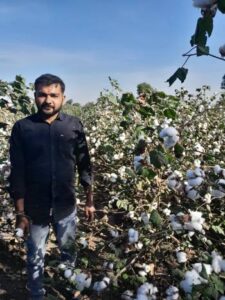
Ashvinbhai Gelani, Village Lunki, Bhavnagar,reported good crop growth with continuous flowering, multiple pickings and increased yield with no chemical inputs used.
Zytonic biofertilizers enhance soil biology, enabling natural nutrient cycling and improved plant vigour. This strengthens the plant’s ability to resist pests, reducing dependency on chemical pesticides and lowering the risk of residue in lint.
Farmer groups in Vidarbha have already begun transitioning to organic cotton using Zytonic practices, in collaboration with partners like CITI CRDA, with improved yields and fibre quality.
Closing the Traceability Gap: From Ginner to Farmer
The Zytonic Technology Platform provides a foundation for scientifically validated, traceable farming practices, making it possible to build farm-level traceability in cotton:
How Zytonic enables traceability:
- Standardized and replicable cultivation practices that can be monitored and documented
- Reduced or zero chemical fertilizer usage, verifiable through input logs and soil tests
- Improved soil organic carbon and FYM usage, providing measurable sustainability indicators
- Lower pesticide usage, enabling residue reporting
- Geo-tagging of farms, capturing field-level data
- Partnership-ready model for textile buyers, ginners, aggregators, and certification bodies
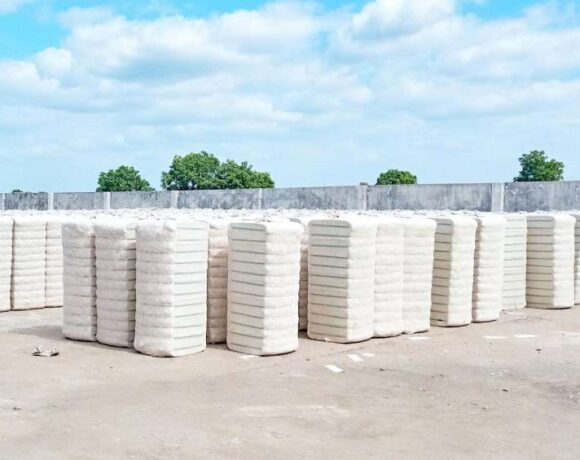
This enables a new traceability model — “Farm → FPO → Ginner → Spinner”, instead of starting only from ginners.
Outcome for global buyers:
- Verified chemical-free cotton
- Predictable and consistent supply
- Lower rejection rates due to residue
- Strong sustainability credentials
- A robust storytelling and ESG documentation platform
Scaling Farmer-Level Traceability in Cotton: The Proposed Pathway
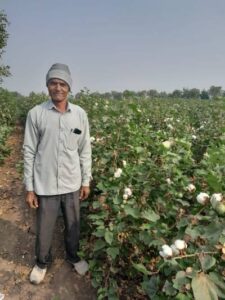
Nandlalbhai Ghevariya, Village Dedakadi,Bhavnagar, observed an increase in the number of bolls and boll size. The plants remained green for a longer period, with continuous flowering and multiple pickings. Improved pest control was also noted, with no chemical inputs used.
A national-scale cotton traceability system can be built through four pillars:
- Standardized Organic/Residue-Free Cotton Protocols Using Zytonic
Farmers follow a defined package of practices involving:
- Zytonic Godhan FYM preparation
- Zytonic soil and plant nutrition programme
- Reduced chemical inputs and IPM protocol
- Irrigation optimization
-
- Digital Farmer Registry
Each cotton field is documented with:
- GPS coordinates
- Zytonic intervention records
- Soil health parameters
- Input usage reports
- Crop growth monitoring
- QR-Based Bale Traceability
Each bale originates from a verified cluster of farms, enabling:
- End-to-end supply chain visibility
- Buyer confidence
- Premium pricing
- Public–Private Partnerships
Stakeholders include:
- Farmer groups/FPOs
- Ginners and textile mills
- Certification bodies
- State departments & LITUs
- Technology partners (Zydex)
This creates an ecosystem where farmers earn more while global buyers gain reliable supply.
Conclusion: A Transformational Opportunity for India’s Cotton Sector
India has the world’s largest cotton farming community, yet it captures only a small share of the high-value organic and residue-free market due to traceability gaps and inconsistent production practices. By providing a scientific, farmer-friendly, scalable solution, the Zytonic Technology Platform enables:
- Reliable, residue-free cotton production
- Reduced input costs and increased profitability
- Strong soil health and climate resilience
- End-to-end traceability starting at the farm
- Confidence for global buyers in supply reliability
With the right collaborations, Zytonic-enabled traceable cotton can become a hallmark of India’s textile leadership—positioning the country as a global hub for certified, sustainable, premium-quality cotton.