Entropy And Enthalpy — My Lifelong Frenemies!
Words like entropy, enthalpy, psychrometric and adiabatic were enough to silence even the bravest soul. No one dared to ask a follow‑up question. These words were my nuclear arsenal, writes S. Murugan
I used to throw around the words entropy and enthalpy to impress people whenever they asked me about humidification in textiles.
Honestly, I had no clue what they actually meant.
Trying to understand them since my Polytechnic days only made me more confused. The more I read, the more the formulas stared back at me like angry algebraic demons.
Whenever someone questioned why I had set the humidification in a certain way, I would simply pull out my secret weapons:
“You see, the entropy expands after adiabatic cooling, and the enthalpy remains constant. So this climate is the only possible outcome for the present outside conditions. If you want, please check the psychrometric chart.”
I would say this while looking straight into their eyes, as if I were Einstein’s long‑lost cousin.
Naturally, they would freeze.
Words like entropy, enthalpy, psychrometric and adiabatic were enough to silence even the bravest soul.
No one dared to ask a follow‑up question.
These words were my nuclear arsenal.
But deep inside, a tiny voice in my head whispered: “Why are you pretending to be a humidification guru when you barely understand the basics?”
Out of guilt, I would occasionally try to learn the real meanings. But the moment I saw the formulas, I would quietly close the book and go make tea.
Later, courtesy of energy auditors, I added more fancy words to my collection: Delta pressure, CFM per kW, inside wet‑bulb vs outside wet‑bulb.
These were enough to make me look intelligent in meetings and seminars.
Now that I’m retired, there is no need for such drama.
When I sit quietly and think about those days, I can’t help laughing at my own theatrics.
Why did I pretend to be a humidification expert when my real job was textiles?
I still don’t know.
But the desire to truly understand these concepts never died.
Recently, I met an expert and asked him to explain entropy in simple terms.
He looked thrilled — as if he had been waiting his whole life for someone to ask this question.
He began confidently: “Entropy is a thermodynamic quantity representing the unavailability of a system’s thermal energy for conversion into mechanical work, often interpreted as the degree of disorder or randomness in the system.”
He looked proud of his explanation.
Then he looked at my face, which was rigid with no emotion.
His pride evaporated instantly.
I hesitantly said, “Sir…what exactly is the unavailability of thermal energy?”
He sighed, regrouped and tried again. “Think of entropy as a measure of how much energy has become so spread out, so evenly mixed, that you can’t use it to do any useful work. The energy is still there — but it’s useless.”
I still looked confused.
He tried a different angle. “Tell me, how do heat engines work?”
“By heat,” I replied confidently. “The answer is already in the question!”
He nearly fainted!
“No! Heat engines work because of a temperature difference, not heat itself!”
Now I was convinced he was a bit eccentric.
Seeing my expression, he continued: “A heat engine absorbs heat from a hot source, converts part of it into work, and dumps the rest into a cold sink. It works only because the energy is concentrated. Once energy spreads out, it becomes high entropy — still present, but useless.”
He paused dramatically.
Then he added: “At the beginning of the Big Bang, the universe had low entropy. As it expanded, entropy increased. Planets formed. Life emerged. Every living being is basically a machine converting low entropy into high entropy. Do you know, when entropy is fully spread out, the universe will die.”
I panicked for a moment.
He laughed and said, “Don’t worry. That will take trillions of years.”
“Thank God! But how does this relate to textile humidification?”
He switched gears.
“Textile humidification is an open system — both matter and energy enter and leave. To understand it, you must know enthalpy too. Entropy and enthalpy are like a married couple — always together, always arguing.”

Murugan Santhanam, Managing Director, Texdoc Online Solution Pvt. Ltd.
He continued: “Enthalpy is the total heat content of moist air: sensible heat of dry air and water vapour, plus the latent heat of vaporisation (the energy needed to keep water as vapour). In an adiabatic process, total enthalpy stays constant — but its components rearrange. Air gives up some sensible heat. That heat evaporates water. Latent heat increases. Total enthalpy remains the same. That’s why it’s called constant‑enthalpy humidification.”
Then he moved to entropy: “When water evaporates, ordered liquid becomes disordered vapour. Molecules spread out. Mixing increases randomness. So entropy increases. Temperature drops, but entropy rises because evaporation dominates.”
He concluded: “Enthalpy stays constant. Entropy increases. Temperature decreases. Humidity ratio increases. That is all about the adiabatic process happening at the air washer of your plant room”
He looked at me expectantly.
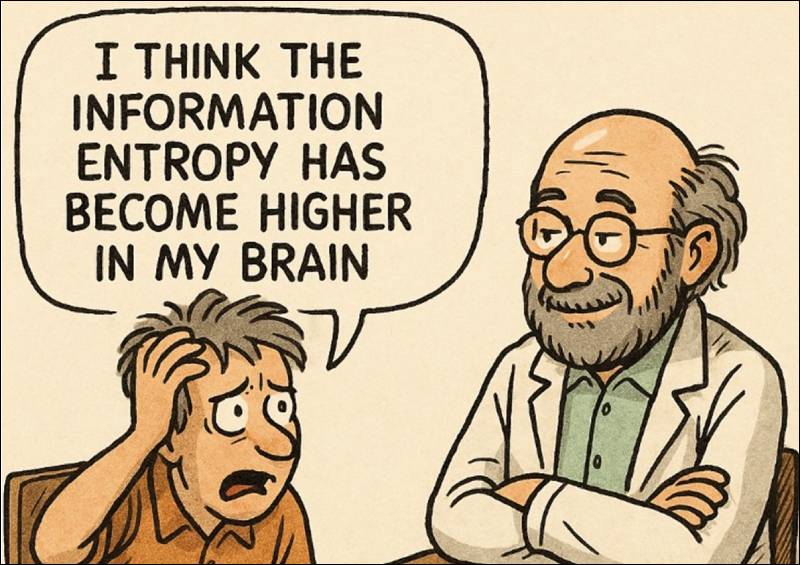
I replied: “Sir, I think the information entropy in my brain has increased. Everything is mixed up. I feel total disorder. Is this what they call brain fog?”
He laughed.
“Don’t worry. Once you understand how supply air behaves inside the department, your entropy will reduce. We’ll discuss that in the next session.”
We both laughed and parted ways.