Fibre Migration At Ring Spinning Machine: Why Viscose Loves The Surface More Than Cotton

By S. Murugan
I could not deduce what he meant. I tortured my brain for an answer, but after days of thinking, the only thing I managed to produce was a beautifully maintained blank.
“The viscose fibres float more in the drafting zone.” That was what the spinning technocrat had told me.

I had met him at a textile exhibition a few months earlier. He was the walking, talking Wikipedia of textile technology. Ask him anything about spinning, and he would immediately answer with figures, theories and practical observations. Sometimes I suspected even Google consulted him before displaying search results.
This time I had called him to clear a doubt. “Sir, in a viscose-cotton blend spun on a ring frame, which fibre tends to dominate the yarn surface?”
Without a moment’s hesitation, he replied, “Viscose fibres. They float more in the drafting zone.”
His answer only created a bigger question in my mind. “But sir, viscose fibres are longer than cotton fibres. How can they float more?”
Instead of answering, he giggled. “Find out yourself and come back to me.”
For a few seconds, I was speechless. Was this an explanation? A challenge? Or a polite way of saying, “Don’t disturb me until you’ve done your homework”?
“Alright, sir,” I replied bravely, hiding my confusion. “I’ll find the answer.”
The call ended. My peace of mind ended with it.
For several days, my brain behaved like an overworked drafting roller. Every spare moment was spent thinking about floating fibres.
At breakfast, I thought about fibre floating. At work, I thought about fibre floating. Even while waiting for traffic signals, I thought about fibre floating.
My family probably thought I was planning a scientific breakthrough.
Then one evening, while repairing a torn portion of my shirt, enlightenment arrived from a completely unexpected direction.

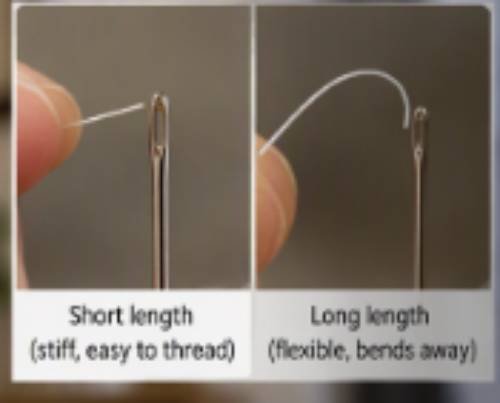
I was trying to insert a sewing thread through the eye of a needle. As usual, it refused to cooperate.
The more thread I left protruding beyond my fingers, the more it bent, wandered and behaved like a drunken snake.
Finally, instinctively, I shortened the free length between my fingers and the tip of the thread. Immediately, the thread became easier to control.
At that moment a light bulb flashed inside my head. “Wait a minute…” The longer the unsupported length, the greater its tendency to bend and wander.
I nearly dropped the needle. “I think I’ve got it!”
Without wasting time, I called the technocrat. “Sir, I think I’ve understood what you meant.”
“Excellent,” he replied. “Let’s hear it.”
I took a deep breath. “When you said viscose floats more, I initially imagined the entire fibre floating freely between the rollers. Now I realise that only the front portion of the fibre is floating. The rear portion is still gripped by the back roller nip.
Since viscose fibres are longer, their unsupported portion in the drafting field is longer. A longer unsupported segment is more flexible and has a greater tendency to bend and deviate.”
There was a brief silence. Then came the verdict. “You are getting very close.”
That was enough encouragement to make me feel like I had just passed a university examination.
“But sir,” I asked, “please explain the complete picture.”
He happily obliged. “The biggest misunderstanding is that people imagine the whole fibre floating freely. In reality, only the fibre segment ahead of the back nip is unsupported.
 Consider a simple example. Suppose both fibres are gripped by about 3 mm at the back nip. A 30 mm cotton fibre has approximately 27 mm unsupported. A 38 mm viscose fibre has approximately 35 mm unsupported. Therefore, the viscose fibre has a longer floating length.”
That part made perfect sense. But another doubt remained.
“I understand that the longer floating segment can bend more easily. But can that small tendency really make a viscose fibre move all the way from the centre of the strand to the surface?”
I wasn’t completely convinced. The technocrat anticipated my skepticism.
“Not all the way in one dramatic movement,” he laughed. “People imagine migration as if a fibre packs its suitcase, leaves the strand centre, and permanently relocates to the surface. It doesn’t happen like that.”
Now I was listening carefully. “The sideways movement during drafting is extremely small, often only fractions of a millimetre. However, thousands of such small movements occur continuously among millions of fibres.”
He continued: “Viscose fibres possess several characteristics that encourage this movement. First, they have a longer floating length. Second, they are more flexible than cotton. Third, their surface is smoother and generally has lower fibre-to-fibre friction. Cotton fibres, with their natural convolutions, generate more resistance to sliding. Viscose fibres slip more readily relative to neighbouring fibres.”
Suddenly the picture became clearer.
He continued his explanation. “When fibres are accelerated in the drafting zone, they constantly interact with neighbouring fibres. The more flexible and smoother fibres can adjust their positions more easily. Over many tiny adjustments, viscose fibres tend to drift toward positions of lower resistance, which statistically places a greater proportion of them nearer the outer regions of the strand.”
Now the idea of migration no longer seemed mysterious. It wasn’t one giant sideways jump.
It was a series of countless microscopic adjustments, each almost invisible, but together producing a measurable effect.
The technocrat concluded: “Migration is the combined consequence of fibre length, flexibility, frictional properties, fibre interactions and drafting dynamics. Longer floating length helps, but it isn’t the only reason.”
That final statement completed the puzzle. My confusion vanished.
The phrase “viscose floats more” suddenly sounded much less mysterious than it had during our first conversation.
I thanked him sincerely. After all, not every textile lesson begins with a drafting zone and ends with a sewing needle.
And not every spinning problem can be solved by staring at textbooks.
Sometimes, the answer is hanging from the tip of a thread, waiting patiently for you to notice it.
(Murugan Santhanam is Managing Director of Texdoc Online Solution Pvt. Ltd.)