
Global Textile Machinery Shipments Decline In 2025, Spinning Segment Bucks Trend: ITMF
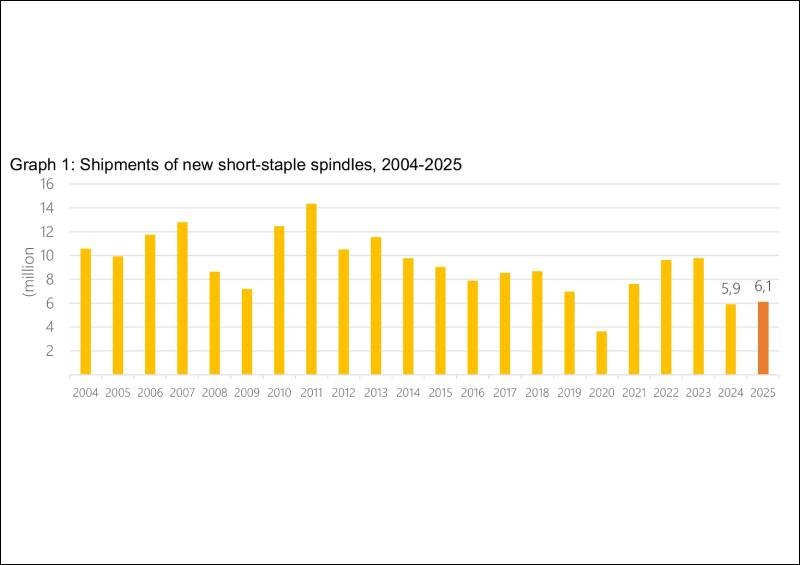
Global textile machinery shipments declined across most categories in 2025, with spinning machinery emerging as the only major segment to record growth, according to the 48th International Textile Machinery Shipment Statistics (ITMSS) released by the International Textile Manufacturers Federation.
The survey, compiled with data from more than 200 machinery manufacturers worldwide, showed that shipments of short-staple spindles increased by 3.3% to 6.11 million units, while open-end rotor deliveries rose 3.5% to 645,000 units. In contrast, long-staple spindle shipments fell sharply, declining by 31% to around 90,000 units.
Asia and Oceania remained the dominant destination for spinning machinery, accounting for 95% of short-staple spindle deliveries and 94% of open-end rotor shipments. China, India, Bangladesh, Indonesia, Uzbekistan and Pakistan were the largest investors in short-staple spinning equipment.

The draw-texturing segment continued to weaken, with shipments of single-heater spindles dropping 21% to 65,000 units and double-heater spindles declining 22% to 743,000 units. China remained the largest investor in both categories.
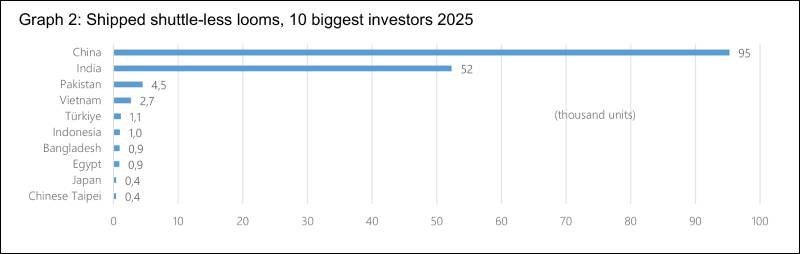
Weaving machinery recorded one of the steepest declines. Global shipments of shuttle-less looms fell 27.5% to 164,000 units, driven by a 38% drop in water-jet looms, an 18% decline in rapier and projectile looms, and a 6% fall in air-jet loom deliveries. While China remained the largest investor in air-jet and water-jet looms, India emerged as the leading buyer of rapier and projectile looms, increasing investments by 21%.
In knitting machinery, shipments of large circular knitting machines declined 13% to 24,500 units, while electronic flat knitting machine deliveries dropped 21% to 106,000 units. China continued to dominate investments in both categories, followed by India and Vietnam.
The finishing machinery segment was the only non-spinning category to show modest growth. Shipments of stenters increased 3% to about 2,300 units, while deliveries of mercerising lines rose 24%. However, several other finishing machines recorded declines, including singeing lines and dyeing equipment.