
Green Regulations Triggering Shift In Textile Machinery Investments
The global textile industry is entering a phase in which sustainability is becoming a condition of market access rather than merely a corporate responsibility commitment. Environmental regulations, rising buyer expectations and growing scrutiny of supply chains are compelling manufacturers to reconsider how they source raw materials, use water and energy, manage chemicals, process fabrics and handle waste. For India’s textile industry, this transition has significant implications not only for production practices but also for the factories and machinery on which competitiveness depends.
The European Union is among the key drivers of this shift. Its evolving framework includes the Ecodesign for Sustainable Products Regulation (ESPR), the Digital Product Passport (DPP) initiative and revisions to waste-management rules. Together, these measures are intended to improve product durability, traceability, resource efficiency and circularity. The Extended Producer Responsibility (EPR) frameworks also place greater emphasis on managing products and materials at the end of their useful lives.
The precise obligations and implementation timelines vary by product category and regulation. Nevertheless, the direction is clear: manufacturers and brands will increasingly need credible information about the materials used in products, their environmental footprint and how they can be reused or recycled.

Indian exporters may not always be directly subject to every overseas requirement. However, they can face them through international brands and buyers that must demonstrate compliance. Suppliers unable to provide reliable data or meet environmental specifications risk losing orders, even when their products remain price-competitive.
India is also strengthening its domestic sustainability framework, including waste management and resource-efficiency initiatives. For manufacturers, the challenge is to prepare for these requirements without undermining margins in an industry already exposed to volatile input costs, intense international competition and pressure on working capital.
India has a diverse textile manufacturing base, ranging from large integrated mills and export-oriented companies to thousands of smaller spinning, weaving, processing and garment units. Their preparedness for the sustainability transition varies considerably.
Larger manufacturers have invested in modern production lines, energy efficient equipment, water management systems and digital monitoring. Such investments can improve productivity while helping companies meet customer requirements on quality, consistency and environmental performance.
However, modernisation remains uneven, particularly among smaller units operating with older machinery and limited access to capital. In some facilities, equipment that remains commercially usable may consume excessive electricity or water, generate higher levels of waste, or lack the instrumentation needed to record resource consumption accurately.
This creates a widening gap between manufacturers that can demonstrate measurable environmental performance and those that depend largely on conventional production methods. Upgrading machinery will therefore become an important part of the industry’s competitiveness agenda, although not every facility will need a complete overhaul. Targeted retrofits, better process controls and phased equipment replacement can deliver meaningful improvements.
Sustainability targets are often articulated at the corporate level, but their success depends on what happens on the factory floor. Every stage of textile production—from spinning and weaving to dyeing, finishing and garment manufacturing—offers opportunities to reduce resource consumption and waste.
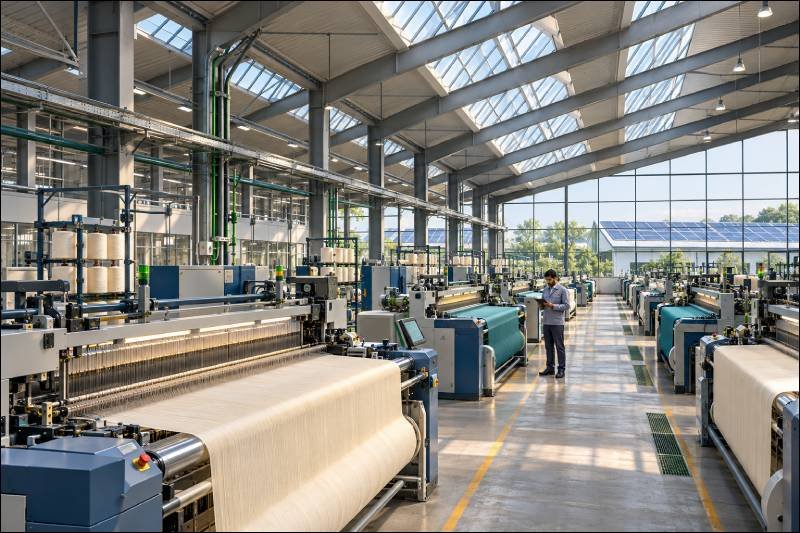
In spinning, efficient motors, drives and process controls can reduce energy use and improve operational consistency. In weaving and knitting, modern machines can minimise defects, reduce downtime and improve material utilisation. In garment manufacturing, automated cutting, pattern optimisation and improved production planning can reduce fabric waste, one of the industry’s most significant cost components.
Machinery selection must therefore consider more than speed and output. Manufacturers need to assess energy consumption per unit of production, material yield, defect rates, maintenance requirements and the availability of data that can substantiate performance claims.
Digital monitoring is particularly important. Sensors, machine-level meters and manufacturing execution systems can help factories track electricity, water and material consumption across production stages. This enables managers to identify inefficiencies, compare performance between machines and provide buyers with more reliable operational information.
Data collection alone, however, is not sufficient. Measurements must be consistent, verifiable and linked to defined production volumes. A factory that knows how much electricity it consumes per kilogramme of yarn or metre of fabric is better positioned to identify improvements and demonstrate progress than one relying on estimated or fragmented records.
Dyeing, bleaching, washing and finishing are among the most resource-intensive stages of textile manufacturing. They require substantial quantities of water, heat and chemicals, while waste water treatment adds to operating costs. As environmental scrutiny increases, wet-processing facilities are likely to face some of the strongest incentives to modernise.
Manufacturers can consider low-liquor-ratio dyeing machines, automated chemical dosing, improved temperature controls and systems that optimise water use. These technologies can reduce consumption while improving shade consistency and limiting reprocessing caused by defects.
Water recovery and reuse will also become increasingly important, particularly in water-stressed industrial clusters. Effluent treatment, recycling and monitoring systems can help facilities reduce freshwater demand and manage discharge more effectively. Yet their effectiveness depends on the quality of incoming water, the chemicals used, process requirements and the economics of treatment.
Chemical management needs equal attention. Accurate dosing and better process controls can reduce excess chemical use and improve consistency. Manufacturers serving international buyers must also understand applicable restricted-substance lists and maintain records that demonstrate compliance with customer specifications.
The transition is not simply about installing a new machine. Equipment must be compatible with the factory’s production mix, existing utilities and treatment infrastructure. Operators need training, maintenance teams must understand new systems, and performance should be measured after commissioning to establish whether expected savings are being achieved.
Electricity and thermal energy are major operating costs across textile manufacturing. Improving efficiency can support both profitability and emissions reduction, making it one of the most commercially attractive areas for investment.
High-efficiency motors, variable-frequency drives, efficient compressors, improved boilers and heat-recovery systems can reduce energy demand. Better insulation and process controls can also minimise heat losses in facilities with substantial thermal requirements.
Manufacturers should assess energy consumption across the plant rather than examining machines in isolation. An efficient production machine may deliver limited overall savings if compressed air systems, steam distribution or auxiliary equipment remain inefficient. Energy audits can help identify where investment will produce the greatest return.
Renewable electricity, including rooftop solar and procurement from renewable energy suppliers where feasible, can complement equipment upgrades. However, companies should distinguish between reducing energy consumption and changing the source of energy. Both can contribute to environmental goals, but they address different aspects of a factory’s footprint.
The shift towards circularity will influence the way textile companies manage fabric scraps, yarn waste, rejected products and post-industrial materials. Waste that was once treated primarily as a disposal problem may increasingly be viewed as a resource, provided it can be collected, sorted and processed economically.
Manufacturers can reduce waste through better cutting-room planning, improved process controls, preventive maintenance and lower defect rates. Segregating waste by fibre type and composition can also improve its potential for recycling. Mixed fibres, dyes, finishes and contaminants may complicate recycling, making material identification and process discipline essential.
Recycled fibres can introduce challenges for machinery. Variations in fibre length, strength and consistency may affect spinning performance, yarn quality and fabric characteristics. Equipment and process settings may need to be adapted to accommodate recycled inputs, while quality control systems must ensure that products meet customer specifications.
Textile-to-textile recycling is developing, but its commercial viability depends on the availability and quality of feedstock, the technology used, energy and processing costs, and demand for recycled output. Manufacturers should evaluate these factors before committing large investments. Partnerships with recyclers, material suppliers and brands can help establish dependable collection and sourcing arrangements.
As sustainability requirements evolve, machinery procurement needs to become a strategic decision rather than a narrow comparison of purchase prices and production speeds.
First, manufacturers should assess resource efficiency. Suppliers should provide credible information on energy and water consumption under clearly defined operating conditions. Where possible, performance should be compared per unit of output rather than through headline specifications alone.
Second, equipment must offer data readiness. The ability to monitor consumption, production, defects and downtime can help factories improve operations and substantiate environmental claims. Buyers should establish whether data can be accessed, exported and integrated with existing systems.
Third, manufacturers need to examine material compatibility. Equipment intended for long-term use should be capable of handling relevant fibre blends and, where commercially appropriate, recycled materials. Flexibility matters in a market where customer specifications and material choices may change.
Fourth, the assessment should include water, chemical and waste management. For wet processing, this means examining dosing accuracy, water reuse, waste water implications and the machine’s compatibility with treatment systems. In spinning and garment production, material yield and waste reduction deserve particular attention.
Fifth, companies should consider adaptability and upgrade potential. Modular systems, software updates, retrofit options and accessible spare parts may extend equipment life and reduce the risk of premature replacement. Supplier support, operator training and maintenance capability are equally important.
Finally, purchasing decisions should be based on total cost of ownership, not just the initial price. Electricity, water, chemicals, labour, maintenance, downtime, defects and waste all affect the economics of a machine over its useful life. Suppliers should be asked to substantiate savings claims through documented performance data or factory references.
For smaller manufacturers, the main obstacle may not be awareness but affordability. Modern machinery, digital monitoring and environmental infrastructure require upfront investment, while the benefits often accumulate over time. Access to finance, reliable technical advice and predictable buyer requirements will be important to accelerating adoption.
A phased approach can help. Manufacturers can begin with energy audits, leak reduction, preventive maintenance, process optimisation and improved waste segregation. These measures may deliver savings while identifying the equipment upgrades with the strongest business case. Larger investments can then be prioritised according to resource intensity, customer requirements, payback periods and the risks of non-compliance.
Industry associations, technology providers, financial institutions and government programmes can support the transition through training, demonstrations, financing and technical assistance. Common measurement practices would also help smaller suppliers report environmental performance without creating disproportionate administrative burdens.
International buyers have a role to play as well. If sustainability requirements are introduced without realistic timelines, technical guidance or purchasing commitments, smaller suppliers may struggle to invest. Longer-term sourcing relationships and clearer specifications can give manufacturers greater confidence to modernise.
The sustainability transition will reshape textile manufacturing well beyond the introduction of new reporting requirements. It will influence the fibres companies use, the machinery they buy, the way factories consume resources and the information they share with customers.
For India, the challenge is to make this transition across a highly diverse manufacturing base. Large integrated mills may be able to deploy advanced systems, while smaller units will require practical, affordable routes to modernisation. The most effective strategy will combine process improvements, targeted machinery upgrades, stronger data systems and investment in recycling and resource recovery.
Compliance should not be treated as a one-time exercise. Regulations, customer specifications and preferred technologies will continue to evolve. Manufacturers that build flexibility into their facilities and procurement decisions will be better equipped to respond.
Ultimately, sustainability and productivity need not be competing objectives. Machines that reduce energy consumption, limit waste, improve quality and provide reliable production data can strengthen both environmental performance and operating margins. As buyers place greater emphasis on traceability and resource efficiency, the ability to demonstrate these gains may become a decisive advantage for Indian textile companies competing in global markets.