India’s Textile Waste Presents US$ 3.5 Bn Circular Market Opportunity
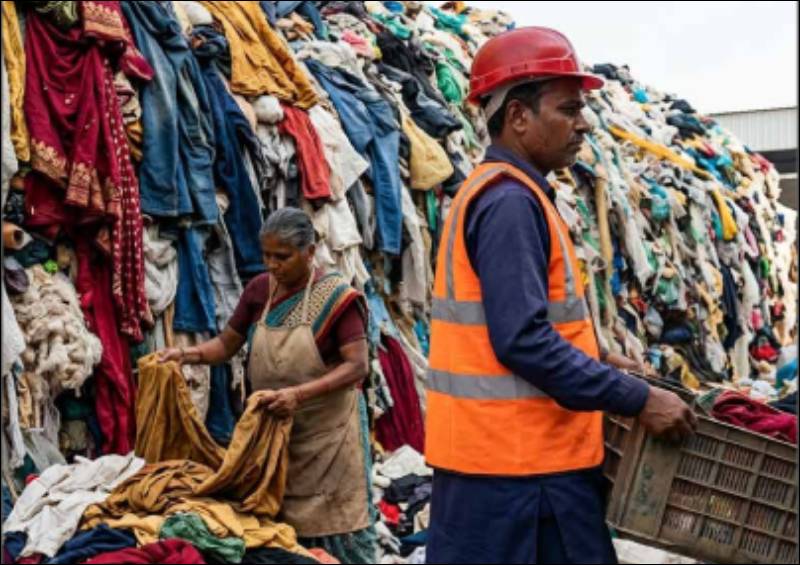
India’s textile sector, a cornerstone of the country’s industrial and export economy, is facing a mounting sustainability challenge as it generates an estimated 7,073 kilotonnes of textile waste every year, according to the latest government-backed report, Mapping of Textile Waste Value Chain in India (2026). The study, commissioned by the Ministry of Textiles, positions this growing waste burden not only as an environmental concern but also as a significant economic opportunity capable of reshaping the industry’s future.
The report reveals that post-consumer waste accounts for 58 per cent of the total, amounting to 4,100 kilotonnes per annum, while pre-consumer waste contributes 42 per cent or 2,973 kilotonnes annually. Despite the scale, more than 70 per cent of the waste is already being recovered through a mix of recycling, reuse and downcycling processes, indicating a strong but largely informal circular ecosystem.
India’s textile recycling market is projected to reach US$ 3.5 billion by 2030, with the potential to generate nearly one lakh green jobs over the next five years, driven by rising global demand for sustainable and circular fashion solutions. The report underscores that transitioning to a circular textile economy is no longer optional, but critical for maintaining export competitiveness and meeting evolving international sustainability standards.
Pre-consumer waste, generated during manufacturing processes such as spinning, weaving and garmenting, demonstrates relatively high efficiency in recovery. Nearly 97 per cent of such waste is recycled, either through upcycling into higher-value products or downcycling into materials like industrial rags and insulation. The spinning segment, in particular, has achieved near-complete circularity, with most waste being reintegrated directly into production. However, the study identifies the garmenting stage as a major contributor, generating approximately 1,850 kilotonnes of waste annually, highlighting the need for better material efficiency and waste reduction strategies at this level.
In contrast, post-consumer textile waste continues to pose structural challenges. Although more than half of this waste is recovered, the process is heavily dependent on informal networks, including waste collectors, ragpickers and community-based systems. These networks support an estimated 4 to 4.5 million livelihoods, predominantly among women, but operate with limited formal recognition and infrastructure. A significant portion of discarded textiles still ends up in landfills or is incinerated due to poor segregation, contamination and lack of advanced sorting technologies.
The report highlights the critical role played by informal actors and non-governmental organisations in extending the lifecycle of garments through reuse, resale and redistribution. Initiatives such as community-driven collection systems and second-hand markets help divert large volumes of textiles from disposal, often extending product life by one to two years. However, the absence of robust traceability and formal integration limits the overall efficiency of the system.
From a technological perspective, the study evaluates multiple recycling pathways, including mechanical, thermo-mechanical, chemical and thermo-chemical processes. While mechanical recycling remains the most widely adopted due to its cost-effectiveness and scalability, it often results in degradation of fibre quality. Chemical recycling, though still in early stages of adoption, is seen as a promising solution for achieving true textile-to-textile circularity, as it can produce near-virgin quality fibres and handle blended materials. The report suggests that no single technology can address the complexity of textile waste, calling instead for a hybrid approach that combines scale, quality and versatility.
Environmental assessments, conducted as part of the study, reinforce the benefits of recycling. Life Cycle Analysis indicates that incorporating recycled materials can significantly reduce greenhouse gas emissions, particularly in viscose and polyester products, where emission reductions of up to 38 per cent and 22 per cent, respectively, were observed. Even in cotton, where gains are relatively modest, the shift toward recycled inputs contributes to overall sustainability goals.
The report also draws attention to policy gaps that hinder the sector’s transition to circularity. The absence of formal classification systems, such as an HSN code for recycled yarn, limits market development and discourages manufacturers from adopting recycled materials. Compared to global benchmarks, including Extended Producer Responsibility frameworks in Europe and Japan, India’s policy landscape remains fragmented and underdeveloped. Strengthening regulatory support, improving data systems and incentivising sustainable practices are identified as critical steps forward.
Cluster-level analysis reveals significant regional imbalances in waste processing infrastructure. Panipat has emerged as the country’s primary textile recycling hub, handling large volumes of waste from across various manufacturing clusters. However, this centralisation creates logistical inefficiencies and underscores the need for decentralised, cluster-based recycling facilities that can process waste closer to its source.
The study concludes that India stands at a pivotal moment in its textile journey. While the country has a long-standing tradition of reuse and resource efficiency, scaling these practices into a modern, technology-driven circular economy will require coordinated efforts across industry, government and informal stakeholders. By aligning policy, investment and innovation, India has the potential to position itself not just as a global textile manufacturing hub, but as a leader in sustainable and circular textiles.