Kriti & Kunal Bring Indian Craft To Global Stage With Heimtextil Debut
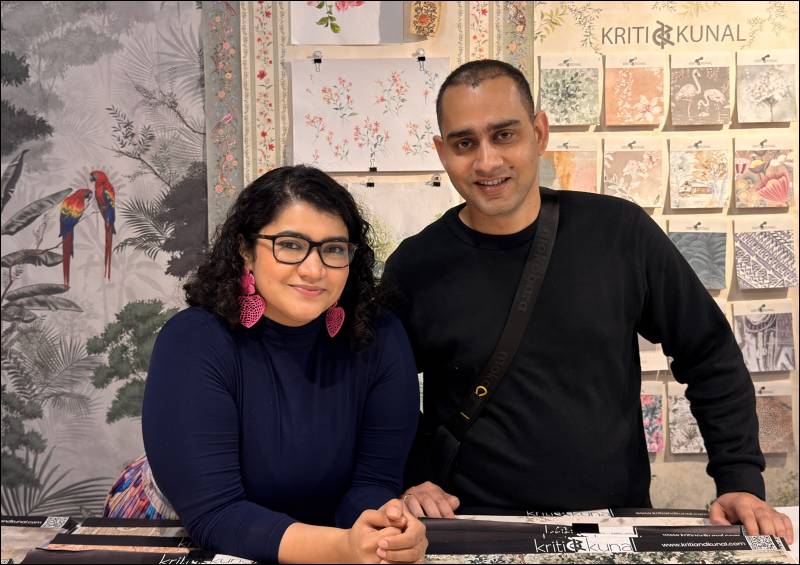
Indian design duo Kriti Sharma and Prince Kunal Gaurav are taking their homegrown textile studio global, debuting at Heimtextil 2026 with a showcase rooted in Indian crafts but tuned to international design sensibilities. The founders of Kriti & Kunal, both textile design graduates from NIFT Delhi, launched their studio nearly nine years ago as a fully bootstrapped business that combines hand-painted art, textile craftsmanship and contemporary product design. Their entry into Heimtextil this year marks their first participation at a major international trade fair.
The studio originated from college collaborations, classroom projects, design project for Indian Railways and World of wearable art that became their first commercial sale. The proceeds were reinvested and the founders have maintained a self-funded model since. “We’ve just been making exciting designs,” Sharma said, emphasizing their shared passion for travel and craft discovery. Road trips across India have shaped much of their visual storytelling, drawing from artisanal and tribal art forms, textiles and traditional hand paintings. The duo’s mandate is clear, preserve Indian craft narratives but make them relevant for global product categories through modern palettes, formats and applications.
At Heimtextil 2026, the studio focused on showcasing India’s natural landscapes, florals and craft traditions through adjusted colorways and contemporary formats from chintz-inspired prints to fauna patterns and hand-embroidery-inspired artworks. The designs were mapped across multiple end-use categories, including wallpapers, bedding, tableware, lamps and other home décor segments. Alongside ready artworks, the studio emphasized on custom design services, offering moodboard-based adaptations for buyers across geographies. “Clients really appreciate the flexibility,” Sharma noted, adding that both original hand-painted work and digital adaptations form part of their portfolio.
Their first day at the show delivered immediate traction, three sales across buyers from the UK, USA and India. Visitor traffic on all days included buyers and agents from the UK, Korea, India and Australia, highlighting the fair’s reach. It was also an opportunity for the studio to observe how global studios operate, given the relatively limited visibility of Indian design studios abroad.
The founders credit their design relevance to a combination of global trend tracking, social media awareness, international market studies and travel-based research. The studio works with a team of in-house designers and over 100 artists across India, allowing them to integrate hand craftsmanship into scalable product directions. Sharma highlighted concerns over the declining sustainability of purely hand-made art as a livelihood, with many artists unable to sustain themselves through gallery-oriented commissions alone. The studio attempts to address this gap by converting hand-painted art into commercially viable surface designs for diverse categories from bedding to lamps, creating new revenue pathways for artisans.
On technology, Sharma acknowledged the rising influence of AI in design, positioning it as a tool rather than a threat. AI, she said, serves as a fast visualization bridge, allowing design teams to quickly communicate concepts before artists build refined hand-painted versions. “It’s a collaboration, technology provides ease, but handcraft provides finesse,” she noted.
With Heimtextil giving the brand its first major global platform, the founders see the fair as both a visibility milestone and a market intelligence tool. For Indian design studios, Sharma believes events like Heimtextil can accelerate recognition, collaboration and integration into global supply chains, especially in a landscape often dominated by European creative studios. From a bootstrap beginning to global design conversations, Kriti & Kunal is betting on a blend of tradition, trend intelligence and artisan partnerships to scale its presence in the international design economy.
(Article by Henry Dsouza, Associate Editor Of Textile Insights)