
Textile Leaders Laud Reforms, Push For GST Relief At Mumbai Conclave
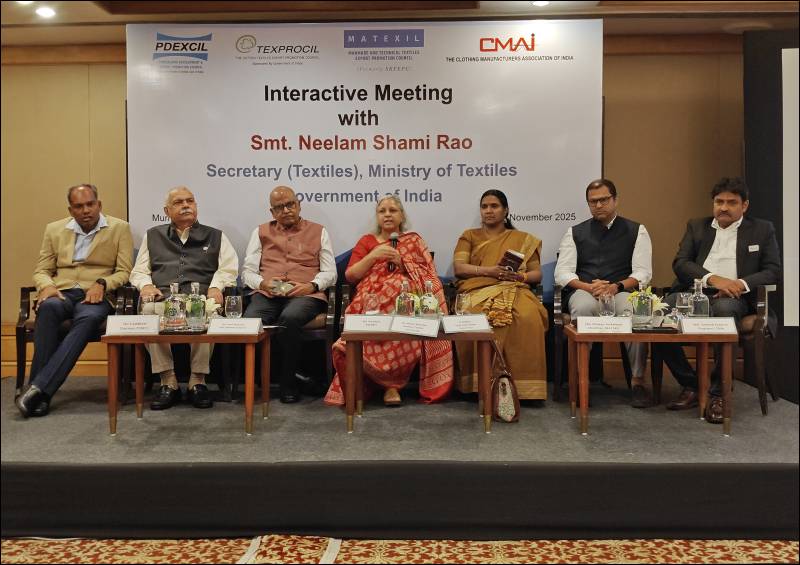
Four of India’s leading textile bodies, PDEXCIL, TEXPROCIL, MATEXIL and CMAI, jointly hosted an energetic and insightful interactive meeting with Textile Secretary Neelam Shami Rao on 13th November 2025 at Mumbai’s Taj President. The gathering brought together exporters, manufacturers, retailers, policy influencers and council heads, creating a rare platform where the entire textile value chain openly voiced aspirations, concerns and recommendations.
From GST rationalisation and export incentives to raw material quality and next-gen technology adoption, the evening reflected a sector ready to evolve and a government signaling an equally strong intent to enable that transformation.
MATEXIL Chairman Shaleen Toshniwal set the tone with a warm welcome, calling it a “very special evening” and commending the Textile Secretary’s swift, solution-driven approach since taking office. He acknowledged the landmark GST 2.0 correction that finally eased the long-standing inverted duty structure burdening the MMF value chain. The reduction of GST on key retail garments from 12% to 5% also drew praise, though he urged that the lower rate be extended across all price points to spur consumption.
Toshniwal highlighted how the revamped PLI scheme with lowered thresholds and expanded HS coverage, has become more inclusive, enabling wider industry participation. He welcomed the Export Promotion Mission as timely support for MSME exporters grappling with finance and global market access. Addressing PQCO challenges, he noted that while quality control is vital, practical norms for industrial inputs would help the supply chain function more efficiently. He emphasised three priorities for unlocking India’s MMF export potential: technology and machinery upgrades, competitive financing, and renewed support for branding and international marketing.
Former TEXPROCIL Chairman Amit Ruparelia echoed these sentiments, appreciating the government’s proactive response to the challenges arising from recent US tariffs. He stressed that the sector stands firmly with the government and said the session helped align perspectives from fibre to fashion. With initiatives like Kasturi Cotton Bharat and Brand India Textiles gaining traction globally, Ruparelia expressed confidence that the Secretary’s leadership would strengthen India’s export image.
Representing the powerloom-driven segment, PDEXCIL Chairman K. Sakthivel thanked the ministry for its responsiveness on GST issues, export incentives and QCO clarifications. Stressing the urgency of modernisation, he pointed out that India’s 26 lakh looms include a vast number of traditional shuttle looms that can be economically upgraded to rapier technology, proven by trials in southern clusters. He requested a dedicated government-supported programme to upgrade 10,000–20,000 looms, arguing that this would significantly improve fabric quality and support downstream sectors such as open-end spinning. Strengthening raw material standards by including raw fibre under QCO, he said, would ensure consistent availability and boost competitiveness against China in key segments.
In the domestic market-focused segment, CMAI President Santosh Katariya highlighted a long-standing concern, that domestic apparel issues often take a backseat to export discussions. He highlighted the distortions created by the 18% GST slab on many garment categories, especially during peak festival seasons when demand for ethnic wear surges. With a humorous anecdote involving his 75-year-old mother questioning why a Rs 1-lakh saree attracts only 5% GST while a Rs 3,000 Punjabi suit attracts 18%, he illustrated the confusion and mismatch that retailers face every day. Katariya informed the Secretary that CMAI has completed a detailed state-wise domestic market survey, which will be presented to the minister shortly, along with deeper insights gathered from brands, manufacturers and retailers.
R.K. Mishra, Additional DGFT, called the launch of the new Export Promotion Mission significant and timely, particularly in the context of US tariff pressure. He urged exporters to leverage the scheme vigorously and maintain strong global buyer relationships. Wearing his additional hat as Director of the Indian Institute of Packaging, he highlighted the value-added potential of smart packaging and invited the industry to collaborate with IIP’s R&D capabilities. Stressing the need for market diversification beyond the US, he encouraged exploring Africa and optimising opportunities arising from FTAs with Australia, the UK and the upcoming EU agreement. He reminded exporters to fully utilise DGFT’s online schemes such as Advance Authorisation and EPCG, reiterating that while the government provides the enabling framework, industry must shape its own growth trajectory.
Voicing the retailer’s perspective, Rakesh from a leading domestic retail chain, called the 18% GST bracket absurd and inconsistent with modern retail practices. He argued for a uniform 5% GST rate across the value chain, stressing that the apparel industry generates employment, pays taxes and receives minimal incentives, yet faces barriers that dampen consumer demand. Another manufacturer pointed to challenges in defence textile supply, where high-value products attract 18% GST despite long payment cycles and cautioned that reverse auctions on GeM often compromise quality.
Industry veteran Prem Malik offered a lucid strategic vision, reminding the audience that India once commanded a 13% global textile market share. With global trade crossing US$ 800 billion, he urged the ministry to prioritise technology, innovation, capacity expansion and raw material security to help India reclaim a 10–13% share. He proposed the creation of a dedicated Board of Textiles to unify industry representation and accelerate decision-making.
From the manufacturing clusters, Arun Sen highlighted the acute infrastructure and technology deficit in Bhiwandi, calling for parity in capital incentives with regions like Surat and Malegaon. He noted that outdated machinery and weak infrastructure continue to hold back one of India’s largest weaving clusters.
Responding to the industry’s wide-ranging submissions, Textile Secretary Neelam Shami Rao reiterated the government’s vision of elevating the textile sector from US$ 180 billion to US$ 300 billion by 2047. She emphasised that both domestic and export markets are integral to this growth journey and that policy-making today is increasingly data-driven and aligned with consumer behaviour, especially Gen Z’s influence on trends and demand cycles.
Rao highlighted the government’s whole-of-government approach, with multiple ministries working together to streamline schemes and reduce friction. She pointed to the Export Promotion Mission as a major step in consolidating earlier fragmented schemes, integrating components like warehousing, e-commerce and interest support. She also highlighted progress on the Cotton Productivity Mission and the Manufacturing Mission announced in the Budget, both aimed at addressing raw material challenges and scaling production.
Encouraging diversification beyond India’s traditional export categories, she urged the industry to explore winter wear, jerseys and value-added products. She reiterated the government’s commitment to continuous improvements in GST scheme design and cotton availability. Noting the importance of innovation and R&D, Rao welcomed stronger collaborations between industry and institutions, and expressed readiness to revisit the current training and curriculum structure for engineering and technical textiles.
The evening closed on a lighter yet insightful note as CMAI Chief Mentor Rahul Mehta praised the government’s responsiveness to capture the rapid reforms seen in recent months. He noted that industry-government interactions have transformed from complaint-driven to collaborative and appreciative. Calling the meeting one of the rare sessions where genuinely actionable ideas emerged, Mehta encouraged the Secretary to hold more direct engagements with domestic manufacturers during her next visit.
The interaction concluded with a strong sense of collaborative momentum. Industry leaders applauded the government’s openness, and the Ministry signaled its readiness to accelerate reforms. Together, the conversations underscored the collective determination to propel India’s textile sector into a more competitive, technology-driven and globally prominent future.
(Article by Henry Dsouza, Associate Editor Of Textile Insights)