The Industrial Anchor: Ensuring Workforce Stability In Textiles
A 28-Year Perspective on Technical Excellence, Production Management, and Human Capital Engineering.
By Pravin Salokhe
The Executive Crisis: The Annual “60-Day Drain”
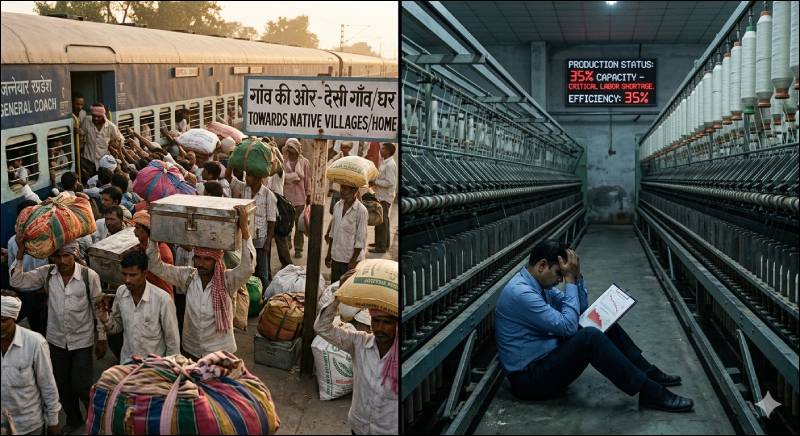
In the high-stakes world of the Indian textile industry, specifically within the precision-driven environment of cotton ring spinning productivity is measured in milliseconds and grams. For a standard 60,000-spindle mill producing 60s count yarn, the margin for error is razor-thin. Yet, every year, like an unstoppable tide, the industry faces a Industrial Paralysis between the months of April and June.
As the Rabi harvest peaks across the fertile plains of Uttar Pradesh and Bihar and the auspicious dates of the Lagan (wedding) season commence, the backbone of our industry, the migrant workforce returns to its roots. This is not merely an HR issue, it is a systemic financial leakage. When 20% of your workforce migrates, you aren’t just losing people; you are losing Rs 10.4 Crore in potential annual savings and roughly Rs 2.1 Crore in direct contribution margin over a 60-day window.
This article argues that we must treat it as a Failure of Infrastructure and Strategic Design. To survive the Summer Peak, we must transition from managing labor as a variable cost to engineering it as Critical Capital.
Pillar 1: Infrastructure As The Ultimate Retention Tool
The primary pull of the native village is the security of home and the proximity of family. To counter this, the modern mill must evolve into a Self-Sustaining Ecosystem.
1. The Mill Village Concept: Hostels and Colonies
For 30 years, I have observed that mills with on-site housing have 40% higher retention rates during the summer.
- Bachelor Hostels: Designed for the migrant or trainee workforce (4–6 per room) with high-standard hygiene, nutritious mess facilities and high-speed Wi-Fi.
- Family Quarters (1RK/1BHK): These should not be viewed as labor quarters but as Performance Incentives. Allotting a family unit to a top-tier operator (Star Performer) creates a Social Anchor. When a worker’s family is with them, the urge to return home for every minor village event vanishes.
2. The CAPEX vs. OPEX Reality (The Financial Eye-Opener)
- Investment: A Rs 9.0 Crore investment in housing (~400 capacity).
- Recovery: Through the elimination of seasonal shutdowns, reduction in recruitment costs and Waste reduction (from untrained temporary hands), the Payback Period is approximately 3.4 years.
- The Logic: You are already paying for a colony every four years through lost production. Why not build it and own the asset?
Pillar 2: The State-Mix And Vocal For Local Buffering
Over-reliance on a single geographic demographic is a strategic vulnerability. If 90% of your Ring Frame department is from one district in Bihar, your mill is essentially governed by that district’s harvest calendar.
1. The 50% Diversification Rule
Corporate HR must mandate a State-Mix policy. No single department should have more than 50% of its workforce from one region. By balancing workers from Odisha, Madhya Pradesh, Jharkhand and local regions, you ensure that Mass Leaves do not happen simultaneously.
2. The Local Stabilizer Layer
We must embrace the Vocal for Local philosophy. Building a 30% Base Layer of employees from within a 30–50 km radius is essential.
- The Local Advantage: These workers do not have Native Travel requirements. They are your stabilizers during the harvest months.
- The Marriage Gift Policy: To cement this loyalty, the company should announce a formal Shagun (Marriage Gift) for local workers or their children, contingent on a 90% annual attendance record. This turns the mill into a respected community institution, not just a factory.
Pillar 3: The 1+1 Mentorship And Continuous Pipeline
Labor shortages should never be a surprise; they should be a scheduled MCO (Machine Care Operator) Recruitment event.
1. The One Worker, One Trainee Scheme
Instead of relying on expensive third-party contractors who provide low-quality labor, incentivize your best workers to become Recruitment Partners.
- The Strategy: Encourage a senior worker to bring one relative or friend from their village as a trainee.
- The Mentorship Bonus: The Sponsor receives a monthly mentorship bonus as long as their trainee stays and hits production KPIs. This creates a natural Support System for the newcomer, drastically reducing the First-Month Attrition that plagues our industry.
Pillar 4: Financial Leverage And Lagan Support
The primary reason workers go home is financial to save money on harvest labor or to manage high-interest debts for family weddings.
1. The 26-Day Interest-Free Loan
This is the most potent retention tool in our arsenal.
- The Policy: Any worker who completes 26 days of attendance during the peak months of April or May becomes eligible for an Interest-Free Emergency/Marriage Loan.
- The ROI: The Cost of Capital for the mill to provide this loan is negligible compared to the Rs 35,000– Rs 50,000 loss per day incurred when a machine sits idle. By becoming the worker’s Banker, you eliminate the need for them to return to village moneylenders.
Pillar 5: Corporate Integrity And Cultural Bonding
Nothing destroys a mill’s reputation faster than False Statements from the HR department. In the tight-knit communities of textile workers, word travels fast.
1. The Zero-Gap HR Mandate
If a Summer Attendance Scheme is announced, it must be honored with the same rigidity as a bank guarantee. Payouts must be transparent, public, and automated. When HR sticks to announced benefits, it builds a Trust Premium that competitors cannot poach with a simple Rs 500 salary hike.
2. On-Site Cultural Integration
We must bring the festival to the mill.
- Ram Navami & Community Bonding: Organizing high-impact, on-site celebrations for festivals like Ram Navami, including community meals (Bhandara) and cultural programs creates Social Capital.
- The Result: A worker who celebrates with his Mill Family develops an emotional bond with the organization. It transforms the workplace from a cold industrial site into a community.
The Earning-To-Benefit Ratio: A Comparative Summary
To the Managing Directors and Board Members, look at these numbers as a Financial Eye-Ope
| Strategic Activity | Annual Investment (Est.) | Annual Benefit/Value Realized |
| Housing & Hostels | Rs 90 Lakhs (Amortized) | Rs 2.10 Crore (Prod. Recovery) |
| Interest-Free Loans | Rs 8 Lakhs (Interest Loss) | Rs 40 Lakhs (Retention Value) |
| Local Marriage Gifts | Rs 5 Lakhs | Rs 15 Lakhs (Local Stability) |
| “1+1” Mentorship | Rs 15 Lakhs | Rs 25 Lakhs (Training Savings) |
| Cultural/Fest Events | Rs 7 Lakhs | Rs 10 Lakhs (Moral/Quality) |
| TOTAL | Rs 1.25 Crore | Rs 3.00 Crore+ |
Net Benefit Ratio: For every Rs 1 spent on strategic retention, the mill earns back Rs 2.40 in direct and indirect profit.
Conclusion: Beyond Labor Management
As we move toward a future of high-speed automation and global competition, the Indian textile industry can no longer afford the Seasonal Prayer, the hope that workers will return quickly after the harvest.
We must build Engineered Stability. By investing in Physical Infrastructure (Hostels), Financial Anchors (Interest-Free Loans) and Cultural Integrity, we don’t just retain workers. We build a permanent, loyal and highly efficient workforce that views the mill as their primary home and their primary future.
(Pravin Salokhe is the Production Manager at Alok Industries Ltd