‘We Want To Build More Sustainable & Long-term Relationships With Customers’
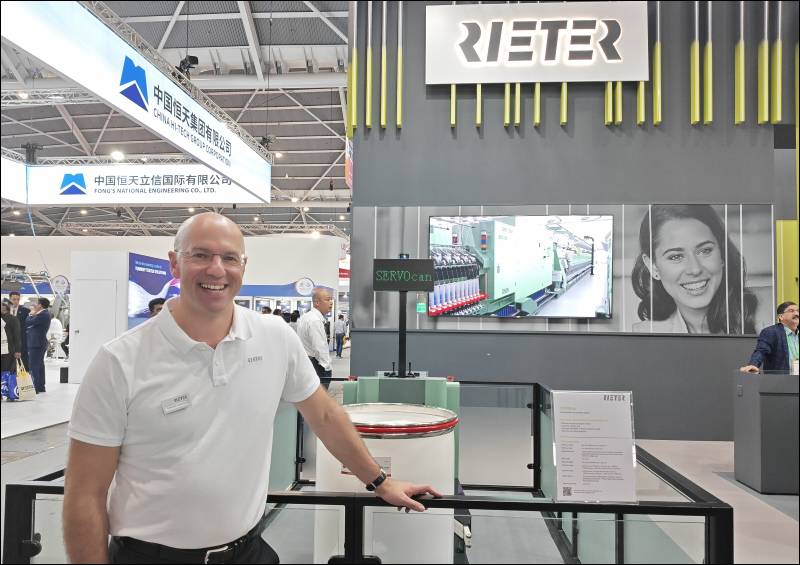
We offer numerous retrofit solutions that bring the innovations of our latest machines to existing installations. Through continuous upgrades, customers can maintain high productivity and efficiency throughout the machine’s lifetime, states Alexander Özbahadir in this exclusive interview with Textile Insights Associate Editor, Henry Dsouza.
What will be the key priorities for Rieter After Sales in 2026 and beyond?
Our number one priority is to be much closer to the customer and present a unified face to them. Rieter is a company with more than 230 years of history and we stand for continuous innovation and forward-thinking progress. Our focus must be on ensuring that our customers can access the full breadth of our expertise and services simply and seamlessly.
The second key priority is to bring our spare parts closer to customers. We are focusing on establishing spare parts centres in strategic locations to ensure faster delivery and greater availability.
And finally, we want to build more sustainable, long-term relationships. Moving forward, our goal is to offer a continuous service partnership, ensuring that customers always have Rieter by their side.
Which after-sales solutions or upgrades are most in demand from spinning mills?
Compacting upgrades are definitely among the most in-demand solutions. We offer both pneumatic and mechanical compacting systems and the preference varies depending on the market. Some regions favour pneumatic systems, while others prefer mechanical ones.
Another very popular upgrade is our ROBOspin, the industry’s first fully automated piecing robot. It can be retrofitted to existing ring spinning machines and it significantly reduces labour requirements, as the robot performs the piecing automatically. This not only improves efficiency, but also ensures consistent quality in operation.
How is Rieter integrating digital tools like ESSENTIAL into its after-sales services?
ESSENTIAL operates on several levels. The first layer provides complete transparency over each machine, allowing operators to monitor performance in real time from a central control screen and directly influence productivity and efficiency.
The second layer focuses on system-wide connectivity. ESSENTIAL links machines across the spinning process, helping users clearly identify where to intervene to achieve performance improvements.
And finally, one of the most practical benefits is digitalization of workflows. By eliminating paper on the shop floor, we reduce manual errors and improve data accuracy. It’s a simple but powerful step toward a smarter, more efficient mill operation.
What role does predictive maintenance play in Rieter’s after-sales approach?
Predictive maintenance is a big topic, but its relevance differs across industries. To give a simple example, if you’re in an airplane and there’s even a 10% chance of an engine failure, the plane will never take off. But if one spindle in a spinning mill has a 10% chance of malfunctioning, would you send an engineer immediately or wait until it fails? It’s a very different scenario.
Predictive systems work best when customers are ready to act on early warnings. We are observing and analyzing data to understand failure patterns, but in our industry, predictive maintenance is not yet fully practical on a daily basis. It will come in time, but right now, it’s still developing toward that stage.
How does Rieter help customers improve efficiency and sustainability through retrofit and upgrade packages?
As mentioned earlier, compacting is one of our most in-demand upgrades because it significantly improves yarn quality. Compact yarn offers better performance for many applications. Another important solution isROBOspin, which automates the piecing process. By reducing manual intervention, it not only saves labour but also enhances productivity and consistency.
Beyond these, we offer numerous retrofit solutions that bring the innovations of our latest machines to existing installations. Since Rieter machines are built to run for many years and beyond, it’s essential to keep them at modern performance level. Through continuous upgrades, customers can maintain high productivity and efficiency throughout the machine’s lifetime.
Textile mills often demand high uptime and quick service response. How is Rieter strengthening its after-sales service network to meet these expectations?
It’s very straightforward, we need to be closer to our customers, both through people and parts. First, we are increasing the presence of our service technicians, ensuring they are more frequently on-site and available when needed.
Second, we are moving regionally specified portions of our spare parts portfolio into regional hubs to shorten delivery times. We’re expanding local spare parts inventories in four key regions, i.e. India, China, the Americas and Europe, so that customers are supported from nearby hubs rather than from a central location.
At the same time, we are regionalizing and expanding our field service teams, enabling more regular visits and preventive support. This approach ensures our customers’ machines consistently run at the highest possible efficiency and uptime.
What is your outlook for the Indian spinning industry?
It’s quite simple as one of my math professors once said, “Everything you multiply by 1.4 billion becomes very, very big.” India is still in an early stage of development, but it has enormous potential ahead.
With a growing middle class and a rising standard of living, the demand for textiles will continue to expand. People will always need clothing and as prosperity increases, so does the market for higher-quality yarns and fabrics. So, all signs point to a bright future for India’s spinning industry.