Bharat Tex Has Maintained The Bharat Flavour While Creating A Global Platform: Samir Joshipura
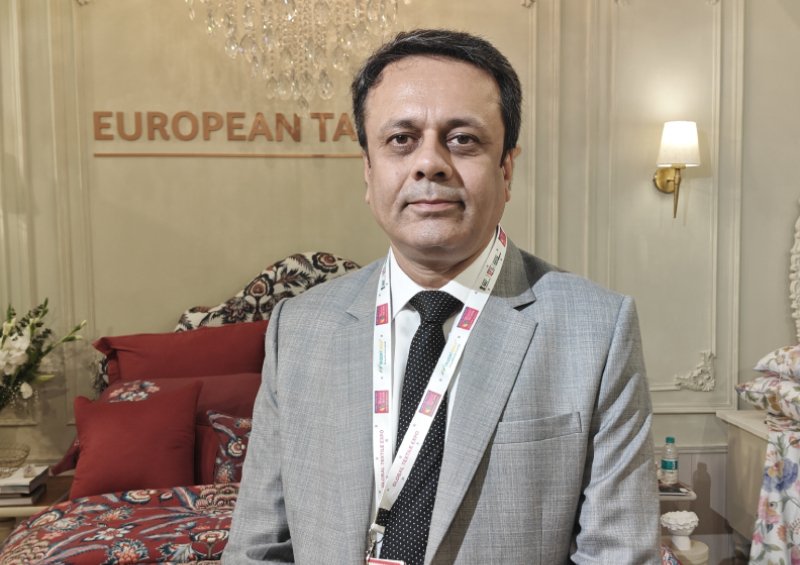
Samir Joshipura, Group CEO, Trident Group, speaks on the overwhelming response at Bharat Tex 2026, evolving consumer preferences, global market challenges, India’s growing competitiveness and Trident’s sustainability journey.
Trident Group’s booth at Bharat Tex 2026 has been witnessing a steady stream of visitors, reflecting the growing interest in the company’s diverse product offerings and design-led collections.
“The response has been fantastic. A lot of people are visiting us, including our partners and international buyers. We are also seeing a large number of walk-in visitors,” says Samir Joshipura

According to Joshipura, the growing scale of Bharat Tex is a positive development for the Indian textile industry. “Year on year, Bharat Tex is growing, which is a good thing,” he says.
Mapping the changing consumer
Trident has designed its booth to reflect the diversity of consumer preferences. Rather than showcasing products as a single, uniform collection, the company has attempted to map different design sensibilities from minimalist and maximalist preferences to traditional aesthetics.
“Different consumers might have different preferences, so we have tried to cater to them,” explains Joshipura. The company is also using the exhibition as an opportunity to learn directly from visitors and buyers.
“We are also learning from them through their feedback. If they need something more or something less, we are ready to incorporate that into our collections,” he adds.
Among the highlights at the booth are collections created in collaboration with leading Indian designers Shivan & Naresh and Karan Torani. Trident is also showcasing its traditional collections, including Sanskriti and collections inspired by tales from the Ramayana.
The traditional segment, Joshipura says, has been witnessing strong interest from visitors. “These are some of the sections we have, but I think everyone will have to experience and see those collections here,” he says.
Agility is key in a challenging global market
The first half of the year has presented a challenging business environment for textile companies, with geopolitical uncertainties and disruptions affecting global trade.
“Business is obviously challenging because of the uncertainties we are facing,” Joshipura acknowledges. However, he believes that agility and strong partnerships have helped Trident navigate the changing environment.
“The key part is being agile and our partnership with customers, where we work together to find a solution to whatever challenge comes up,” he says.
For Trident, this approach extends across the entire value chain. The company works closely with both suppliers and customers to develop solutions that create mutual value.
“Our approach going forward is to be agile and reactive to any challenge that comes up, and to work with our partners on both the supply side as well as the customer side to find a common solution a win-win solution,” Joshipura explains.
FTAs open new opportunities
Looking ahead, Joshipura is optimistic about the prospects for the Indian textile industry. The signing of free trade agreements, he believes, will help Indian companies become more competitive and gain access to new markets.
“The market is going to keep improving, especially with the FTAs being signed by India, which are opening up a few more territories and making us competitive there,” he says.
For home textile and textile companies, he sees significant opportunities emerging as India strengthens its global trade relationships.
“From an opportunity point of view, there is a very large opportunity for all the home textile players and textile players of India,” he adds.
Bharat Tex: Global ambition with a distinctly Indian identity
Joshipura believes Bharat Tex has evolved rapidly in just three editions and is now being compared with some of the leading international textile fairs.
“It is a fantastic effort. In three years, we have matured to an extent that Bharat Tex is now being compared with, or has surpassed, globally renowned textile fairs,” he says.
What sets the event apart, however, is its ability to retain its Indian identity while building a global presence. “The most important part is that Bharat Tex has maintained the Bharat flavour,” says Joshipura.
He points out that the exhibition is not limited to large organisations and global brands. SMEs and handicraft businesses also receive significant visibility, creating a more inclusive representation of India’s textile ecosystem.
“It has not become just a showcase for large organisations or big brands. Even SMEs and handicrafts get equal weightage. From that point of view, it has maintained that Bharat flair, but it still has a global context,” he says.
The growing presence of international buyers, he adds, is proof of Bharat Tex’s increasing global relevance.
Sustainability is embedded in the business
For Trident, sustainability is not viewed as a standalone project or a separate initiative. It is integrated into the company’s overall business strategy.
“Sustainability is not a project. It is a part of any initiative that we do,” Joshipura says.
The significant reduction in GHG emissions across our upstream and downstream value chain reflects the effectiveness of our ongoing initiatives and our unwavering commitment to climate action and sustainable business practices.
“We have got a notch up in our sustainability rating, and we have surpassed our 2026 targets for emission reduction,” he says.
Trident is also working on a new solar power project, reflecting its continued focus on renewable energy and reducing its environmental footprint.
Continuing the growth journey
Looking ahead, Trident plans to continue investing in new projects and expanding its business as opportunities emerge.
“Trident would keep progressing through projects as it has in the past, and we would continue investing in new projects as and when we plan for them,” says Joshipura.
For the company, the road ahead will be defined by continued investment, agility in responding to global challenges, closer partnerships and sustainability embedded into every aspect of growth.
By Henry Dsouza, Associate Editor of Textile Insights.