
India ITME Panel Discussion: Moving From ‘Make In India’ To ‘Make For The World’ To Grab US$ 100 Bn Textile Machinery Opportunity
India has the engineering talent, a large textile industry and a growing manufacturing base. What it lacks is not capability alone, but the depth of ecosystem, policy alignment, scale and collective ambition required to become a global textile machinery powerhouse.
The next phase of India’s textile growth may not be determined only by how much fabric or apparel the country produces. It could depend equally on whether India can build the machines, technologies, components and engineering capabilities that will power the global textile industry of the future.
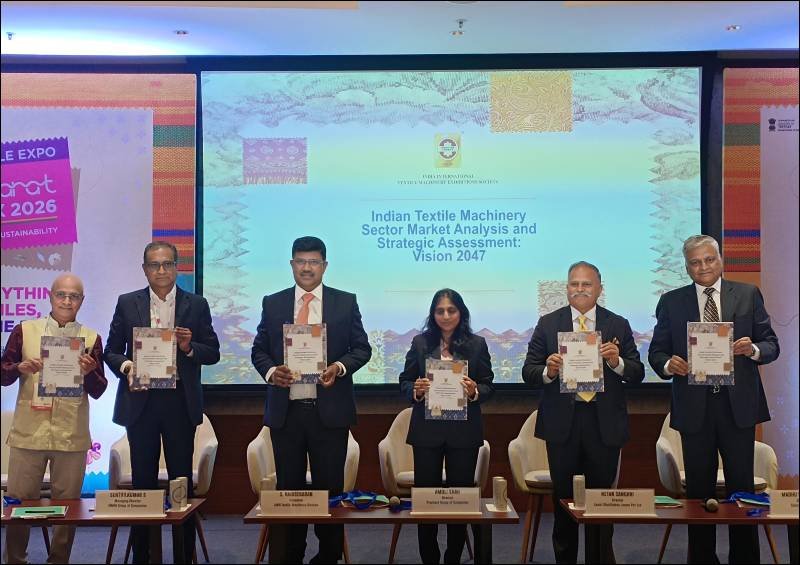
That was the larger question behind the panel discussion on ‘Make-In-India – Textile Machinery – The US$ 100 Billion Opportunity’ at Bharat Tex 2026. The discussion focused on whether India can move beyond manufacturing machines for its own market and become a major global supplier of textile machinery and technology?

The answer from the panel was cautiously optimistic, but only if India addresses some fundamental structural weaknesses.
The opportunity is large. So is the gap.
The global textile machinery market was estimated at US$ 34 billion in 2025. China, Germany and Japan occupy dominant positions, while India’s share remains relatively small. That disparity highlights both the challenge and the opportunity.
India is one of the world’s major textile and apparel manufacturing economies. It has a substantial domestic market, engineering talent, a growing manufacturing ecosystem and a large base of MSMEs. Yet its position in the global textile machinery trade does not reflect the scale of its textile industry.
This creates an important strategic contradiction.
India wants to become a major global textile and apparel manufacturing hub. It wants to increase exports, attract investment and build domestic manufacturing capabilities. But if the machinery required to expand that industry continues to be predominantly imported, a significant portion of the value created by textile growth will remain outside the country.
The opportunity, therefore, is not merely to manufacture more machines. It is to build an integrated textile engineering ecosystem. That distinction is critical.
The first challenge: Moving beyond assembly

S. Rajasekaran
S. Rajasekaran, President of LMW Textile Machinery Division, offered one of the clearest perspectives on what separates a genuine machinery manufacturing ecosystem from an assembly operation.
For LMW, the approach was not to simply assemble imported components and market the final product as Indian.
“We were not satisfied with just assembly of imported parts,” Rajasekaran said. “If we are going to take that forward, let us not start with the assembly of imported parts.”
“The real challenge”, Rajasekaran argued, “lies in developing high-precision manufacturing capabilities, building internal engineering competence, upskilling workers and automating repetitive processes.”
This is the difference between manufacturing in India and developing manufacturing capability in India. The distinction will become increasingly important as global competition intensifies.
India can assemble machines at competitive prices. But to compete with established machinery-producing nations, it must also control more of the technology stack from precision components and materials to software, automation and product development.
LMW’s experience demonstrates the importance of investing in the ecosystem around the machine itself. The company developed its own manufacturing capabilities and invested heavily in R&D.
Its R&D organisation, Rajasekaran explained, includes around 250 engineers across disciplines such as metals, aerodynamics and mechatronics.
The objective is not simply to respond to what customers ask for. “The voice of the customer reverberates into us in full,” he said. More importantly, the company also seeks to understand the problems customers may not yet be able to articulate.
That is a significant shift in the competitive model. The future of machinery manufacturing will not be determined only by the ability to produce equipment at a lower cost. It will depend increasingly on the ability to understand a customer’s production problem and engineer a better solution.
The missing ecosystem is costing India
The most immediate challenge for many Indian machinery manufacturers is that the supporting ecosystem remains uneven.

Madhu Sudan Dadu
Madhu Sudan Dadu, Chairman of Colorjet India Ltd., described the problem from the perspective of a technology company that had to build capabilities outside its core area because suitable suppliers were unavailable.
“When we started, we found that we could not find the right suppliers who could deliver the quality that we wanted, at the right time and with the safety of our designs,” Dadu said.
The result was backward integration into areas such as powder coating and sheet metal manufacturing. This may be necessary for an individual company, but it is not an efficient model for the industry as a whole.
When a machinery manufacturer has to spend capital, management time and engineering resources developing basic supporting capabilities, fewer resources remain available for core innovation. This is why the depth of the supply chain matters.
A global machinery ecosystem requires specialised suppliers capable of producing precision components consistently, at scale and to international quality standards.
Without that network, even technically capable machinery manufacturers remain vulnerable to imported components and supply disruptions.
The challenge is particularly significant for MSMEs, which often lack the financial capacity to vertically integrate across every layer of the value chain.
Policy support must recognise machinery industry as strategic capital goods
The panel also raised a fundamental policy question: Should textile machinery manufacturers be treated differently from the textile industry they supply? Dadu argued that the answer should be ‘no’.
“Capital goods or machines go hand-in-hand with the textile industry itself,” Dadu said, adding: “The growth of the textile industry in India cannot succeed without the growth of the capital goods or the machines which they use in their industry.”
This has important implications for policy design. Schemes aimed at strengthening the textile industry often focus on the user of machinery. However, if the objective is to build domestic manufacturing capability, the machinery producer must also be a part of the policy framework. This includes access to appropriate incentives, financing support, R&D assistance and industrial infrastructure.
A policy framework that supports the purchase of machinery but does not adequately support its domestic manufacture can produce an unintended result: the expansion of the textile industry without the corresponding development of a domestic textile engineering base. The result is a form of industrial growth that remains dependent on imported technology.
Inverted duty structures: When ‘Make in India’ becomes more expensive
One of the most significant issues raised during the discussion was the inverted duty structure.
In several cases, imported finished machinery can enter India at low or zero duty, while domestic manufacturers are required to pay customs duties on imported components used to manufacture competing machinery. This creates a paradox.
The domestic manufacturer is expected to invest in manufacturing, employ people, develop technology and build local capability, but may still face a higher cost structure than a foreign manufacturer shipping a finished machine into India.

Prasanta Deka
Prasanta Deka, Managing Director of Rieter India Pvt. Ltd., described this as one of the key structural concerns facing the industry. Deka pointed to examples where machinery components attract duties while finished imported equipment can enter at lower rates. The consequences go beyond the immediate cost of a machine.
If domestic manufacturing becomes more expensive than importing, the incentive to establish manufacturing facilities in India weakens.
Deka referred to an example involving a Japanese machinery company that compared the cost of manufacturing in India with producing the machinery in Japan and exporting it to India. The result, he said, was that manufacturing in India was found to be almost twice as expensive.
The implication is stark. “India cannot simultaneously ask global companies to manufacture locally and maintain a tariff structure that makes local production economically unattractive,” says Deka.
The policy objective must therefore be to create a framework where manufacturing in India is structurally competitive, not merely politically desirable.
Scale or technology? India needs both.

Amoli Shah
Amoli Shah, Director of Prashant Group of Companies, outlined two possible paths for Indian machinery manufacturers. One is scale. The other is technology.
A manufacturer can attempt to achieve competitiveness through large-scale production and cost efficiency. Alternatively, it can compete through smarter, more automated, faster and more sustainable machinery. For most Indian manufacturers, the second path may be particularly important.
India is unlikely to out-scale China in every segment. Competing purely on price against the world’s largest manufacturing ecosystems will be difficult. The alternative is to compete through technology.
“Your product has to be smarter, automated, faster and sustainable,” Shah said.
Artificial intelligence, automation, lower labour requirements, energy efficiency and intelligent production systems will increasingly determine the competitiveness of textile machinery.
This is where R&D becomes a strategic necessity rather than an optional investment. The machinery manufacturer of the future will increasingly resemble a technology company.

Amol Kailash Monga
Amol Kailash Monga, Director, Strayfield, reduced the challenge to two essentials: “Aspiration and R&D.” The statement is simple, but its significance is considerable. India’s machinery industry cannot become a global technology supplier without the ambition to compete beyond the domestic market and the sustained investment required to develop proprietary technology.
“R&D cannot be treated as a cost centre. It must be viewed as the foundation of long-term competitiveness,” says Monga.
From suppliers to global technology partners
India’s accessories and components industry could play a crucial role in this transformation.

Senthil Kumar S
Senthil Kumar S, Managing Director of SIMTA Group of Companies, argued that Indian accessory manufacturers must stop viewing India as their natural market boundary.
Indian suppliers already provide components and accessories to domestic machinery manufacturers and international companies.
But the next step is to develop a global mindset. “The Indian accessories market is very nice, but we should change our mindset,” Kumar said. “We should focus on the global market, not only India.”
This is an important observation. The difference between a local supplier and a global supplier is not simply production capacity. It is the ability to meet international quality standards, deliver consistently, innovate with customers and scale production when required.
The automobile industry provides a useful precedent. A large network of MSME suppliers has developed around major automotive manufacturers. A similar model could emerge in textile machinery.
But that will require Indian component manufacturers to think beyond supplying one domestic customer and instead develop products for multiple global machinery platforms.
Looking beyond traditional machinery strengths
The opportunity for India is not limited to the machinery segments where it has already established capabilities.

Ketan Sanghvi
Ketan Sanghvi, Director, Laxmi Shuttleless Looms Pvt. Ltd. and Chairman of India ITME Society, pointed towards garmenting machinery as one potential opportunity for Indian manufacturers.
His observation is significant because India’s machinery ambitions cannot remain concentrated only in traditional upstream segments of the textile value chain. “As the country seeks to become a more complete textile and apparel manufacturing hub, downstream machinery, including garmenting equipment, could offer opportunities for domestic capability development and eventually for exports,” said Sanghvi.
The opportunity is therefore not restricted to replacing existing imports. India can also develop machinery for markets that are themselves changing. This could create opportunities for Indian manufacturers to focus on intelligent, automated and sustainable machinery designed for the future of textile production.
The larger question is collective ambition
The message from the panel was loud and clear.
India does not need to prove that it can manufacture textile machinery. It has already begun doing that. The more difficult task is to build an ecosystem capable of creating globally competitive technology at scale.
The US$ 100 billion opportunity will not be captured by assembling more machines. It will be captured by developing more technology, building deeper industrial capabilities and creating companies that think of the world as their market.
For India’s textile machinery industry, the next chapter of ‘Make in India’ must therefore be ‘Make for the World’.