Global Textile Fibre Market Crosses 139 Million Tonnes: Polyester Is Driving Next Phase Of Growth
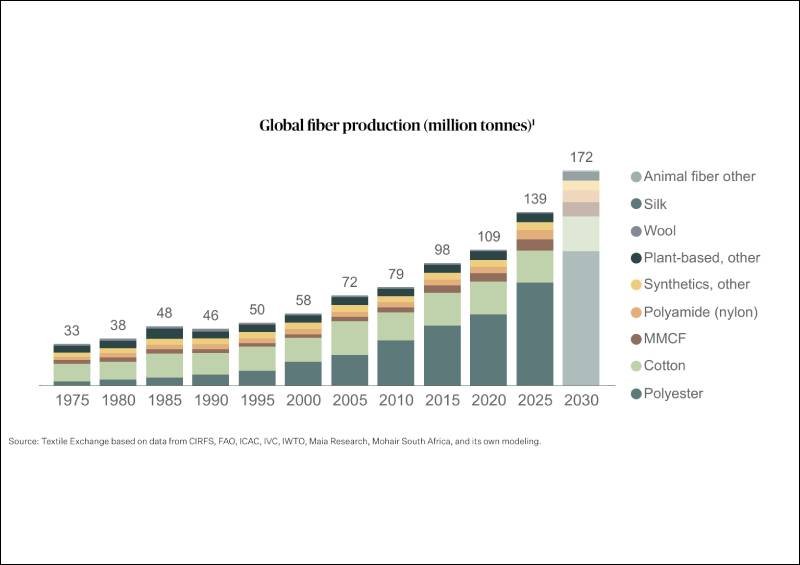
The global textile industry produced a record 139 million tonnes of fibres in 2025, up from 132 million tonnes a year earlier, as polyester and other virgin fossil-based synthetics continued to drive market expansion.
But behind the headline growth is a more complicated picture. While the industry has invested heavily in recycled fibres, the overall share of recycled feedstocks remained at only 7.6% of global fibre production in 2025, unchanged from 2024. More significantly, only around 1% of the global fibre market came from recycled pre- or post-consumer textiles.
The numbers point to a widening gap between the industry’s rapidly increasing appetite for fibre and its ability to build a genuinely circular raw-material system.

Textile Exchange estimates that global fibre production, which stood at 58 million tonnes in 2000, has more than doubled and could reach 172 million tonnes by 2030 if business-as-usual trends continue. Production per person has also climbed from 8.3 kg in 1975 to 17 kg in 2025 and could reach 20.4 kg by 2030.
Polyester drives the next phase of growth
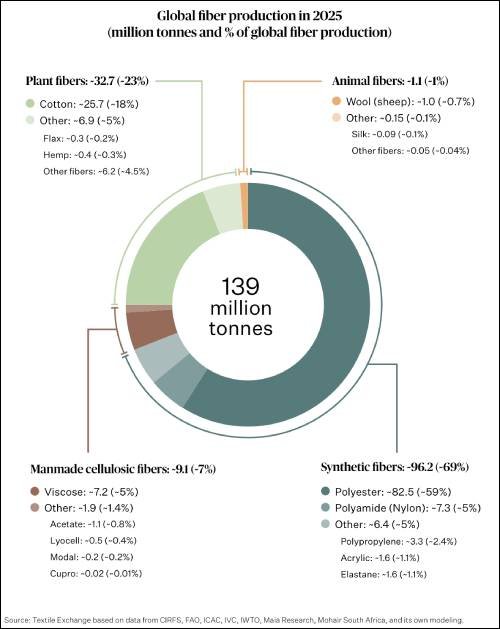
Polyester remains the defining material of the global fibre industry. Production increased from 77.7 million tonnes in 2024 to 82.5 million tonnes in 2025, giving polyester a 59% share of the entire global fibre market. Polyester production alone therefore exceeded the combined production of cotton, manmade cellulosic fibres and wool by a considerable margin.
The growth of polyester has been particularly striking over the longer term. Textile Exchange estimates that polyester production has risen from approximately 9 million tonnes in 1990 to more than 82.5 million tonnes in 2025.
Its expansion has been supported by its cost, durability, versatility and suitability for high-volume manufacturing. Apparel remains one of its largest markets, while home textiles and technical textiles are also important and growing applications. Technical textile demand has expanded across automotive textiles, geotextiles, construction materials, filtration, textile-based packaging and nonwoven hygiene products.
Recycled polyester grows, but virgin polyester grows faster
One of the report’s most revealing findings is that recycled polyester production actually increased in 2025, but its share of the polyester market declined slightly.
Recycled polyester production rose from approximately 9.4 million tonnes in 2024 to 9.7 million tonnes in 2025. However, because virgin polyester production increased more rapidly, recycled polyester’s market share slipped from around 12% to 11.8%.
There is another important distinction. Approximately 97% of recycled polyester continued to come from plastic bottles and other non-textile feedstocks, while only around 3% of recycled polyester was produced through textile-to-textile recycling. That means textile waste remains a relatively minor feedstock for the world’s largest fibre category.
This is arguably the most important circularity statistic in the report: recycled fibre growth does not automatically mean textile circularity.
 Textile-to-textile recycling remains at about 1%
Across the entire fibre industry, only around 1–1.5 million tonnes of fibre produced in 2025 came from pre- or post-consumer recycled textiles. That represents approximately 1% of the global fibre market.
Textile Exchange estimates that textile-to-textile recycled fibre production could increase to approximately 3–5 million tonnes by 2030. Even at the upper end of that range, however, it would remain a relatively small share of a global fibre market that could reach 172 million tonnes under a business-as-usual scenario.
The distinction between recycled and textile-to-textile recycled material is critical. Recycled polyester made from bottles is technically recycled fibre, but it does not close the textile-to-textile loop.
The report estimates that only around 0.3% of all polyester fibre was textile-to-textile recycled in 2025. By contrast, recycled polyamide had a much higher textile-to-textile component, with an estimated 90% of recycled polyamide coming from textile sources, particularly technical textiles such as fishing nets and home textiles such as carpets.
Cotton remains important, but its market share is far smaller
Cotton remains the world’s second-largest fibre by production volume, with 25.7 million tonnes produced in 2025, equivalent to approximately 18% of the global fibre market.
Of the total, around 25.4 million tonnes was virgin cotton and approximately 0.4 million tonnes was recycled cotton. Thus, recycled cotton represented roughly 1% of total cotton production.
The sustainability programme footprint is growing. Textile Exchange estimates that 37% of virgin cotton production was covered by programmes that shared data for the report in 2024-25, compared with 35% in the previous season.
Better Cotton and its equivalents represented the largest portion of programme-covered cotton, accounting for 24% of all virgin cotton production.
For the cotton industry, therefore, the story is less about a dramatic shift away from conventional production and more about the gradual expansion of certified and programme-covered production within a very large conventional base.
MMCFs gain ground
Man-made cellulosic fibres (MMCFs) are emerging as another important part of the global materials mix.
Production of viscose, lyocell, modal, acetate and cupro increased from 8.4 million tonnes in 2024 to 9.1 million tonnes in 2025, lifting the category’s market share from 6% to 7%.
Around 65–70% of MMCF production used FSC- or PEFC-certified or controlled feedstock in 2025.
At the same time, recycled MMCFs remain small. Their share increased from approximately 1.1% in 2024 to 1.5% in 2025, suggesting that recycled cellulosic fibre technology is developing but remains at an early stage.
Nylon’s next growth story may be technical
Polyamide, or nylon, accounted for approximately 7.3 million tonnes and 5% of the global fibre market in 2025.
The report identifies technical textiles as the fastest-growing end-use area for polyamide. Applications include automotive textiles, fishing nets, ropes, airbags, tyre cords and filtration materials.
Yet recycled polyamide represented only around 3% of total polyamide production, while bio-based polyamide was approximately 0.5%. Cost, availability and technical recycling challenges continue to limit wider adoption.
This provides an important indication of where future fibre demand may be moving: not simply into clothing, but increasingly into performance, industrial and technical applications.
Technical textiles emerge as a structural growth area
One of the most significant additions to the 2026 report is its new analysis of raw-material production by end use.
Textile Exchange estimates that technical textiles have experienced the strongest growth over the past two decades. The category covers automotive textiles, construction materials, medical products, filtration systems, geotextiles and nonwoven hygiene products.
Apparel remains the largest broad end-use market, while home textiles continue to represent an important consumption base. Bags and footwear are comparatively small segments. This changes the way the global materials market needs to be viewed.
The future demand for fibres will not be determined solely by fashion consumption. Infrastructure, mobility, healthcare, hygiene, construction, filtration and industrial applications are increasingly important drivers of material demand.
For polyester, in particular, technical textiles are identified as one of the strongest growth areas.
Natural fibres remain significant, but in a very different market
The scale of synthetic fibres also puts natural fibres into perspective.
Plant fibres accounted for approximately 23% of global fibre production in 2025, with cotton representing the largest component. Man-made cellulosics added another 7%, while animal fibres represented only around 1%.
Sheep wool production was approximately 1 million tonnes, equivalent to only 0.7% of the global fibre market. Yet wool had one of the higher recycling rates among major fibre categories, with recycled wool accounting for around 8% of total wool production in 2025.
This highlights an important characteristic of the materials market: market scale and circularity performance are not necessarily correlated.
A smaller fibre category can have a much higher recycled share, while a massive fibre category can dominate total recycled volumes despite having a relatively low recycling rate.
Beyond fibres: leather, down and rubber
The materials story extends beyond yarn and fibre. Global production of raw hides from cattle, sheep, goats and buffalo was estimated at around 14 million tonnes in 2025. Cattle accounted for approximately 9.5 million tonnes, followed by sheep hides at 2.2 million tonnes, goat hides at 1.5 million tonnes and buffalo hides at 0.8 million tonnes.
Global down production was approximately 0.70 million tonnes, up from 0.67 million tonnes in 2024. Recycled down remained extremely small at around 0.01 million tonnes, while the Responsible Down Standard covered an estimated 13% of virgin down production in 2025.
Natural rubber production was just under 15 million tonnes, with the share of rubber forest covered by FSC and PEFC rising from around 3.7% in 2024 to 4.8% in 2025.
The industry’s central challenge is now visible in the numbers
The 2026 Materials Market Report presents a market growing on two parallel tracks.
The first is volume growth. Global fibre production is rising rapidly, with polyester providing the largest contribution. Under current trends, production could reach 172 million tonnes by 2030.
The second is material transformation. Certified fibres, recycled fibres, bio-based materials, textile-to-textile recycling and alternative feedstocks are all developing.
But these two transitions are moving at different speeds. The recycled share of global fibre production fell from 8.5% in 2021 to 7.6% in 2024 and remained at 7.6% in 2025, even as total production climbed sharply.
That means the industry is currently adding virgin fibre faster than it is replacing it with recycled material.
For manufacturers, brands and textile processors, this creates a significant strategic question: Can circular material supply expand fast enough to keep pace with the industry’s overall growth?
The answer will depend on several factors: collection systems, sorting infrastructure, fibre-to-fibre recycling technologies, economics, design for recyclability, availability of suitable feedstocks and the ability to recycle blended textiles.
The report specifically notes that fibre blends such as cotton-polyester and elastane-containing textiles create significant challenges for recycling. Chemical recycling technologies are being developed to address some of these limitations.
The material market is getting bigger and more complicated
The headline number is 139 million tonnes. But the more revealing numbers are 59% polyester, 18% cotton, 7% MMCFs, 5% polyamide and only about 1% of the total market coming from textile-to-textile recycling. These figures show that the industry’s materials transition is still at an early stage.
The next phase of textile sustainability may therefore be less about simply increasing the percentage of recycled fibres and more about changing where the raw materials come from, how products are designed, how textile waste is collected and separated, and whether fibres can repeatedly return to the textile production system.
As global fibre demand moves towards a potential 172 million tonnes by 2030, the scale of that challenge will become increasingly difficult to ignore.
(Source: Textile Exchange, 2026 Materials Market Report)