India’s Textile Industry Needs To Move From Fragmented Capacity To Integrated Scale
India has one of the world’s largest textile ecosystems, spanning spinning, weaving, processing, garments, home textiles and technical textiles. Yet its manufacturing base remains fragmented. Global brands increasingly want large orders, consistent quality, shorter lead times and traceable, sustainable supply chains. India’s challenge is therefore not simply to produce more, but to build manufacturing ecosystems capable of producing at scale.
India’s textile clusters from Tiruppur, Ahmedabad and Surat to Ludhiana and Panipat, have developed around specialised capabilities. This has created deep entrepreneurial networks and also a supply chain in which spinning, weaving, dyeing, processing, garmenting, packaging and logistics often sit with separate companies.
For a global buyer, that can mean managing multiple vendors for a single order. Coordination becomes harder, lead times can stretch and consistency becomes more difficult to guarantee. China built dense manufacturing ecosystems around large production centres, while countries such as Vietnam have increasingly organised production around export-oriented clusters.

India does not need to copy either model. But it needs to move from a collection of textile units to connected manufacturing ecosystems.
Tiruppur offers a useful template. Its knitwear cluster grew organically into a network of manufacturers, suppliers, processors, logistics providers, service firms and skilled workers. Its strength lies not in one giant factory, but in the density of capabilities around it. The lesson is important: a textile cluster is an ecosystem, not simply an industrial park.
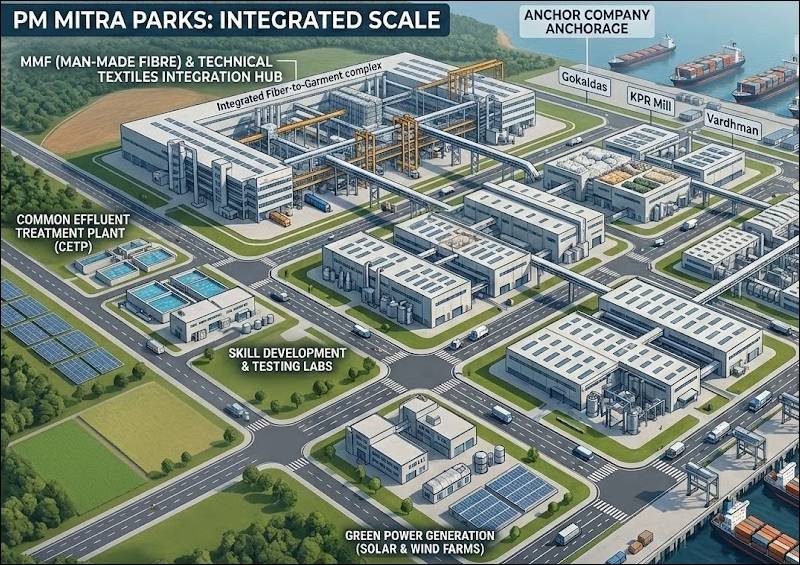
This is where the government’s PM Mega Integrated Textile Regions and Apparel (PM MITRA) parks acquire significance. The scheme envisages seven parks designed to bring much of the textile value chain together, from spinning and weaving to processing and garmenting, alongside common infrastructure, logistics, skill development and other support facilities. The stated objectives include enabling scale, reducing logistics costs, attracting investment and improving export potential.
The real test, however, will be whether these parks become functioning ecosystems rather than collections of factories. Land, roads and factory sheds are only the starting point. Investors also need reliable power and water, effluent treatment, testing laboratories, skilled workers, worker housing, logistics and access to machinery and service providers.
Anchor companies will be critical. Large manufacturers such as Gokaldas Exports, KPR Mill, Vardhman Textiles, Welspun Living and Arvind illustrate how integrated operations can create greater control over quality, sourcing and delivery. Their role in the wider ecosystem can extend beyond their own factories by creating demand for specialised suppliers and services.
This does not mean India’s thousands of textile MSMEs have to disappear. They remain essential to employment, entrepreneurship and specialised production. The problem is excessive fragmentation without adequate linkages.
Smaller companies often struggle to invest in automation, modern machinery, testing systems, digital processes and sustainability certifications. They can also face higher input costs because their purchasing volumes are small. The answer is to connect them more effectively to larger manufacturing ecosystems.
A large apparel exporter, for instance, can serve as an anchor for smaller units supplying accessories, packaging, embroidery, specialised fabrics and other services. Such linkages can allow MSMEs to retain their flexibility while gaining access to larger orders and more demanding global supply chains.
The cost of fragmentation is visible in more than just factory size. It affects productivity, working capital and the ability to respond to changing fashion cycles. When a garment maker depends on several outside suppliers, every change in design, colour, fabric specification or delivery schedule has to travel across the chain. A more integrated cluster can compress those cycles and reduce the risks created by weak links in the supply chain.
This becomes particularly important as buyers diversify sourcing beyond China. The China+1 opportunity is real, but India is competing not only on wages. Bangladesh, Vietnam and other Asian manufacturing hubs have built specialised ecosystems that can handle large export programmes. India has the raw material base, engineering capabilities, labour pool and domestic market to compete, but these advantages need to be translated into globally competitive manufacturing systems.
Scale also matters because global textile consumption has increasingly shifted towards man-made fibres, while India’s historical strength remains cotton. Building competitiveness in man-made fibre (MMF) textiles requires an integrated chain—from fibre and yarn to fabric, processing and apparel.
The government incentives such as the Production Linked Incentive scheme can support investment, but incentives at individual factory level cannot by themselves create a competitive ecosystem. The entire chain has to work together, with reliable raw material supply, consistent fabric quality, efficient processing and competitive logistics.
India’s new textile parks will therefore be judged less by the amount of land developed and more by the activity they generate. A successful cluster needs anchor investors, supplier networks, training institutions, common testing and processing facilities, logistics links and, most importantly, customers.
The Ministry of Textiles’ PM MITRA framework itself recognises this broader requirement, including common processing facilities, effluent treatment, worker housing, training, warehousing and logistics as part of park support infrastructure.
For investors, this also changes the proposition. A textile park with common infrastructure can reduce the upfront burden for individual companies, while proximity to suppliers can lower logistics and inventory costs. For states, clusters can create a wider employment and industrial base than isolated factories. But these benefits will materialise only if park developers and governments focus on commercial viability, rather than treating infrastructure creation as the end goal.
That is also what global brands increasingly look for: not merely a low-cost factory, but a dependable sourcing ecosystem that can deliver volume, quality and compliance.
India’s ambition to expand textile and apparel exports cannot be achieved simply by adding more disconnected production units. Large international orders require manufacturing capacity that can scale quickly, maintain consistency and meet delivery schedules.
Trade agreements can improve market access, but market access is only one part of competitiveness. If Indian manufacturers cannot respond with sufficient scale, speed and reliability, lower tariffs alone will not guarantee a larger share of global sourcing.
The next phase of India’s textile story, therefore, is less about adding another factory and more about connecting the factories it already has. The opportunity is to build a distinctly Indian model: large anchor manufacturers surrounded by specialised MSMEs, supported by common infrastructure and integrated logistics.
If PM MITRA parks can attract anchor companies, bring MSMEs into their supply chains and provide the services that global buyers require, they could help India convert its fragmented strength into manufacturing scale.
India does not need more textile factories merely for the sake of capacity. It needs better-connected factories, stronger clusters and deeper supply chains. The real competitive advantage will come from producing more, faster, at consistent quality and within an integrated ecosystem. That is the scale India has been missing.