Textiles Committee Marks 62 Years Of Service, Sets Sights On A Sustainable Future
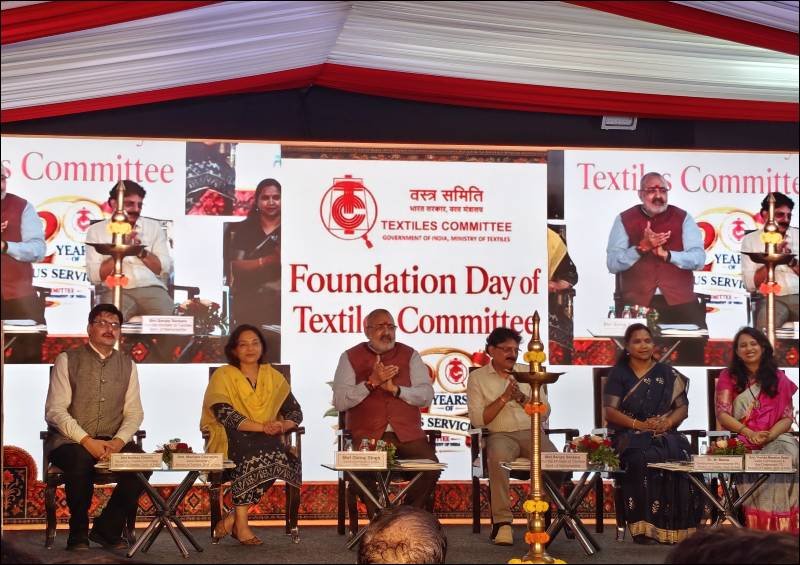
The Textiles Committee, Ministry of Textiles, Government of India, celebrated its 62nd Foundation Day on August 22 in Mumbai, marking more than six decades of contribution to India’s textile sector and outlining a renewed focus on quality, sustainability, circularity, innovation and global competitiveness.
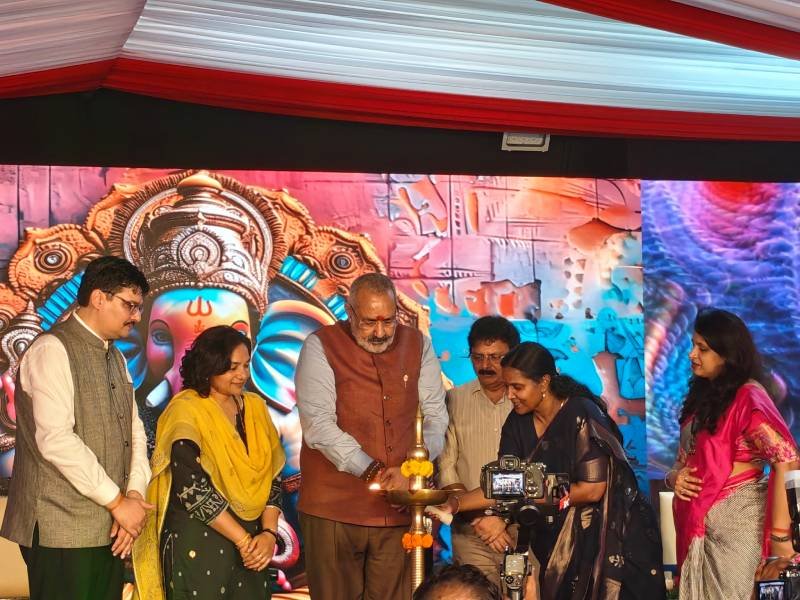
The celebration brought together Giriraj Singh, Union Minister of Textiles, Government of India, as Chief Guest, Sanjay Savkare, Minister of Textiles, Government of Maharashtra, as Guest of Honour; Manisha Chatterjee, Joint Secretary, Ministry of Textiles; Vrunda Manohar Desai, Textile Commissioner and Vice Chairperson, Textiles Committee; Dr. M. Beena, Development Commissioner (Handlooms), Ministry of Textiles; Kartikeya Dhandha, Secretary, Textiles Committee, along with senior officials, industry representatives and other stakeholders.
The event combined a review of the Textiles Committee’s six-decade journey with the launch and showcasing of new initiatives and the felicitation of high-performing textile units.

From regulator to industry facilitator
Welcoming the gathering, the Textiles Committee leadership recalled the organisation’s institutional journey, which began with the establishment of the Cotton Textile Fund in 1944, followed by its re-establishment as a Central Statutory Body in 1948. The Textiles Committee was established through an Act of Parliament in 1963 and commenced its statutory role in 1964.
Over the years, its role has evolved significantly. From its earlier regulatory responsibilities, the Committee has increasingly positioned itself as a facilitator and technical partner for the textile industry, supporting quality assurance, testing, inspection, certification, research, skill development and market intelligence.
The Committee highlighted the modernisation of its laboratory network as one of its key priorities. New laboratories are being established in Bhubaneswar and Indore, while a facility in Ichalkaranji is being developed through the PPP model.
The organisation also emphasised the growing importance of market intelligence, with its Market Research Division undertaking demand estimates, surveys, consumer behaviour studies, import-export analysis, statistical analysis and assessments related to quality control and trade measures.
Manisha Chatterjee: Sustainability must become a competitive strength
Speaking on the occasion, Manisha Chatterjee, Joint Secretary, Ministry of Textiles, underlined the transformation taking place across the global textile industry.
She noted that global supply chains are changing rapidly, while environmental sustainability, chemical safety and circularity are becoming increasingly important in international markets. India, she emphasised, needs to build its global textile identity not only around cost and production capacity, but also around quality, sustainability, innovation and responsible production.
Highlighting the Ministry’s work on safer textile production, she referred to the Textiles Committee’s UNIDO-GEF project on eliminating hazardous chemicals from the textile and fashion supply chain in India.
The initiative seeks to encourage safer and environmentally friendly alternatives, improve production processes and promote better resource management, including energy efficiency, water conservation and zero-liquid-discharge practices. She stressed that such measures are particularly important for MSMEs and textile clusters.
“Sustainability is not just a compliance requirement.”
According to Chatterjee, sustainability can instead become a competitive strength for the Indian textile sector, particularly as India works towards its long-term development goals.
She also highlighted the role of Textile Export Facilitation Centres (TEFCs) in helping exporters access information on rules of origin, free trade agreements, preferential tariffs, certification and changing international regulations.
Looking ahead, she identified three priorities: expanding green chemistry and safer chemical alternatives across textile clusters; integrating TEFC services with national trade and export systems; and harmonising standards covering recycled textile content, circularity and eco-labelling.
Textile Recovery Facility puts circularity into practice
A major focus of the Foundation Day programme was the Textile Recovery Facility (TRF), which demonstrates the Committee’s approach to treating post-consumer textile waste as a resource rather than simply as waste.
Since its launch in 2024, the TRF has collected 52.5 metric tonnes of post-consumer textile waste, of which around four tonnes have been upcycled into value-added products. The initiative has also seen participation from more than 50,000 households, supporting employment and livelihood opportunities.
The Committee also launched a reuse and thrift-store model, through which approximately 2.5 tonnes of good-condition clothing are being washed, pressed and packed before being made available at nominal prices of Rs 100, Rs 150 and Rs 200.
The objective is to extend the lifecycle of garments while creating an affordable avenue for reuse.
A Letter of Intent with the Reviver app was also signed to integrate the TRF collection system with an online pickup facility, allowing consumers to schedule collection of old clothes from their homes.
Digital transformation gathers pace
The Foundation Day also showcased the Committee’s efforts towards digital transformation.
LIMS 2.0, the upgraded Laboratory Information Management System, was highlighted as a significant step towards making laboratory operations more efficient, transparent, traceable and faster.
The event also featured the revamped Textile Statistical Returns System (TSRS) portal, developed by the Office of the Textile Commissioner. The web-based platform is designed to simplify the submission of monthly and annual statistical returns by textile units and improve the availability of reliable and timely data for policymaking.
Textiles Committee and GeM strengthen digital market linkages
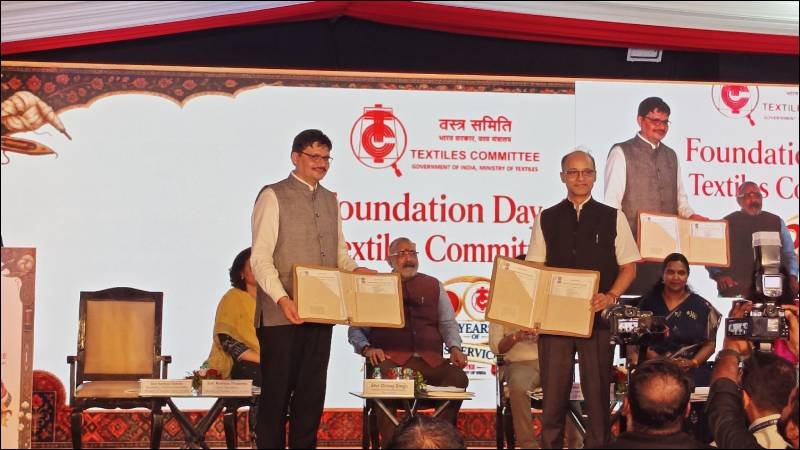
A key development during the Foundation Day celebration was the signing of a Memorandum of Understanding (MoU) between the Textiles Committee and the Government e-Marketplace (GeM), further strengthening the Committee’s efforts towards digital transformation and greater institutional integration.
The MoU is aimed at facilitating collaboration between the two organisations and leveraging the GeM platform for procurement-related activities, while strengthening transparency, efficiency and ease of doing business. The partnership is expected to support the Textiles Committee in accessing a wider and more structured digital marketplace for goods and services.
The collaboration also reflects the growing role of digital platforms in modernising government institutions and streamlining procurement processes. By connecting the Committee more closely with the national public procurement ecosystem, the MoU is expected to contribute to greater efficiency, transparency and accountability in its operations.
Star Rating Scheme strengthens cotton quality
The Star Rating Scheme for Ginning & Pressing units, introduced by the Textiles Committee in 2009, was another major highlight.
The scheme was developed to improve cotton quality through comprehensive assessment of machinery, infrastructure and management practices. According to the presentation at the event, the number of rated units has reached 1,463, including 139 five-star units.
The initiative has contributed to improved quality, lower impurities, greater credibility for ginned cotton and better market opportunities for ginners, farmers and textile mills.
Top-performing G&P units from several states were felicitated during the Foundation Day ceremony in recognition of their performance.
Giriraj Singh: India must raise productivity and global textile presence
Addressing the gathering, Giriraj Singh, Union Minister of Textiles, spoke about the opportunities and challenges before the Indian textile sector and the need to strengthen the country’s position in global markets.
The Minister stressed that quality remains fundamental to exports, while India’s traditional textile heritage and diverse regional products can also become important elements of its global identity. He pointed to the diversity of Indian textiles, fashion and cultural traditions as a significant strength.
He also highlighted the potential of advanced materials and technical textiles, referring to developments in carbon fibre and new-age fibres and the need to move promising technologies from laboratories towards commercial production.
The Minister stressed the importance of productivity across the textile value chain, including cotton and man-made fibres and discussed efforts to expand the production of new-age fibres and strengthen the raw-material base.
He also pointed to the substantial growth potential of India’s domestic textile market and the need for the industry to simultaneously focus on domestic consumption and exports.
On global trade, Singh highlighted the importance of expanding India’s access to international markets and leveraging trade agreements to strengthen textile exports. He also referred to the gap between India’s per-capita textile consumption and that of developed markets, indicating significant potential for future domestic demand.
Dr. M. Beena highlights GI, handloom and circularity
The event also placed emphasis on India’s rich handloom and craft heritage. Dr. M. Beena, Development Commissioner (Handlooms), highlighted the importance of connecting artisans and weavers with organised markets, strengthening product authentication and digital traceability, and leveraging Geographical Indication (GI) products.
The discussion underlined that GI recognition should go beyond being a label and become a means of strengthening the identity, market access and economic prospects of artisans.
The importance of Textile Export Facilitation Centres for emerging handloom exporters was also highlighted, particularly in helping them meet quality requirements and access international markets.
Sanjay Savkare: Technology, exports and reuse must move together
Sanjay Savkare, Minister of Textiles, Government of Maharashtra, emphasised the importance of improving the competitiveness of Indian textiles while promoting the country’s diverse textile and cultural heritage.
His remarks highlighted the need to reduce the difficulties faced by exporters, from registration and documentation to other procedures involved in accessing international markets. He stressed that easing such challenges could contribute directly to higher exports.
He also pointed to Maharashtra’s progress in implementing the PM MITRA Park, noting that more than 95% of infrastructure work had been completed, along with several MoUs.
The Minister highlighted Maharashtra’s technical textile policy and the state’s efforts in reuse and recycling, including work on recovering value from everyday clothing rather than limiting recycling initiatives to industrial waste.
A new phase for the Textiles Committee
The Foundation Day celebration ultimately served as a bridge between the Textiles Committee’s six-decade legacy and the challenges facing the sector today.
From laboratory modernisation and digital systems to export facilitation, cotton quality, technical textiles and textile waste recovery, the Committee is expanding its role from testing and regulatory support towards a broader industry-enabling function.
The celebration therefore marked not merely 62 years of institutional history, but the beginning of another phase in which the Textiles Committee aims to work more closely with government, industry, exporters, manufacturers, artisans and other stakeholders to build a stronger and more globally competitive Indian textile sector.