
Recycling To Drive Indian Polyester Industry’s Next Growth Phase
Recycling is poised to become a significant new business opportunity for India’s polyester industry, driven not only by tightening sustainability and circularity requirements in major overseas markets but also by increasingly compelling economics at home. As global brands face pressure to reduce virgin material use and incorporate recycled content, Indian polyester producers have a growing opportunity to supply higher-value recycled fibres and yarn while reducing their dependence on virgin feedstock.
The Indian polyester industry currently has a production capacity of around 3.6 million tonnes per annum of polyester filament yarn and around 1.50 million tonnes per annum of polyester staple fibre. Industry estimates suggest that India’s polyester recycling capacity could exceed 1.6 million tonnes a year by 2030, driven by rising demand for recycled fibres and increased investment in advanced recycling technologies.
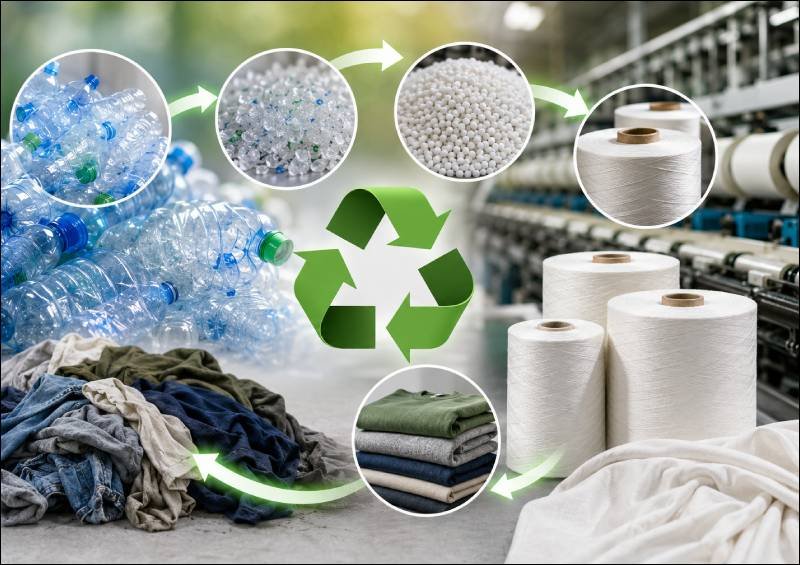
For years, recycling in India’s polyester industry has largely followed a simple model: collect discarded PET bottles, convert them into flakes and then turn them into recycled polyester fibre or yarn. That business has grown into a sizeable ecosystem, helping keep millions of bottles out of landfills while providing textile makers with an alternative to virgin polyester.

But the industry is now approaching a more difficult and potentially much larger frontier: turning discarded polyester textiles back into polyester. The shift from bottle-to-fibre to genuine textile-to-textile recycling is still at an early stage, but Indian companies are beginning to invest in the chemical technologies and capacity needed to make it commercially viable. Currently things are at a nascent stage. Globally also the scale remains tiny as compared to the size of the polyester industry. Textile-to-textile recycling accounted for less than 1 per cent of global fibre production in 2024. Meanwhile, the global polyester production alone stood at around 78 million tonnes.
In India, Filatex India is making one of the most ambitious bets through its wholly-owned subsidiary, Ecosis. The company is planning to invest significant capex in the next few years to build up its textile-to-textile polyester recycling platform which will convert end-of-life textiles into virgin-grade polymer and yarn, through its patented technology.
Ecosis will convert pre-and post-consumer polyester textile waste into virgin grade PET chips and yarn using a molecular regeneration process based on glycolysis. The company says the technology is patent-protected, GRS-certified and supported by lifecycle assessment. Its proposition is fundamentally different from simply converting bottles into recycled fibre: the feedstock itself is textile waste.
Filatex has already operated a pilot plant and is now moving towards commercial scale operations. Its planned facility has a capacity of around 26,750 tonnes a year, backed by an investment of about Rs 300 crore. The company has said the plant in Dahej is targeted for commissioning in September-October 2026. The company believes the recycling vertical has the potential to emerge as a key growth driver, capable of generating topline revenue comparable to the company’s current revenue over the long term.

Madhu Sudhan Bhageria
Chairman and Managing Director Madhu Sudhan Bhageria has described Ecosis as the company’s biggest step in sustainability, saying the process converts end-of-life polyester textiles into virgin grade recycled chips and yarn and represents “genuine closed-loop recycling, not downcycling.” He has also made clear that the company sees recycling as a major future growth area.
In an earnings call, Bhageria said, “Going forward I don’t think too much opportunity would be left and major expansions would come only in the recycle business where we would be converting textile waste into virgin chips.”
That is a significant statement from a listed polyester manufacturer. It suggests that recycling is not being viewed merely as an ESG add-on but potentially as the company’s principal avenue for future expansion.
Filatex is also trying to build the customer ecosystem around Ecosis. It has been working with companies including Decathlon India and American & Efird on applications for recycled polyester, recognising that the economics of textile-to-textile recycling will ultimately depend on securing brand and industrial offtake.
The move comes at a time when polyester is becoming even more dominant globally. Textile Exchange’s latest Materials Market Report estimates that global fibre production reached a record 132 million tonnes in 2024, with polyester accounting for about 77.7 million tonnes, or 59 per cent of the total. Recycled polyester production rose from 8.9 million tonnes in 2023 to 9.3 million tonnes in 2024, but its share of polyester production fell from 12.5 per cent to 12 per cent, as virgin polyester continued to grow faster. Textile Exchange estimates that, if current trends continue, global fibre production could reach around 169 million tonnes by 2030. Meanwhile, less than 1 per cent of global fibre production came from pre-and post-consumer recycled textiles in 2024, highlighting the huge gap between the growth of polyester and the development of textile-to-textile recycling.
That gap is precisely where the next recycling opportunity lies. Filatex India’s Ecosis is perhaps the clearest example of an Indian conventional polyester producer trying to move into this next generation of recycling and experts believe that others may follow with some concrete plan to explore this vast opportunity.
The move towards textile-to-textile recycling is being built on an already established Indian recycling industry. Ganesha Ecosphere, one of India’s pioneers in PET recycling, has built a sizeable presence across the recycled-polyester value chain, converting post-consumer PET bottles into recycled polyester fibre, yarn and rPET or recycled PET chips. The company’s rPET chips business currently has 64,500 tonnes of installed capacity, of which 42,000 tonnes is operational, while another 22,500-tonne line has been commissioned at Warangal and is awaiting regulatory approval. The company plans a further 22,500-tonne expansion along with debottlenecking, taking its rPET chips capacity to around 97,000–98,000 tonnes, or nearly 1 lakh tonnes, by the end of FY27.
The company management says demand for rPET is currently running ahead of supply: against estimated industry demand of 4.5–5 lakh tonnes, current supply is only around 2.5–2.8 lakh tonnes. Ganesha is also seeing growing interest from global and Indian brands, with its recycled filament yarn having qualified with a leading global textile brand.

Sharad Sharma
“We are proud that our country is accelerating adoption of circular economy and building resilience and adaptability to climate risk. With 30 years of experience in plastics recycling and years of R&D in bottle-to-bottle recycling, we are ready to support our suppliers, customers and nation to close the plastic recycling loop,” says Sharad Sharma, Managing Director, Ganesha Ecosphere.
Revalyu Recycling India, formerly Polygenta, represents another technological step. It uses chemical recycling to convert PET waste into polyester polymer and filament yarn and has been commercially producing chemically recycled polyester for more than a decade.
Sanathan Textiles is also building a presence in recycled polyester through its Reviro range of recycled filament yarns, made from waste PET bottles. The company cleans and processes the bottles into flakes and polyester feedstock before converting them into recycled yarn, which is used in apparel and other textile applications. Its Reviro products are GRS-certified, and Sanathan says the process can reduce water consumption by 90 per cent, energy use by 66 per cent and greenhouse-gas emissions by 26 per cent compared with conventional polyester. Although recycling is still a relatively small part of its overall polyester business, the company is expanding its broader polyester-yarn capacity sharply, with total capacity expected to reach about 5.47 lakh tonnes annually as its Punjab expansion is fully ramped up.

Sammir Dattani
“At Sanathan Textiles, we have recently launched our range of recycled yarns under our brand name Sanathan ‘Reviro’ because the textile industry at large needs to be more sustainable. Brands and companies are pushing this concept because they are demanding recycled yarns and fibres from suppliers like Sanathan Textiles and other suppliers. So anticipating the growing demand for this kind of recycled yarns, we have introduced this product range and I’m looking at a good growth in this segment in the coming years,” says Sammir Dattani, Executive Director, Sanathan Textiles.

Ritesh Dodhia
Dodhia Synthetics is another Indian polyester-yarn maker that has built recycling into its business through its Petopoly range of recycled polyester filament yarn. The company converts post-consumer PET bottles and plastic waste into recycled POY and FDY, with the material washed, sorted, shredded and processed into flakes before being spun into yarn. Its specialised recycled POY/FDY facility has a capacity of 100 tonnes a day or roughly 36,500 tonnes annually. Ritesh Dodhia, Managing Director, says the company sees recycled polyester as an important growth opportunity, with the business aimed at reducing dependence on virgin polyester while creating a more circular production system.
Reliance Industries has been one of India’s largest recyclers of post-consumer PET bottles, converting them into recycled polyester staple fibre under its Recron GreenGold brand and into sustainable fabrics under R|Elan GreenGold. It is estimated that the company currently recycles more than 2 billion PET bottles a year, and its PET-recycling capacity is being expanded significantly. Its current recycling capacity for Recron GreenGold is around 3,000 tonnes a month across facilities in Hoshiarpur, Barabanki and Nagothane. Importantly, Reliance is also moving beyond conventional bottle-to-fibre recycling: its R&D programme is working on chemical recycling of polyester textile waste into BHET monomer, which could enable discarded polyester textiles to be converted back into a raw material for producing new polyester, potentially opening the way for a more circular textile-to-textile recycling model.
India has already built a sizeable polyester-recycling ecosystem, but much of it remains concentrated on the bottle-to-fibre model—converting discarded PET bottles into recycled polyester chips, staple fibre and filament yarn. The bigger opportunity now lies in textile-to-textile recycling, where discarded polyester garments and textile waste are converted back into raw material for new polyester products, effectively closing the loop.
The key challenge is technology. Mechanical recycling, which is widely used today, works best with relatively clean and homogeneous waste. Textile waste, by contrast, is often a complex mix of polyester, cotton, elastane, dyes and other materials. Chemical recycling addresses this by breaking polyester down at the molecular level into chemical building blocks such as BHET, which can then be purified and repolymerised into polyester of near-virgin quality. This offers the possibility of turning an old polyester garment into a new polyester garment rather than downcycling it into lower-value applications.
The opportunity is being reinforced by developments in overseas markets. The EU’s revised Waste Framework Directive has introduced Extended Producer Responsibility (EPR) for textiles, with producer fees increasingly linked to the sustainability and recyclability of products. The EU’s Ecodesign for Sustainable Products Regulation (ESPR) is also bringing textiles into a framework that will emphasise durability, recyclability and product information through mechanisms such as the Digital Product Passport. These requirements will increasingly influence Indian textile exporters supplying to European brands.
Voluntary standards are also raising the bar. The Global Recycled Standard (GRS) provides certification for recycled content and chain of custody, helping brands verify that recycled materials are genuinely sourced and traceable. Such standards are becoming increasingly important as global brands seek credible evidence of circularity.
For India, therefore, the next phase of polyester recycling is likely to move from bottles to garments and from downcycling to genuine closed-loop recycling. Companies are already researching chemical technologies capable of converting polyester textile waste into monomers such as BHET. The technology remains more expensive and complex than conventional recycling, and India also needs better collection, sorting and pre-processing systems for post-consumer textiles.
But the direction is clear. India has built the foundation through bottle-to-fibre recycling; the next big opportunity is to develop the technology and infrastructure needed to keep polyester textiles circulating within the economy. If commercially viable chemical recycling can be scaled, textile-to-textile recycling could become a significant new growth engine for India’s polyester industry.